November 13, 2026 4 min read

Top EHS Software Companies of 2026: Ranked by Use Case
Industry:
Solution:
You’ve spent weeks evaluating EHS platforms one at a time. Then, after purchase, you realize training records still live in your LMS. Incident data sits in a separate system. Workforce scheduling hasn’t moved at all. The software is live. The silos aren’t gone.
Most rankings of top EHS software companies hand you a flat vendor list with no context. What matters is which platform fits your size, industry, and how your safety data connects to the rest of your operations.
Choosing by use case and fit reduces data silos across safety, training, and workforce operations. It gets you to a shortlist aligned to how your team works, not what a vendor can demo.
Main Takeaways
- The right EHS platform depends on your size, site count, industry, and how safety data connects to training. Vector Solutions is built around that last factor, pairing EHS management with a training LMS in one system.
- Separate training and incident systems slow down compliance checks and widen audit gaps as headcount grows. Vector keeps training completions and incidents in a single record.
- Enablon and Cority include ESG modules for auditable emissions reporting. That matters given California’s SB 253 Scope 1/2 deadline of November 2026.
- AI capabilities vary widely across vendors. Hidden AI-related costs beyond the base license are a documented pitfall.
- Go-live timelines range from weeks for small teams to twelve months for enterprise deployments. Ask for a scoped plan before signing.
Build Your EHS Software Shortlist Faster
Knowing which features matter for your industry cuts evaluation time. This guide covers must-have functionality so you can compare platforms with confidence.
Read the EHS Software Guide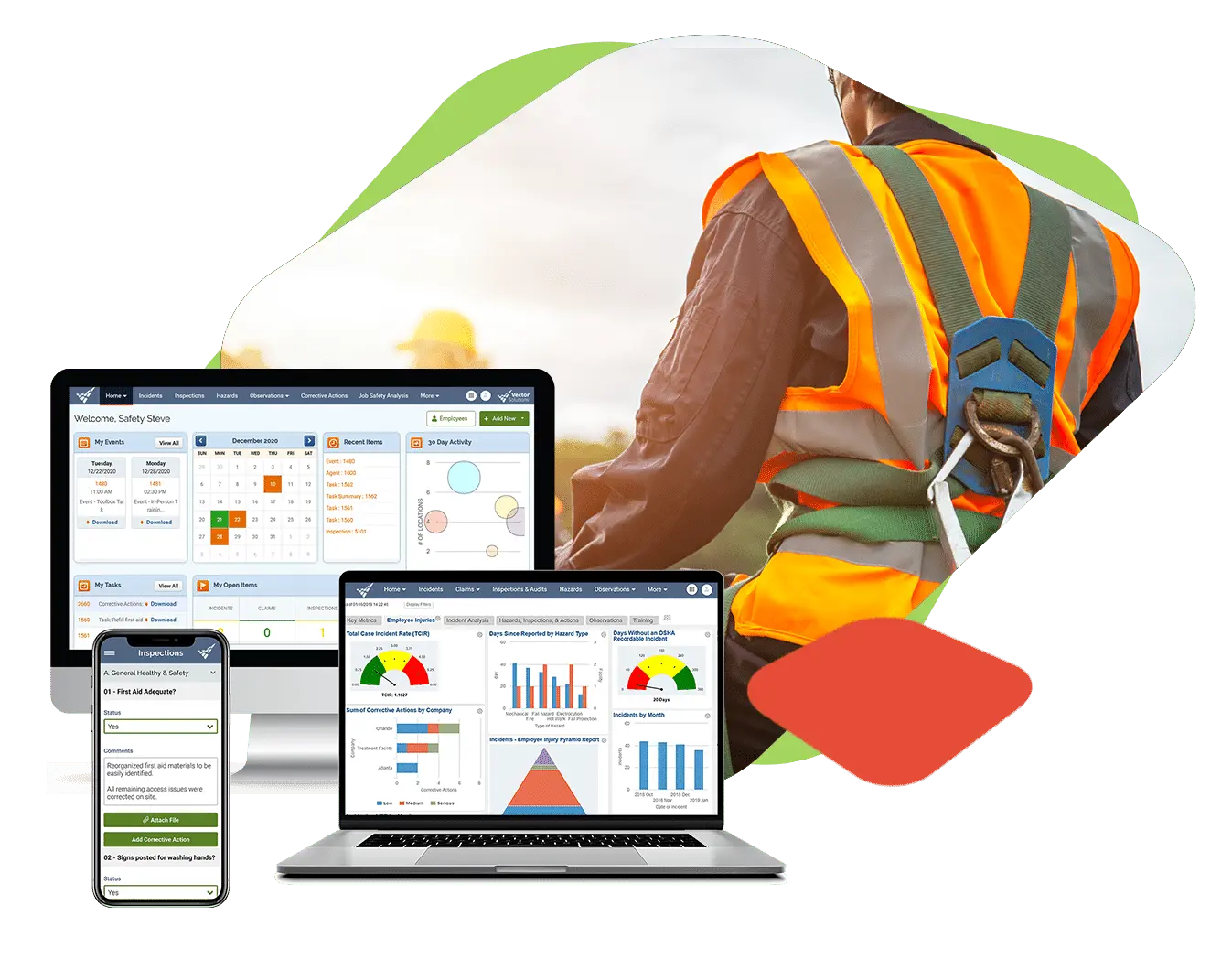
Top EHS Software Companies: Ranked by Use Case
The best EHS software depends on your buyer profile. That means your size, your industry, and how safety connects to training and workforce operations. Below are shortlists organized by the use cases that matter most.
Best for Frontline and Mobile-First Operations
If your team does most of its safety work in the field, these platforms reduce friction at the point of work.
- Vector EHS Management: Mobile web experience lets frontline workers record incidents, inspections, and observations from any web-enabled device, online or offline. Field data flows directly into the same system as training records. Supervisors see safety activity and compliance status together, instead of in separate tools.
- SafetyCulture: Built for mobile inspections and hazard reporting. Offline checklists, photo/video capture, and real-time issue flagging.
- VelocityEHS: Covers inspections, incident reporting, and ergonomic assessments from mobile devices. Recognized as a 2026 G2 Software Leader and evaluated in the Verdantix Green Quadrant 2025.
Best EHS Software for Mid-Sized Companies
For mid-sized organizations with 2 to 10 sites, four platforms stand out. They offer strong compliance tracking, incident management, and fast go-live timelines:
- Vector EHS Management: Built around the modules mid-sized teams use most: incident management, inspections, corrective actions, and dashboards. Training completion status connects directly to compliance records. That removes a step most platforms leave to manual matching.
- Intelex: Configurable compliance tracking, incident management, and mobile inspections, reviewed on Gartner Peer Insights. Workflows scale with site count.
- Benchmark Gensuite: Modular deployment, behavior-based safety, and audit management. Quote-based pricing suited to growing organizations.
- iReportSource: OSHA recordkeeping, digital inspections, corrective action tracking. Minimal setup time.
Best for Enterprise Multi-Site Governance
Organizations managing dozens of sites across multiple regulatory regions need platforms built for governance complexity. So do teams in chemical, refining, or heavy manufacturing settings.
- Vector EHS Management: Standardizes incident management, inspections, corrective actions, and SDS/chemical management across every site. Training completion stays visible alongside compliance data. Serves multi-site industrial, construction, mining, utilities, and transportation organizations that need consistent safety programs at scale.
- Enablon: Process safety management, management of change (MOC) tracking, automated SDS management, and ESG reporting with Scope 1/2/3 emissions tracking.
- Cority: CorityOne offers predictive risk scoring, chemical management, and sustainability reporting modules.
- VelocityEHS: Chemical/SDS management, ergonomic assessment, incident analytics.
Enablon and Cority both include ESG modules. These support auditable GHG data pipelines aligned to disclosure frameworks. California’s SB 253 sets a Scope 1/2 reporting deadline. CARB deferred that deadline to November 10, 2026, from August 10. Your platform needs to produce finance-grade emissions data on that timeline.
EPA’s 2024 RMP rule adds more requirements too. Covered facilities with a prior accident now face third-party audits and root-cause reviews, with compliance due in 2027. Process safety modules matter more than ever for these sites.
Best for Integrated Training and Compliance
Some organizations face a specific problem: training records, safety incidents, and workforce scheduling live in separate systems. That slows compliance checks and creates gaps during audits. When an incident occurs, you need to confirm the worker’s training status right away.
- Vector EHS Management: Connects training completion records and safety compliance data in one platform. You can verify a worker’s training status the moment an incident happens. Includes smart forms, automated reporting, and real-time alerts. Training integration removes manual matching between systems.
- HSI: Pairs EHS management with a built-in LMS and safety training library, a fit for teams that want content and compliance from one vendor.
- Intelex: Adds training and competency management within its broader EHSQ suite, useful where quality and safety are managed together.
Vector serves this profile at scale, with 24,000+ clients across critical industries.
Vector EHS Management at a Glance
- Unifies EHS management with Vector LMS training records in one platform
- Mobile web experience for online and offline field data capture
- Core modules: incidents and claims, inspections, corrective actions, dashboards, contractor management, SDS and chemical management
- 24,000+ clients and 31M+ users annually across industrial, construction, transportation, and other high-compliance industries
- Quote-based pricing, scaled to modules and site count
Matching your shortlist to a specific buyer profile cuts evaluation time. It surfaces the platforms most likely to stick after go-live.
Your EHS Software Evaluation Checklist
- How many sites and regions do you need to cover, and does the platform support staged rollouts across them?
- Which regulations apply to your industry, and does the platform have modules built for them?
- Does the platform connect to your HRIS, ERP, and LMS, or will you manage training and compliance separately?
- What’s the realistic go-live timeline for your deployment size, and can the vendor provide a scoped plan with milestones?
- What does the AI feature actually do, what data was it trained on, and what happens when it’s wrong?
- What costs exist beyond the base license: setup, migration, integrations, AI modules?
How to Choose EHS Software for Your Organization
Choosing EHS software comes down to five factors:
- Your company size and site count
- Your industry’s regulatory requirements
- How the platform connects to existing systems
- How long implementation takes
- What it actually costs
Getting these right separates a platform that sticks from one your team replaces in 18 months.
A three-site manufacturer has very different deployment needs than a 50-site enterprise across multiple countries. Single-site teams can often deploy a SaaS platform in weeks. Setup is simple, and there are few user roles to configure. Multi-site rollouts need more: staged setup, role-based access controls for different facility types, and regional regulatory libraries. Your site count drives the deployment model you need. Start there.
Industry-specific regulations shape which modules you need. OSHA’s expanded electronic submission now covers Forms 300 and 301 for high-hazard employers with 100 or more employees. Your platform must validate OSHA fields at entry and export ITA-ready data. A 2025 OSHA press release confirmed the agency posted partial details from more than 732,000 case records. OSHA also updated its inspection targeting to use this data. Chemical facilities face extra requirements too. EPA’s 2024 RMP rule adds audit and root-cause requirements for facilities with a prior accident. This makes process safety modules essential for covered sites.
Integration needs deserve more attention than most buyers give them. Ask whether the platform connects to your HRIS, ERP, and LMS. If training records live in a separate system, you end up matching compliance status by hand after every incident. That gap grows as headcount grows. A 2024 Verdantix global survey found that 73% of EHS executives expect budget increases. Leadership will fund integration work. But they’ll expect measurable time-to-value in return.
Connect Safety Data and Training in One Platform
Manual matching between incident records and training logs slows audit response. See how a connected platform closes that gap across every site.
Explore Vector EHS Management Software
AI capability is now part of the evaluation. But it varies widely. Marketing language often outpaces what the tools actually do. A 2025 Verdantix Green Quadrant assessment of 21 vendors described the market as “teetering on the AI innovation precipice.” Some platforms offer real predictive features, like computer vision for ergonomic assessment or predictive risk scoring across incident data. Others just rebrand rules-based alerts as AI. Three questions can help you tell the difference during a demo:
- What data trains your AI model? Is it trained on my industry’s incident patterns?
- Can you show a live example of a predictive risk score changing a real workflow?
- What happens when the AI is wrong? How do users override or correct it?
Implementation complexity is where many EHS software projects fall apart. Verdantix warns that many go-lives “fail to deliver their expected impact.” The main causes are unclear requirements, underestimated data migration, and not enough prep for system complexity. Typical timelines vary widely:
- SMB cloud tools: two to four weeks to go live
- Mid-market platforms: two to four months
- Enterprise deployments with legacy data migration and custom integrations: six to twelve months
Ask for a scoped plan with milestones before signing any contract.
Pricing follows a pattern by tier. SMB tools often publish pricing openly. SafetyCulture runs about $24 per seat per month, billed annually. Workhub starts around $3 per user per month. Mid-market platforms use quote-based pricing that scales with modules, user count, and site count. Enterprise platforms often have setup costs that exceed the first-year license fee. Watch for costs beyond the base license too: Verdantix flags hidden AI-related expenses as a recurring pitfall. Confirm whether AI modules carry added fees before you sign.
Free-tier EHS software options exist for small teams. But they typically lack the compliance depth and integration that mid-market and enterprise buyers need. Four cost drivers matter most: number of modules activated, user tiers, site count, and integration complexity.
Start Building Your EHS Software Shortlist with Vector Solutions
You now have a framework for filtering top EHS software companies by fit. Your size, industry exposure, and whether safety data lives connected to training records should drive your shortlist. The platforms that survive evaluation are the ones built for how your team works.
We built Vector EHS Management to connect safety workflows to training compliance in a single platform. This removes the manual matching that slows incident response and audit readiness.
More than 24,000 clients across critical industries use it to ensure every location runs the same safety initiative on time. They surface incident trends before they escalate and verify compliance in real time.
Verify Worker Training Status During Any Incident
When safety incidents happen at high-hazard sites, you need training compliance confirmed in real time. Vector EHS Management gives you that answer without switching systems.
Request a Demo Today
FAQs About Top EHS Software Companies
How Do I Know if My Organization Needs Enterprise-Level EHS Software or a Mid-Market Platform?
You likely need enterprise-level EHS software if you manage 10 or more sites across multiple regulatory regions. The same applies if you require role-based access controls or need to connect EHS data to SAP or Oracle ERP. Mid-market platforms work best for 2 to 10 sites where compliance tracking, incident management, and mobile inspections are the main needs. Enterprise platforms handle multi-country regulatory libraries and staged rollouts. Mid-market tools typically go live in 2 to 4 months versus 6 to 12 for enterprise.
What Happens to My Historical Safety Data When I Switch EHS Software Platforms?
Most EHS vendors support data migration from legacy systems. The process varies widely. Expect to export incident records, inspection histories, and training logs in CSV or Excel format. Then work with the new vendor’s team to map fields and import data. Plan for 4 to 8 weeks for mid-market deployments and 3 to 6 months for enterprise systems. Verdantix warns that underestimated data migration is a top reason EHS projects miss their goals. Some vendors charge separately for migration services.
Can EHS Software Integrate with My Existing LMS and HRIS, or Will I Need to Manage Training Records Separately?
Most modern EHS platforms offer API-based integrations with major HRIS systems like Workday, ADP, and UKG. They also connect to learning management systems. But integration depth varies. Some platforms only sync employee rosters and job titles. Others connect training completion status directly to incident records and inspection workflows. That depth determines whether you can verify a worker’s training status during an incident in real time. Platforms like Vector EHS Management that combine EHS and training in one system remove integration complexity entirely. Ask vendors for a live demo showing how training data flows into safety records.
How Do I Verify That a Vendor’s AI Capabilities Are Real and Not Just Marketing Language?
During vendor demos, ask to see a live example of the AI feature changing a real workflow. Don’t accept a pre-recorded video or a slide. Request details on the training data the model uses. Ask whether it reflects your industry’s incident patterns. Find out what happens when the AI prediction is wrong and how users correct it. If the vendor can’t answer with specifics, the feature is likely rules-based automation. Look for features like PSIF analysis or predictive risk scoring.
What Are the Hidden Costs I Should Budget for Beyond the Software License Fee?
Beyond the annual license, budget for:
- Setup services (typically 20 to 50% of the first-year license for mid-market, often exceeding the license for enterprise)
- Data migration
- Integration development for HRIS or ERP connections
- User training
Verdantix flags hidden AI-related expenses as a recurring pitfall. Confirm whether AI modules, advanced reporting, or ESG tracking carry added costs. Ask for a total cost of ownership estimate covering three years.