April 27, 2026 5 min read

What Is EHS Software? Features, Benefits, & How It Works
Industry:
Solution:
Spreadsheets track your incidents. Corrective actions live in email threads. Inspection forms stay on clipboards until someone re-keys them at the shift’s end. When leadership asks for proof of compliance, you pull reports from three places and hope nothing slipped through.
Environmental Health and Safety (EHS) software replaces that fragmented process with one connected platform for safety operations, including:
- Incidents
- Inspections
- Corrective actions
- Training
- Regulatory reporting
Main Takeaways
- EHS software replaces spreadsheets, paper forms, and email threads with one connected platform.
- Mobile incident capture with auto-routing, photos, and timestamps speeds corrective action closure across shifts and sites.
- Automated compliance reminders and pre-built OSHA and EPA reports lower the risk of missed deadlines and documentation gaps.
- Integrate EHS data and training records so incident findings trigger targeted retraining assignments with completion tracked in the same audit trail.
- Preventing costly injury and reclaiming weekly admin hours can cover a meaningful share of annual EHS software subscription costs.
See What the Data Says About EHS Outcomes
Real-world OSHA data and Vector client results, side by side. Use this report to benchmark your current safety program and build a case for a more connected approach.
Download the Workforce Safety Report
What EHS Management Software Does
EHS software is a single digital platform that brings together every core safety process:
- Incident reporting
- Risk assessments
- Audits
- Compliance tracking
- Training records
- Analytics
It replaces the spreadsheets, paper forms, email threads, and standalone tools most safety teams have cobbled together. EHS software delivers fewer incidents, faster compliance proof, and a clear picture of program performance.
Sometimes written as EH&S or EHSQ, EHS management is your program—the policies, procedures, and culture you’ve built. Vector EHS Management software is the engine that keeps it running, with:
- Standardized forms
- Automated task routing
- Deadline tracking
- Audit-ready records
Incident Management and Risk Assessment
Our platform accepts reports and near-miss submissions from any device. Each case routes to the right investigator with photos, GPS coordinates, and a time-stamped log already attached. A near miss filed from a mobile phone at the start of the first shift can land on your screen, complete with evidence, before the morning huddle.
Risk assessment works alongside it. You build JSAs, score hazards with risk matrices, and tie each one to a specific task or location. Those outputs drive your inspection calendar and training priorities. Your team acts on leading indicators instead of reacting to lagging ones.
Compliance Tracking and Audits
Compliance tracking ties your obligations to OSHA and EPA requirements. Automated reminders flag deadlines. Vector’s system preserves the documentation trail an inspector expects: who acted, when, and with what evidence. With OSHA penalties reaching up to $165,514 per violation, compliance trail gaps are expensive.
On the audit side, configurable digital checklists replace clipboard forms. They work on a phone or tablet—even offline. Attach photos, signatures, and timestamps. Every finding automatically flows into a corrective-action workflow.
Training Management and Reporting
Training management tracks completions, certifications, and renewal dates by person, role, and site. When EHS software connects to an LMS, you can assign courses directly and confirm completion without hunting down sign-in sheets.
Fast Fact: According to the 2025 Verdantix Global Corporate EHS Survey, 62% of EHS leaders plan to increase training spend to centralize data and improve integrations.
Vector offers reporting and analytics through configurable dashboards you can set up without IT help. They refresh as new data arrives. Filter by site, shift, or hazard type, and generate executive-ready reports in minutes.
Who Needs EHS Software?
Any organization managing workplace hazards, regulatory obligations, or multi-site safety programs can benefit from EHS software. The table below shows where manual processes break down and what shifts with a centralized EHS platform.
Manual EHS Processes vs. EHS Software Platforms
| Capability | Manual & Disconnected Tools | Centralized EHS Software Platform |
| Incident capture | Paper form or email; re-keyed into a spreadsheet later | Mobile form with auto-routing, photos, timestamps |
| Corrective action tracking | Email follow-ups; easy to lose or delay | Assigned, tracked, and escalated with reminders |
| Inspection scheduling | Calendar reminders or memory | Automated schedule with digital checklists |
| Audit trail | Scattered across files, inboxes, and filing cabinets | Every action logged with who, what, and when |
| OSHA / EPA reporting | Manual data assembly; risk of errors and missed deadlines | Pre-built reports; validated fields; export-ready |
| Visibility for leadership | Compiled manually before meetings | Real-time dashboards accessible anytime |
The gap between what you know about your program and what you can prove to an auditor grows with every site you add. That widening gap is the strongest argument for leaving disconnected tools behind.
Construction and AEC
This sector logged 1,032 worker fatalities in 2024, per the U.S. Department of Labor. Field crews work where connectivity is unreliable, and conditions change by the hour. Target the right risks before trends turn fatal with:
- BBS observation forms you can complete on a phone
- Inspection checklists that function offline
- Dashboards that highlight fall and struck-by hotspots
Industrial Manufacturing
On a plant floor, the EHS software platform standardizes how incidents are captured across shifts and production lines. LOTO-related near misses route into corrective-action queues. Chemical inventories stay current through SDS management.
Chemical Processing
Workers handle dangerous substances daily. Real-time SDS access, chemical inventory tracking, and incident root-cause analysis tied to training histories are non-negotiable controls.
When a chemical exposure event occurs, the platform connects the investigation findings directly to a targeted retraining assignment. This closes the loop between what happened and what changes.
Energy and Utilities
From oil and gas operations to mining, this sector requires continuous investigation, recording, and reporting to minimize risk across geographically dispersed operations.
A centralized platform gives safety leaders visibility across sites without requiring manual report consolidation before every leadership meeting.
Transportation and Logistics
Warehouse workers, distribution center employees, and drivers face concentrated physical hazards across locations that vary significantly in size, staffing, and regulatory exposure.
EHS management software helps logistics organizations standardize safety execution across every site. Role-specific training assignments and mobile inspection tools are built for the floor.
Healthcare
In hospitals and clinical settings, EHS spans employee safety along with hazardous materials management for chemicals, pharmaceuticals, and regulated waste. The incident rate of 3.4 cases per 100 full-time workers in healthcare sits well above the 2.3 private-industry average.
A connected EHS platform handles the full cycle:
- A nurse reports a needlestick through a mobile form
- The system auto-classifies and routes it to the EHS manager
- Root-cause analysis identifies a protocol gap
- A corrective action goes to the department supervisor
- Bloodborne pathogen refresher training is auto-assigned
Map Your EHS Workflows End-To-End
See how incidents, inspections, corrective actions, and dashboards connect in one system. Then assess mobile capture, offline use, and audit trails across sites.
Explore Vector EHS Management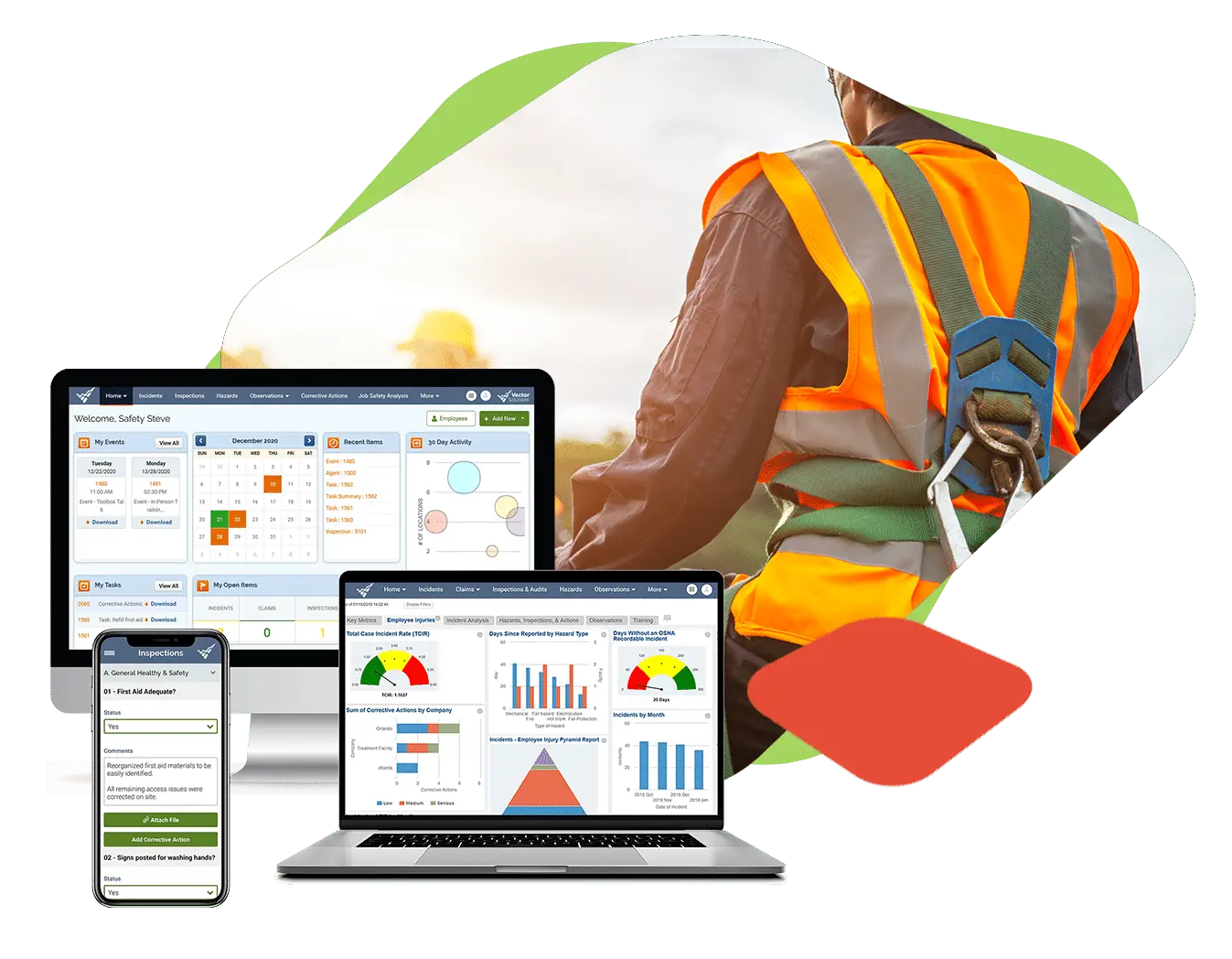
How EHS Software Connects to Training Management
The most valuable workflow in an EHS management system is the closed loop between safety data and training response.
A connected platform runs this cycle in five steps:
- An incident, near miss, or BBS observation reveals a skill or knowledge gap.
- The EHS system flags the gap and generates a training assignment for the affected employee or crew.
- The LMS delivers the course (online, via mobile device, or instructor-led) and records completion.
- A follow-up observation or inspection confirms the behavior actually changed on the job.
- Completion records and follow-up evidence feed back into dashboards and audit reports.
Without that loop, investigation findings sit in one database while training records sit in another. No one can show an auditor that you responded to what you found.
Vector EHS Management and Vector LMS live within one system. This closed-loop workflow runs without forcing you to export data between tools. Over 24,000 clients across critical industries use this connected approach.
EHS Software Cost: How to Build a Business Case
EHS software delivers four outcomes that compound over time:
- Save time. Removing manual processes with a connected platform streamlines data collection, automates reports, and routes corrective actions without email follow-ups.
- Protect employees. A proactive EHS management strategy reduces risks before they produce recordable incidents.
- Improve compliance. Centralized tracking, automated reminders, and pre-built OSHA and EPA reports reduce the risk of missed deadlines and documentation gaps.
- Save money. Preventing injuries, reducing downtime, and avoiding fines produce cost savings that typically exceed the subscription cost within the first year.
The fastest path to budget approval is showing how those costs compare to the incidents, penalties, and admin hours your organization already absorbs.
Anchor your ROI conversation to one defensible number: The average cost of a medically consulted workplace injury in 2023 was $43,000, according to the NSC. Preventing even one recordable case can cover a meaningful share of your annual subscription.
Stack avoided OSHA penalties alongside reclaimed admin hours. Factor in faster corrective-action closure, and the case starts writing itself. Those numbers are your real baseline.
Trigger Training From Every Incident
See how an incident investigation routes tasks, closes corrective actions, and assigns targeted retraining with completion tracking.
Request a Demo
Build Your EHS Business Case with Vector Solutions
Vector Solutions brings EHS data and training records together in one platform. Incident findings trigger corrective actions and targeted retraining without manual handoffs. The result: consistent safety execution across every site, faster closure on open items, and audit-ready proof that you acted on what you found.
Ready to see it in action? Request a demo to find out how your incident data and training records can close the loop in one system.
FAQs about What EHS Software Is
What data do I need to migrate when switching from spreadsheets to EHS software?
Migrate your:
- Active incident records, including corrective actions
- Current employee roster with roles and certifications
- Recent inspection and audit findings
- Past 5 years of OSHA 300 logs
- SDS inventories
Older closed incidents and archived training records can often stay in legacy files unless you need them for trending or audits. Plan 2–4 weeks for data cleanup before upload.
How long does it take to see ROI from EHS software?
Many teams recover their first-year investment within 6–12 months. Preventing one or two recordable injuries at $43,000 each makes a major dent. Cutting 5–10 hours per week of manual reporting and avoiding late OSHA submissions that trigger penalties adds to the return.