
Built for Higher Ed
Our courses are specifically designed for higher education, so that faculty and staff can relate to the content and learn valuable strategies.
Address the people-oriented aspects of safety, such as substance misuse and health emergencies and equip faculty and staff to respond to common safety incidents and reduce risk.
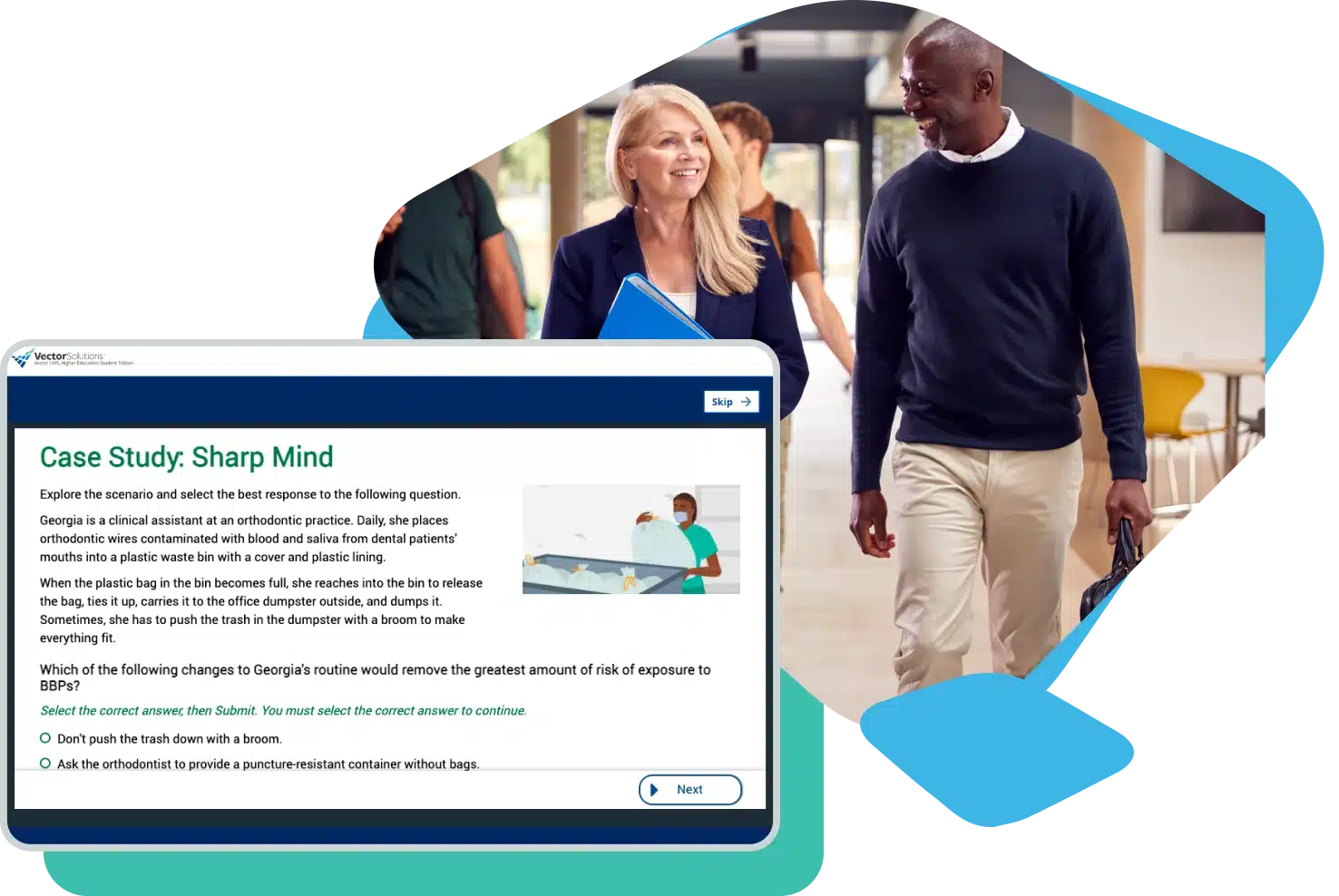
This course provides an overview of bloodborne pathogens and how they are transmitted; practices that minimize the risk of exposure; what to do if there is an exposure incident, and how to handle and dispose of contaminated items.

Defines key terms related to bloodborne pathogens
Identifies how to avoid exposure to bloodborne pathogens
Best practices to handle contaminated material
Review exposure control plan and how to best use it

This course provides an overview of the mental and physical toll hazing has on those joining organizations and helps institutions comply with the Stop Campus Hazing Act. Learners will build knowledge and skills related to why hazing occurs, the health and legal risks of hazing, and more.
Recall the key components of hazing
Summarize the nature of the continuum of hazing
Identify who is involved in hazing and why they exhibit certain behaviors
Explain what they can do to prevent hazing and support victims

This course provides specific guidelines to help prevent slip, trip and fall injuries, best practices for walking on slippery surfaces, precautions to avoid trip hazards and safety policies.
Define key terms related to workplace safety and slips, trips, and falls
Understand strategies that reduce the risk from slips
Identify proactive strategies to increase campus safety
Review policies that increase safety on campuses

This course provides an overview of key first aid issues and concerns. It will review scene safety, universal precautions, and what first aid procedures should be taken for physical trauma, chronic conditions, fractures, burns, and bleeding.
Better understand fractures, bleeding, anaphylaxis, diabetes, and dislocations
Understand head injuries, nosebleeds, shocks, and burns
Identify how to respond to burns, choking, asthma, and seizures
Review scene safety and universal precautions

Each day more than 130 people in the U.S. die after overdosing on opioids. This course provides an overview of opioid overdose response procedures and the usage, storage and maintenance of opioid reversal agents, such as naloxone.
Understand types of opioids
Identify signs and symptoms of an overdose
Gain understanding of naloxone administration procedures and after-incident resource identification
Review terminology related to the national opioid health crisis

Self-harm is a major concern that affects many teens and adolescents. This course provides an overview of self-harm among students as well as strategies to respond to and mitigate the effects of self-harm.
Gain a better understanding of self-harm
Identify types of self-harm and risk factors
Better understand the role of faculty and staff in mitigating self-harm
Identify self care strategies and how to manage the effects of self-harm

It is important to provide a safe environment for all faculty and staff. This course provides an overview of simple strategies to avoid common workplace injury hazards.
Define terms related to workplace injury prevention
Better understand ergonomic injury avoidance
Define safety protocols during incidents of workplace violence
Review back injury prevention


Our courses are specifically designed for higher education, so that faculty and staff can relate to the content and learn valuable strategies.

Easily comply with federal and state training requirements, such as Title IX, OSHA, Clery Act, and more.

Spend less time on training administration with intuitive features, including analytics and reporting, notifications and reminders, customization and policy attestation, and more.

OSHA
Clery Act
Title IX
State-Specific Regulations
Stop Campus Hazing Act


“Vector LMS, Higher Education platform gives our employees important knowledge that is advancing safety campus-wide and is directly responsible for a $500,000+ discount on last year’s annual insurance premium!”
Terry Wynne
Associate Director of Safety
Read the customer story








Reducing workplace risk requires employees to understand both safety expectations and compliance responsibilities. Through training on topics such as workplace safety, regulatory requirements, emergency preparedness, and risk awareness, Vector Solutions helps institutions reinforce safer practices across campus. Online delivery also helps ensure employees can access required training regardless of location or schedule.
Vector’s built-in reporting tools make it easier to monitor employee engagement and training activity across campus. Institutions can track course completion, participation status, and historical training data while gaining insight into broader performance trends.
Access to participation data, completion rates, and training trends allows administrators to identify gaps, monitor progress, and evaluate safety initiatives across departments. Vector’s reporting tools make these insights more accessible, helping leaders make data-informed decisions.
Yes. With Vector Solutions’ Learning Studio, institutions can customize training to include institution-specific policies, procedures, and other content relevant to different departments. This flexibility helps ensure employees receive health and human safety training that reflects campus requirements while supporting a consistent learning experience across the institution.

Our Environmental Health and Facilities Management library offers tactile training for facility and asset maintenance, including basic facilities skills and hazard communication.
Our Facilities Maintenance library covers training on topics like electrical, hydronic, and fire systems, as well as HVAC and plumbing.
Our Health and Human Safety library addresses the people-oriented aspects of safety, such as substance misuse and health emergencies.
Our Security and Risk library is designed to help mitigate human error and address the personal and physical security aspects of institutional safety.
Help faculty and staff foster belonging, respectful communication, and a stronger campus culture.


September 7, 2023

March 15, 2023

August 11, 2020