October 26, 2026 6 min read

Incident Investigation: 4 Phases, Methods, and Reports
Industry:
Solution:
Equipment fails, someone gets hurt, and the clock starts. Within hours, you need roles assigned, the scene secured, and witnesses identified, before physical evidence degrades and memories blur.
An accident investigation, also called an incident investigation, is the structured process of determining what happened, why it happened, and what will prevent it from happening again. It applies to recordable injuries, property damage, environmental releases, and near misses, and it runs from immediate scene response through verified corrective action.
This article covers the four phases of a workplace incident investigation, when to start and who should lead, how near-miss investigations differ, which root cause method fits which event, what belongs in the report, and how to track corrective actions to verified closure.
Accident investigation and incident investigation refer to the same structured process. “Accident” implies an event that was random and unpreventable. Nearly all workplace injuries and fatalities are preventable, which is why “incident” is the preferred term. Throughout this article we use “incident,” though you will still see “accident investigation” in common usage.
Main Takeaways
- An incident investigation runs in four phases: immediate response, information gathering, cause analysis, and corrective action and reporting.
- Start as soon as the scene is safe, ideally within the same shift. Physical evidence degrades and witness recall fades fast.
- Interview to learn what happened, not to establish who is at fault. Ask what and how questions about actions rather than why questions about behavior.
- Cause analysis needs a named method. 5 Whys suits simple single-chain events, fishbone suits multi-factor events, and fault tree analysis suits complex or high-consequence failures.
- The report is not the finish line. Every corrective action needs an owner, a due date, and a verification step, and effectiveness is measured by whether the same event type recurs.
Free Near Miss Reporting Form
Near misses surface the same hazards as injuries without the cost. Start capturing them consistently.
Download the Form
The 4 Phases of an Incident Investigation
A complete incident investigation follows four phases in sequence: immediate response, information gathering, cause analysis, and corrective action and reporting. Each phase has specific actions that move the investigation from scene safety to prevention.
Phase 1: Immediate Response
When an incident occurs, first priority is medical care and confirming the scene is safe to enter. Then secure the area to preserve physical evidence, identify and separate witnesses while recall is fresh, and notify the supervisor and EHS lead per the reporting protocol. Immediate response does not mean entering an unsafe scene. It means response begins the moment conditions allow. Assemble the tools you will need at the scene, such as a camera, measuring tape, notepad, and evidence bags, into an investigation kit in advance so no time is lost locating them. For a step-by-step approach to building that groundwork, see How to Create an Incident Investigation Plan.
Phase 2: Information Gathering
Collect physical evidence first, since it changes fastest. Photograph the general area and specific items, and document equipment position and condition, guard and control positions, environmental readings, housekeeping, and lighting. Then pull documentation: maintenance logs, training records, procedures, prior incident reports, and safety committee minutes. Interview witnesses individually and as soon as possible.
Safety professional, Joe Estey, identifies two common interviewing mistakes. The first is improper interviewing, which treats witnesses as the object of the investigation instead of a part of the process. The second is asking why questions about behavior instead of what and how questions about actions. Estey’s reasoning is that if someone knew why they did something, they would not have done it, and if it was deliberate, they are unlikely to answer honestly. He notes that fewer than 2% of incidents involve deliberate violation, and most involve honest, unintentional mistakes. Better accident investigation questions include “how do you use the procedure in this process” or simply “walk me through your process.”
Estey also points to what he calls the proctoring hazard. Returning to the same witness a second or third time can make them feel they are being tested on their earlier answers rather than consulted. Recording information properly the first time matters for this reason.
Phase 3: Cause Analysis
This phase moves past the immediate trigger to the systemic conditions that allowed it, including procedures, training, equipment design, supervision, and management systems. When a shortcoming surfaces, ask why it existed and why it had not already been addressed. The team selects and applies a named root cause method at this stage. The methods are compared later in this article.
Investigator bias is the hardest error to catch, and Estey names three forms of it. Confirmation bias narrows the search to evidence that supports what the investigator already believes. Availability bias limits the investigation to the documents and accounts that were handed over, leaving unrequested evidence unexamined. Primacy bias sets in when the same characterization is heard early and repeatedly, so later information that breaks the pattern does not register.
The greatest risk is investigating work you have personally done. It becomes hard to separate your own version of events from the one you are supposed to be learning, and you start filling in blanks with what the person should have been doing rather than what they were doing.
Phase 4: Corrective Action and Reporting
This phase produces two outputs: the investigation report and the corrective action plan. Each action needs an owner, a due date, and a verification step. Recommendations should be specific rather than general, and they should never address discipline. Discipline belongs in separate personnel processes, and mixing it into investigations undermines the free flow of information in future investigations.
Specific recommendations are easier to act on. Rather than recommending “eliminate blind corners,” recommend installing a mirror at a named corner of a named building, and pair it with a general recommendation to install mirrors at blind corners site-wide.
Skipping or compressing a phase, especially jumping from response straight to corrective action, produces fixes that address symptoms rather than causes and leaves the organization exposed to recurrence.
When to Start, Who Leads, and How Near Misses Differ
Begin an incident investigation as soon as the scene is safe, ideally within the same shift. Physical evidence changes or disappears quickly, and witness recall degrades within hours. Waiting for a recordable classification before starting wastes the window when the best evidence is still available.
Accidents associated with which of the following require investigation? Start an investigation for any of the following:
- Workplace injury or illness
- Property or equipment damage
- Environmental release or spill
- Near miss or close call
- Any event with serious injury or fatality potential
Health and safety incidents of any of these types warrant investigation, even when the outcome was minor. Determining whether an event is work-related is a useful first step when the connection to the job is unclear.
Who Should Be on the Investigation Team
The core team is the direct supervisor, who knows the work process; the safety or EHS lead, who knows investigation method; the involved employees and witnesses, who know what happened; and subject-matter experts such as maintenance or engineering as the event requires. Investigations conducted by managers and employees together are more effective than those run by a supervisor alone, because each brings a different vantage point.
Including the direct supervisor is usually right, since that person knows the work best and can act immediately. The counterargument is that a supervisor may have an interest in glossing over shortcomings in their own area. A team-based investigation with worker representation neutralizes that risk. Bringing in an external investigator or cross-functional reviewer is warranted for fatalities, high-severity events, or situations where the supervisor’s own area is central.
Matching Investigation Depth to the Event
Not every event warrants the same depth. Organizations typically tier their response: a full root cause analysis for high-consequence events, a lighter apparent-cause analysis for lower-risk events, and trend-only logging for minor events that are tracked but not individually investigated. Define which combinations of severity and likelihood trigger each tier in advance. Review trend data periodically, since a pattern of minor events can justify a formal investigation that the individual events did not. A safety audit is one way to find those patterns before they turn into incidents.
How Near-Miss Investigations Differ
Near-miss investigations follow the same four phases but differ in urgency of medical response and often in documentation depth. Their value is that they surface the same hazards as injuries without the human cost, which makes them the most efficient prevention data an organization has. Skipping them means giving up the clearest early-warning signal for serious events. To see why these reports matter so much, read why near-miss reporting is important.
The investigation window closes fast. Starting within hours, staffing the team so no single perspective dominates, and including near misses gives you the strongest evidence base and the widest prevention reach.
Root Cause Methods, Report Contents, and Corrective Action Tracking
Finding root causes requires a named method, not guesswork, and an investigation only prevents recurrence when the report drives tracked corrective actions to verified completion.
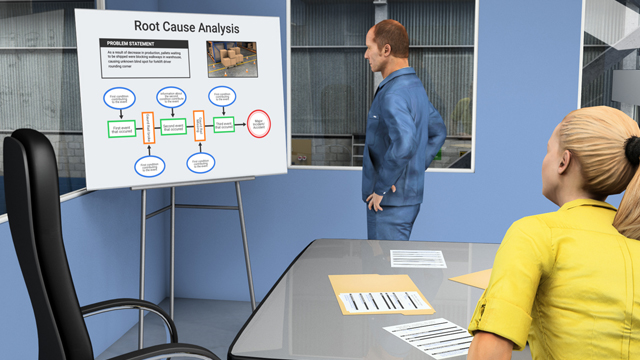
Most incident investigations fail at cause analysis because the team stops at the immediate trigger. Concluding that a worker was careless and going no further leaves the real questions unasked. Was the worker distracted, and why? Was a safe procedure being followed, and if not, why not? Were safety devices in order? Had the worker been trained? The three incident investigation methods below are the most widely used, and the table shows where each fits.
| Method | How It Works | Best For | Limitations |
| 5 Whys | Ask why repeatedly until the systemic cause surfaces | Simple, single-chain events; quick field investigations | Can oversimplify events with multiple contributing causes |
| Fishbone (Ishikawa) | Map potential causes across categories such as people, equipment, process, environment, and management | Events with multiple contributing factors; team analysis | Requires facilitation skill; does not quantify probability |
| Fault Tree Analysis | Work backward from the event using Boolean logic to map all failure paths | Complex system failures; process safety events | Time-intensive; needs technical expertise |
Use 5 Whys when one causal chain is likely. Use fishbone when multiple departments or factors may be involved. Use fault tree analysis for complex or high-consequence process safety events. Document which method the team used and why, so the reasoning is auditable and reviewable if the event recurs. Whichever incident investigation techniques you choose, the goal is the same: reach a cause the organization can act on. For hands-on practice applying these methods, see the root cause analysis online course.
A Framework for Where to Look
The possible cause categories for an accident fall into five groups. Working through each one reduces the chance of examining facts in isolation, and it pairs with whichever method the team selects.
- Task. Was a safe procedure used? Had conditions changed to make the normal procedure unsafe? Were the right tools available, and were they used? Were safety devices working? Was lockout applied where required
- Material. Did equipment fail, and why? Was the equipment maintained as the manufacturer recommends? Were hazardous products involved and clearly identified? Was PPE required, available, and used by trained workers?
- Environment. What were the conditions at the moment of the incident, not the usual conditions? Consider weather, temperature, noise, lighting, housekeeping, and airborne hazards.
- Personnel. Were workers experienced and trained for the task? Were they fatigued, under time pressure, or affected by shift work? The purpose is to understand conditions, not to assign blame.
- Management. Were safe procedures established, communicated, and enforced? Was supervision adequate? Had the hazard been identified previously, and if it had been reported, was action taken?
What to Include in an Incident Investigation Report
An incident investigation report should include an event summary of what happened, where, and when; a timeline of events leading to the incident; evidence collected; witness statements; causal findings covering both immediate and root causes; corrective actions with named owners and due dates; and reviewer sign-off. Anyone reviewing the file should be able to follow the investigation from start to finish. Where injuries are involved, the OSHA Form 301 injury and illness incident report is a common reference for the fields to capture.
Write for readers who were not there. State plainly where a conclusion rests on physical evidence, on a witness account, or on the team’s assumption, and say so where doubt remains. Leave out material that does not aid understanding of the incident and its causes. The measure of a good report is quality, not length.
Organizations standardizing these fields across sites often use an EHS platform such as Vector EHS Management to connect incident forms directly to corrective action workflows.
Corrective Action Tracking and Effectiveness Verification
The report is not the end of the investigation. Assign a specific owner to each action, set a realistic due date, monitor status, and verify completion with documented evidence such as a photograph, inspection record, or updated procedure.
Effectiveness verification is a separate step from completion. After the fix is in place, track whether the same event type recurs over the following months using category-specific incident counts and leading indicators such as near-miss reports from the same area. If it recurs, reopen the investigation, because the fix missed something.
With the average medically consulted work injury costing roughly $48,000, verified corrective actions are a direct investment in avoided loss.
From Report to Verified Corrective Action
Connect incident reporting to corrective action tracking so findings become assigned work with owners and deadlines.
Explore Incident Management
Put Your Incident Investigation Findings into Action with Vector Solutions
Readers now have a four-phase process, a timing rule and team structure, a framework for where to look, a method comparison, and a tracking process that closes the loop from report to verification.
Vector EHS Management connects incident reporting to corrective action tracking in one system, so findings become assigned work with owners and deadlines rather than items in a closed report.
With that workflow in place, every location follows the same process, actions close before they are forgotten, and recurrence data shows whether the fix worked.
See Vector EHS Management in Action
Incident reporting, root cause documentation, and corrective action tracking connected in one platform.
Request a Demo
FAQs About Incident Investigation
What Is the Difference Between an Incident and an Accident?
The terms are often used interchangeably, but “accident” implies an event that was random and unpreventable. Since nearly all workplace injuries and fatalities are preventable, “incident” is the preferred term. Incident also covers events that caused no injury or damage but could have, including near misses and close calls.
What Is the Difference Between Immediate Causes and Root Causes?
Immediate causes are the direct, observable triggers, such as a worker slipping on a wet floor. Root causes are the systemic failures that allowed those conditions to exist, such as no spill response procedure or inadequate training. Immediate causes answer what happened; root causes answer why the conditions existed. Stopping at the first produces fixes that do not prevent recurrence.
Can You Investigate Effectively if the Scene Has Already Been Disturbed?
Yes, but the investigation shifts weight from physical evidence to witness interviews, maintenance and training records, photographs taken after the fact, and process documentation. Document what changed between the incident and your arrival, interview anyone who saw the original scene, and focus cause analysis on procedural and training factors rather than equipment position.
What Should You Do if the Investigation Reveals Human Error?
Document it. Failing to record human factors weakens the investigation and allows the same causes to produce future incidents. But do not make recommendations about discipline; that belongs in normal personnel processes. Corrective actions should aim at preventing repetition through training, supervision, or procedural change, not at penalizing the individual.
Do Small Organizations Need the Same Investigation Rigor?
The four-phase process and root cause analysis apply at any size, because the goal is prevention rather than compliance. Small organizations can scale the formality, using a one-person team and a simplified report template, but skipping cause analysis or corrective action tracking leaves the same hazards in place.