











Data Security & Privacy
This course teaches employees how to recognize potential threats and risky behaviors and how to respond mindfully to cyber threats. Along the way, employees can apply what they’ve learned in various realistic scenarios. Specific topics include phishing, pharming, social engineering, secure wireless connections, creating strong passwords, encryption, safe browsing, and watering hole attacks.


Demos + Pricing
Learn more about our courses, get pricing, and see our platform.
Course Details
Learning Objectives
- Understand the data security problem
- Identify what needs protected and how to prepare against a security incident
- Recognize threat actors and their tactics
- Implement strategies to protect data
- Respond to incidents and report effectively
Specs
- English (US)
- Spanish (US)
- Spanish (European)
- Spanish (Mexican)
- French (Canada)
- French (European)
- Arabic
- Chinese (Simplified Mandarin)
- Chinese (Traditional Mandarin)
- Filipino Tagalog
- German
- Hindi
- Italian
- Japanese
- Korean
- Portuguese (Brazilian)
- Portuguese (European
- Russian
- Thai
- Vietnamese
Frequently Asked Questions
What is data security, and why does it matter to higher education faculty and staff?
Data security in higher education involves safeguarding digital information—including student academic records, faculty research, intellectual property, and administrative data—from unauthorized access, loss, or misuse. This is especially critical for faculty and staff because they handle sensitive student information, proprietary research data, and daily personal communications. A data breach can compromise academic integrity, damage institutional reputation, and lead to legal consequences under federal laws like FERPA or HIPAA. By understanding and implementing secure practices, faculty and staff help create a safe digital environment that supports learning, research, and institutional trust.
What are the best practices for securing academic research data?
Securing research data begins with understanding the nature and sensitivity of the collected data. Faculty should classify their public, confidential, or restricted data and apply appropriate safeguards. Storing data on encrypted drives or using institution-approved, cloud-based storage with access controls is vital. Regular backups should be automated, stored securely, and tested periodically for data integrity. Additionally, faculty must be aware of grant-related data requirements and Institutional Review Board (IRB) protocols that often have specific security expectations. For collaborative research, permissions should be role-based to limit data exposure, and access logs should be monitored when possible. Keeping software and systems updated is also a crucial defense against vulnerabilities.
How can professors recognize and prevent phishing attacks?
Phishing attacks are a common cybersecurity threat in higher education, often targeting faculty through fake emails that appear to come from trusted sources. These emails may request login credentials, payment information, or sensitive documents. Warning signs include generic greetings, urgent language, unexpected attachments, and email addresses that closely mimic real ones. Faculty can prevent phishing attacks by carefully inspecting email headers, avoiding clicking on suspicious links, and enabling multi-factor authentication (MFA) on university systems. When in doubt, emails should be reported to the institution’s IT or information security team. Regular training and staying updated on the latest phishing tactics are also key to reducing risk.
What data privacy policies should higher education faculty and staff be familiar with?
Faculty and staff should familiarize themselves with institutional data privacy and security policies, which often outline how to handle, store, and share different types of information. At a minimum, faculty and staff should understand the implications of FERPA for student records, HIPAA for health-related research or counseling data, and the university’s data classification framework (e.g., public, internal, confidential, restricted). These policies often dictate acceptable tools and practices for storing or transmitting data. Faculty or staff involved in sponsored research or data-intensive projects should also know compliance requirements from funding agencies, especially those involving personal or international data subject to laws like GDPR.
Sample Video Transcript
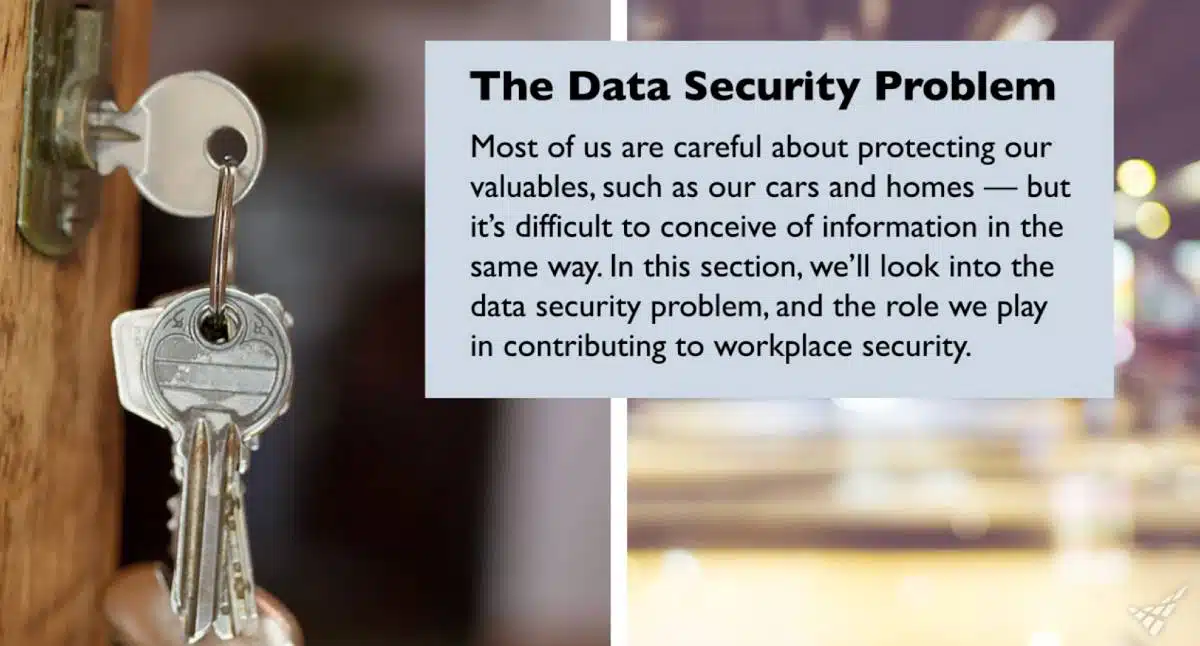
Protecting our data may not seem as intuitive as protecting our physical belongings, but it is just as critical. As an individual, you play a significant role in protecting the information you are privy to in your organization. Most of us are careful about protecting our valuables. We lock our cars and homes and don’t leave our things unattended. But when it comes to information, we tend to be less careful. We often have access to data that, in the wrong hands, could be used to harm. By gaining access to specific data, adversaries can steal information by breaking into computer systems, but the user is surprisingly the most vulnerable target. Manipulating, deceiving, or socially engineering employees is often easier than breaking into applications or devices. To ensure sensitive and critical data is protected, there are a few security practices that will help mitigate potential risk.


