











Cybersecurity Overview
The convenience of web access makes it easy to forget that we need to protect and care for our information. Easy access can strip away our wariness of strangers. It can allow someone to access sensitive information we would never hand over to a stranger. Cybercrime affects not only bank accounts, but also the personal lives of everyone involved. No one wants to be a target. In this story, a teacher learns why school staff have increasingly become targets for cybercrime and the insidious methods cybercriminals use to obtain money and information.



Demos + Pricing
Learn more about our courses, get pricing, and see our platform.
Course Details
Learning Objectives
- Describe the effects of cybercrime on individuals, organizations, and society, including financial, legal, and reputational impacts
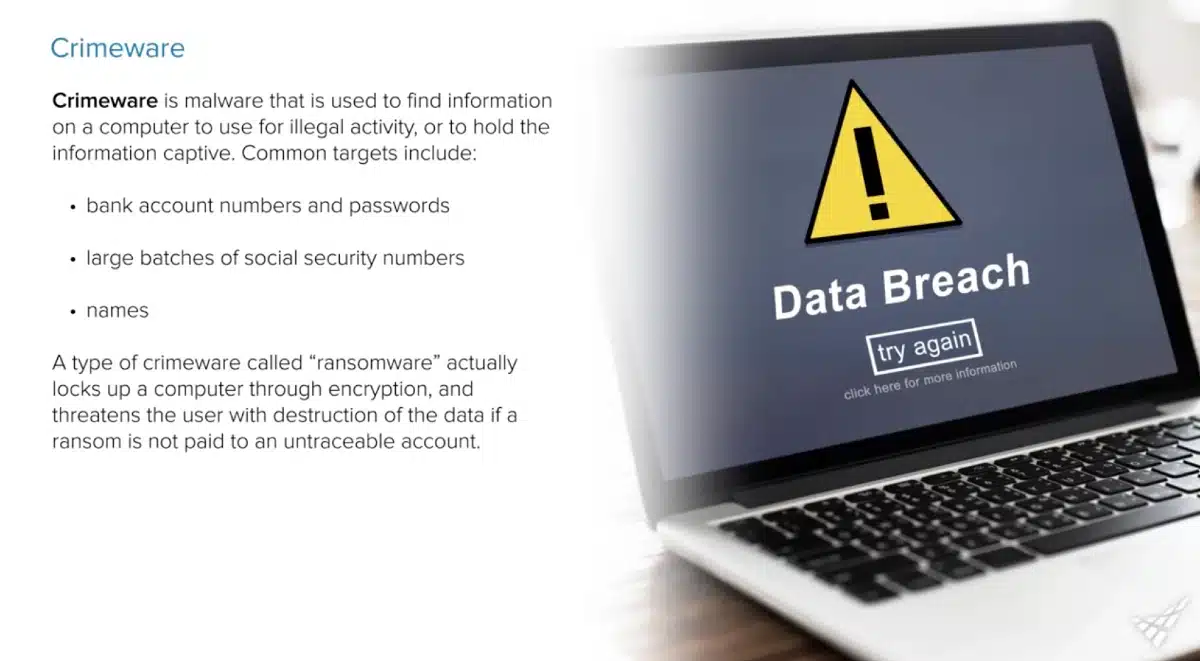
- Identify common types of cybersecurity threats, such as phishing, malware, ransomware, and social engineering tactics
- Explain how individuals are vulnerable to cyberattacks, including risky behaviors, weak passwords, and unsecured networks
- Demonstrate a basic understanding of cybersecurity principles and best practices for protecting personal and organizational information
Specs
- English (US)
- Spanish (US)
- Spanish (European)
- Spanish (Mexican)
- French (Canada)
- French (European)
- Arabic
- Chinese (Simplified Mandarin)
- Chinese (Traditional Mandarin)
- Filipino Tagalog
- German
- Hindi
- Italian
- Japanese
- Korean
- Portuguese (Brazilian)
- Portuguese (European
- Russian
- Thai
- Vietnamese
Frequently Asked Questions
What are the effects of cybercrime on schools and individuals?
Cybercrime can have serious consequences for both individuals and educational institutions. For schools, a successful cyberattack can lead to data breaches, system shutdowns, and financial loss due to recovery costs or ransomware payments. It can also damage trust with families, staff, and the community. For individuals, cybercrime may result in identity theft, financial fraud, or personal data loss. In both cases, the reputational impact can be long-lasting and challenging.
What are the most common types of cybersecurity threats facing schools?
Educational institutions are frequent targets of various cyber threats, including phishing emails, which trick users into revealing sensitive information; malware, which can infect and disable devices; ransomware, which locks down systems until a payment is made; and social engineering tactics, which manipulate people into bypassing security protocols. Understanding these threats is the first step in recognizing and avoiding them.
Why are school staff and systems especially susceptible to cyberattacks?
School environments are particularly vulnerable to cyberattacks because they often rely on a wide range of devices, platforms, and users with different levels of cybersecurity awareness. Common vulnerabilities include weak or reused passwords, outdated software, unsecured networks, and a general lack of training on cyber threats. In addition, attackers may take advantage of busy staff members who may be more likely to click on a suspicious link or download a malicious attachment without realizing it.
What are the basic principles of cybersecurity that school staff should follow?
School staff can significantly reduce risk by following key cybersecurity practices. These include using strong, unique passwords and enabling multi-factor authentication; avoiding suspicious emails or links; keeping software and operating systems up to date; and reporting any suspected security incidents to the appropriate IT personnel. Even simple actions like locking your screen when stepping away from your computer or verifying unexpected email requests can go a long way in protecting sensitive data.
Sample Video Transcript
Over the years, cybercrime has become a significant problem in the US. Over the past five years, more than 332 million records with sensitive personal information were at risk because of security breaches. In the education sector, more than 5.8 million records were exposed.
The direct cost after a breach occurs is about $80 per record. However, when the cost of notification detection and escalation is added, the average comes to about $225 per record for all industry classes, making the average total cost of a data breach just over $7 million. Consider that thousands or even millions of records are exposed in an average data breach. The cost to individuals can be astronomical.


