May 7, 2026 5 min read

Contractor Safety Program: How to Reduce Site Risk
Industry:
Solution:
When a contractor gets injured on your site, your organization faces liability, not just theirs. OSHA’s multi-employer worksite policy says you keep responsibility as the controlling employer. This holds true even when the contractor caused the problem.
This article shows you how to build a contractor safety program that reduces your risk. You’ll learn how to screen contractors before they bid. You’ll learn what safety terms to put in every contract. And you’ll learn what daily controls prevent incidents once work starts.
Main takeaways
- You face legal liability when contractors get hurt on your site. This is true even when the contractor caused the problem. OSHA calls you the controlling employer.
- Screen every contractor before they bid. Check their EMR and TRIR scores. Make safety history a requirement, not just something you consider alongside price.
- Add five safety rules to every contract. Include audit rights, incident reporting deadlines, PPE requirements, stop-work authority, and financial penalties.
- Run four daily controls once work starts. Require site orientation before any task. Issue written permits for dangerous work. Conduct surprise inspections weekly. Use one channel for all incident reports.
- Track metrics that show your program works. Monitor near-miss reports and inspection close-outs before incidents happen. Track contractor TRIR and recordables after incidents occur. Use both to prove ROI to leadership.
Build Site-Specific Contractor Orientations That Stick
Learn the seven-phase contractor management framework and best practices for online orientation systems.
Read Contractor Orientation Best Practices
What Is contractor safety management?
Contractor safety management is how you oversee contractor safety on your property. It includes checking risks, enforcing safety rules, running training, and meeting regulations. A good program protects your workers while cutting liability and preventing project delays.
You manage contractors through every step: rating them before hiring, onboarding them when they arrive, overseeing their work, and holding them accountable for safety.
OSHA’s multi-employer worksite policy says you carry liability for site conditions. This is true even when a contractor created the hazard. OSHA names four employer roles on worksites: controlling, creating, exposing, and correcting. You are the controlling employer. You can get citations even if your own workers weren’t involved in the violation.
Your contractor safety program has two phases. The first happens before contractors arrive. The second runs while they’re on site.

How to build a contractor safety program before work begins
Your contractor safety program starts before anyone arrives at your site. The most important work happens during pre-qualification and procurement. This is when you check how much risk each contractor brings, score bidders against clear limits, and put safety rules into the contract.
With 92% of construction firms reporting trouble hiring, owners stack more subcontractor tiers onto every project. More layers mean more hazards to manage. Tight deadlines and budgets push contractors to cut corners. Workers show up without the right skills or safety training for the job.
1. Screen contractors using EMR and TRIR benchmarks
Screen every bidder against four criteria: EMR, TRIR, a written safety management system, and workers’ comp claims history. Collect these documents from each contractor:
- EMR letter issued directly by their insurer
- OSHA 300 logs covering the past three years
- A written safety program describing their management system
- Workers’ comp loss runs
- Any corrective action plans tied to recent recordables
Treat safety history as a pass/fail gate during bid review, not a tiebreaker you weigh against price. When a contractor’s EMR lands above 1.25, require a written corrective action plan and proof of progress before you award any scope.
The limits below give you a solid screening framework. EMR cutoffs apply across all industries. Align TRIR benchmarks to the contractor’s NAICS sector using 2024 data from the U.S. Bureau of Labor Statistics.
Contractor safety screening thresholds by industry
| Metric | Favorable | Review Required | Disqualifying |
| EMR | Below 1.0 | 1.0–1.25 | Above 1.25 |
| TRIR — Construction | Below 2.3 | 2.3–3.5 | Above 3.5 |
| TRIR — Manufacturing | Below 2.8 | 2.8–4.0 | Above 4.0 |
| TRIR — Facilities/Admin | Below 1.8 | 1.8–2.5 | Above 2.5 |
TRIR benchmarks come from the BLS Survey of Occupational Injuries and Illnesses. The 2024 private industry average was 2.3 cases per 100 full-time workers. Before you use these thresholds, verify your contractor’s NAICS code. Check the current year benchmarks for their specific industry at www.bls.gov/iif/nonfatal-injuries-and-illnesses-tables.htm.
2. Embed safety clauses into every contract
Every MSA and bid package needs five safety clause types. This applies to construction work and facility support work. These clauses put your rules in writing and give you tools to enforce them:
- Right-to-audit: Your authority to inspect contractor work, records, and OSHA logs at any time without advance notice.
- Incident reporting duties: Contractors must report any recordable event on your site within 24 hours.
- PPE compliance standards: Contractors must meet or exceed your site-specific PPE rules, not just OSHA minimums.
- Stop-work authority: Your named personnel have the power to stop any task they judge unsafe.
- Financial penalties for violations: Back-charges, contract hold, or termination for repeated safety failures.
3. Verify contractor OSHA filings against your records
Since January 1, 2024, OSHA’s expanded electronic recordkeeping rules require many sites to submit Form 300 and 301 data each year. OSHA publishes most of that data publicly. Your contracts should require contractors to provide 300/301 extracts that match their ITA filings. This lets you verify what they report to you against what they report to the agency.
Every limit you set and every clause you enforce before work begins shapes your legal and financial exposure for the life of the project. Once contractors are on site, four daily controls determine whether those contractual protections hold.
How to run your contractor safety program on site
Once contracts are signed, your contractor safety program holds or breaks on four daily controls. First, orientation before any worker starts a task. Second, work permits for high-risk activities. Third, surprise inspections while work is underway. Fourth, a single channel for incidents and near misses.
1. Require site-specific orientation before work starts
No contractor worker should touch a tool on your property without completing a site safety orientation first. They must also pass a competency test. That orientation must cover:
- Site-specific hazards: confined spaces, energized systems, fall exposures
- PPE rules that go beyond OSHA minimums
- Emergency steps including assembly points, alarm signals, and medical response
- Your site safety rules
Managing dozens or hundreds of contractors across multiple locations gets complex fast. Spreadsheets break down when you’re tracking multi-language crews. You need a system that assigns orientation by site and role, confirms completion in real time, and flags gaps before workers badge in. Platforms like Vector LMS handle training assignments and completion tracking across contractor pools without manual follow-up.
2. Issue written permits for high-risk work
Require written work permits before contractors start high-risk tasks. This includes confined space entry, hot work, electrical work on energized systems, or excavation. The permit confirms three things: pre-task hazard analysis is complete, required controls are in place, and your site lead gave authorization.
Issue permits for a specific time window (typically one shift or one day). Require reauthorization if conditions change or work extends past the deadline. Track permit status in your EHS system alongside inspection and incident records. This creates a complete audit trail showing what work was authorized, when, and under what controls.
3. Run surprise inspections with standard checklists
Build your monitoring program around surprise walkthroughs with standard checklists. Don’t schedule audits that give contractors time to clean up. Run inspections weekly at minimum for high-hazard work and every two weeks for lower-risk work. Add behavior-based safety (BBS) observations where your personnel watch contractor work in real time and give immediate feedback on unsafe behaviors.
Fall protection deserves top priority on every checklist. In 2023, 39.2% of construction deaths resulted from falls. Most fatal falls to a lower level happened between 6 and 30 feet, according to BLS data.
Record every finding. Assign corrective actions with firm deadlines. Confirm close-out before moving on. OSHA’s 2024 walkaround rule now allows workers to name third-party reps during inspections. Your records and stop-work protocols need to be ready at any time. Vector EHS Management brings inspection records, corrective actions, and incident data into one system. You get audit-ready records without pulling files from multiple sources.
4. Establish one reporting channel for all incidents
Send all incident reports, near-miss findings, and safety concerns through one reporting channel. Don’t scatter them across email threads. Require near misses to be reported within the same shift. Require recordables to be reported within 24 hours. The reporting path should be clear: contractor supervisor to your site safety lead to the EHS director. Send unnamed incident summaries to every active contractor crew monthly so lessons learned reach the people who need them.
Centralize Contractor Safety Data Across All Sites
Track orientations, inspections, and incidents in one system. Pull audit-ready records without searching through spreadsheets or email threads.
See How Vector EHS Management Works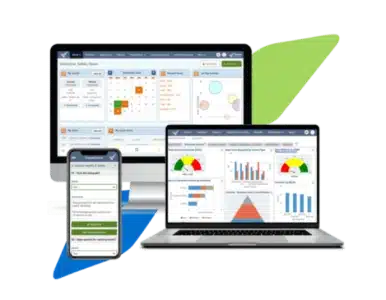
How to measure contractor safety program effectiveness
The data your contractor safety program creates only matters if you track the right metrics. Leading indicators flag risk before someone gets hurt. Lagging indicators confirm whether your controls are working. Together, they give you the dollar-based case your VP of operations needs to keep funding the program.
Track leading indicators that predict incidents
Leading indicators show whether your program works before an incident forces the question:
- Safety observations finished per week
- Near-miss reports sent in by contractor crews
- Orientation completion rate (target: 100% before first shift)
- Inspection findings closed within their assigned deadline
Monitor lagging indicators that confirm results
Lagging indicators confirm outcomes after the fact:
- Contractor-specific TRIR and DART rates
- Workers’ comp claims filed by contractor workers on your site
- OSHA recordables tied to contractor work
Build the ROI case for leadership
Ground your budget case in hard numbers. The National Safety Council reports that the average cost of a work injury needing medical care in 2023 was $43,000. Total U.S. work-injury costs reached $176.5 billion. Stopping just three recordable incidents among your contractor crews avoids roughly $129,000 in direct costs. That’s likely more than your entire yearly spend on contractor safety. When you present those numbers to leadership, the conversation shifts from defending a cost to showing a return.
Prove Contractor Compliance In Real Time
Walk through a contractor safety setup that verifies site orientation, captures unannounced inspection findings, and tracks close-out deadlines across locations.
Request a demo today
Run your contractor safety program with Vector Solutions
Managing orientation records, inspection findings, and incident data across multiple contractor pools doesn’t scale on spreadsheets.
Vector Solutions brings those functions into one platform. EHS teams can show compliance on demand and build a prevention-based budget case from real program data. You replace manual tracking across locations with a centralized record of contractor safety data. Compliance status and incident history are available without pulling files from multiple sources.
Walk through how it works for your contractor program in a personalized demo.
FAQs about contractor safety
What are the responsibilities of a contractor in safety?
Contractors must train, equip, and supervise their own workers while meeting all required OSHA standards on site. That said, the hiring organization, as the controlling employer, keeps the duty to coordinate and oversee overall site safety. Contractor compliance alone doesn’t remove your exposure.
Is a contractor safety plan required by OSHA?
OSHA requires a contractor safety plan on multi-employer worksites under its enforcement directives. Both host employers and contractors carry responsibility for maintaining safe job site conditions. OSHA’s multi-employer worksite policy holds you liable for violations that affect worker safety even when a contractor caused the hazard. Your contractor safety program documents how you discharge that duty.
How do I handle a contractor who refuses to provide their EMR or OSHA 300 logs during pre-qualification?
Treat refusal as a reason to disqualify. If a contractor won’t share safety records, they’re either hiding poor results or lack the basic capacity to manage compliance on your site. Require EMR letters and 300 logs as required bid documents. Non-submission equals automatic rejection. Document the refusal and notify your procurement team to flag the contractor for future bids.
What do I do if a contractor’s TRIR falls in the “review required” range but they have the lowest bid?
Require a written corrective action plan and a 90-day review period before awarding the full scope. Price alone doesn’t offset the financial and public risk of a recordable incident. The National Safety Council reports the average injury needing medical care costs $43,000. That figure can erase bid savings. Request their incident trend data from the past three years and root-cause analysis for recent recordables. Structure the contract with early exit rights if TRIR or audit findings worsen during the review period.
What leading indicators should I prioritize if I can only track two or three?
Focus on near-miss reports from contractor crews and inspection findings closed within deadline. These predict incident risk and measure your corrective action follow-through. Near-miss reporting reveals whether contractors feel safe raising concerns. Low submission rates signal a reporting culture problem. Tracking close-out speed on inspection findings tells you whether hazards get fixed before they cause injuries.
How often should I conduct unannounced contractor inspections on a low-hazard scope like janitorial or landscaping?
Conduct surprise inspections at least monthly for low-hazard scopes. Even routine work creates slip, trip, and ergonomic exposures that need checking. Focus inspections on:
- PPE compliance including gloves and eye protection
- Chemical storage and labeling
- Housekeeping in access routes
For multi-site work, rotate inspection timing so contractors can’t predict when you’ll arrive.