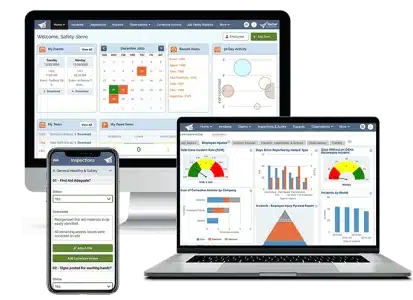











September 25, 2025 4 min read
Levels of a Risk Matrix
Industry:
Solution:
A risk matrix is a tool used to evaluate and prioritize risks based on their likelihood and impact. Different risk matrix levels, such as 3×3, 4×4, 5×5, and low/medium/high, help organizations decide which format best fits their needs. Whether you’re building a new safety program or improving a project plan, having the right risk matrix template can make risk events easier to assess, communicate, and manage.
Risk matrices are widely used in operational risk management, project planning, and safety assessments because they make complex information simple to understand. By color coding risk impact and likelihood, they allow teams to quickly identify which risks must be addressed immediately and which can be monitored over time.
Risk Matrix Examples and Templates
Risk matrices can be structured in several ways depending on the level of detail needed. The following are common risk matrix formats, such as 3×3, 4×4, 5×5 used by organizations of different sizes and industries, with examples and templates that show how each approach helps manage risk.
What is a 3×3 Risk Matrix?
As a refresher, a risk matrix is a tool that safety professionals use to assess the various risks of workplace hazards. EHS workers assess risks by evaluating the severity of a potential hazard, as well as the probability that it will occur.
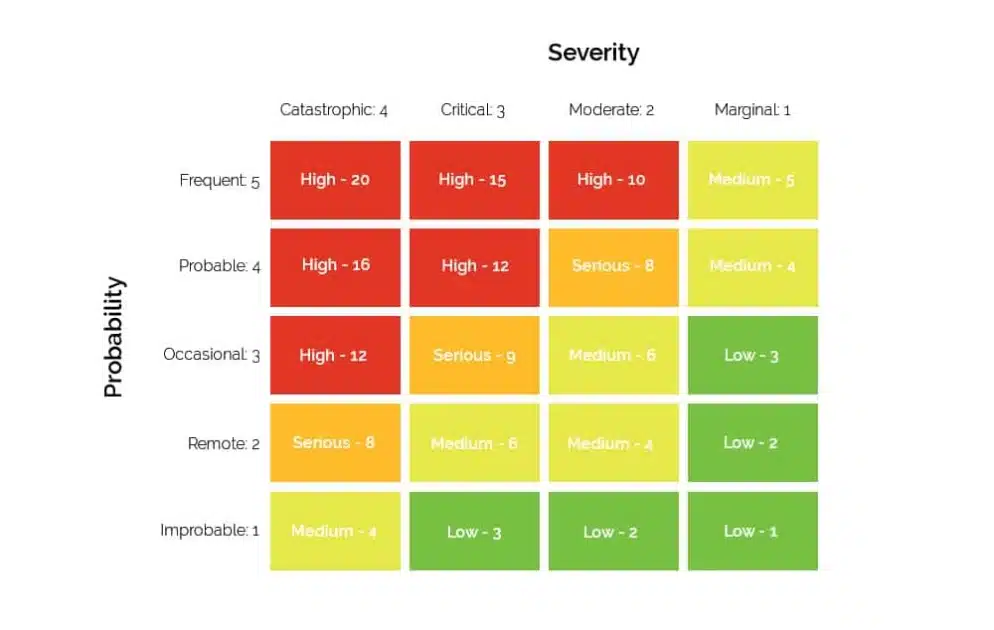
A risk assessment matrix contains a set of values for a hazard’s probability and severity. A 3×3 risk matrix has 3 levels of probability and 3 levels of severity.
For example, a standard 3×3 risk matrix contains the following values:
Severity:
- Marginal: The hazard may either be controlled, or would commonly result in less than minor, illness, injury or system damage.
- Moderate: The hazard may commonly cause severe injury or illness or major system damage, requiring immediate corrective action.
- Critical: The hazard may commonly cause death or major system loss, requiring immediate cessation of the unsafe activity or operation.
Probability:
- Improbable: Unlikely but possible to occur during standard operations
- Occasional: Likely to occur some time during standard operations
- Probable: Likely to occur often during standard operations
By multiplying a hazard‘s probability and severity values, you can calculate the acceptability level of its risk. For more information on how to perform a risk assessment, see our more detailed guide.
Risk Matrix Guide
Get the Guide
What are the benefits of using a 3×3 risk matrix?
3×3 risk matrices are generally straightforward to use. When a risk matrix is easily understood, it’s more likely to encourage an informed discussion of how severe hazardous scenarios can be.

What are the drawbacks of using a 3×3 risk matrix?
On the other hand, because the 3×3 matrix has a basic design it’s open to errors. (“It’s simple, so I don’t have to think very hard”). For that reason, it might become difficult to truly determine where the boundary between acceptable and unacceptable lies. In addition, with a 3×3 matrix, there are only three categories of risks — low, medium and high. For complex hazards or projects, a 4×4 or 5×5 matrix may be more appropriate, as they allow for more nuanced risk assessments.
What is a 4×4 risk matrix?
A 4×4 risk matrix contains 4 levels of probability and severity.
For example, a standard 4×4 matrix has the following values:
Likelihood
- Improbable (unlikely, though possible)
- Remote (could occur occasionally)
- Probable (not surprised, will occur in given time)
- Frequent (likely to occur, to be expected)
Severity
- Negligible (the hazard will not result in serious injury or illness, or has a remote possibility of damage)
- Marginal (the hazard could cause illness, injury, or equipment damage but its effects would not be serious)
- Critical (the hazard can result in serious injury or illness, property or equipment damage)
- Catastrophic (the hazard is capable of causing death and illness)
What are the benefits of using a 4×4 risk matrix?
The 4×4 risk matrix offers more complexity than the simpler 3×3 template. Too small or too large a matrix may not give a sufficient, or too vague of an assessment, so for many projects, a 4×4 matrix is “just right.”
What are the drawbacks to using a 4×4 risk matrix?
Critics argue that it can become all too easy for potential risks to be classified in the medium range and therefore for management to view risk assessments as a “tick the box” exercise. When this occurs, it’s possible for common safety hazards to be taken less seriously despite still posing potential risk.

What is a 5×5 risk matrix?
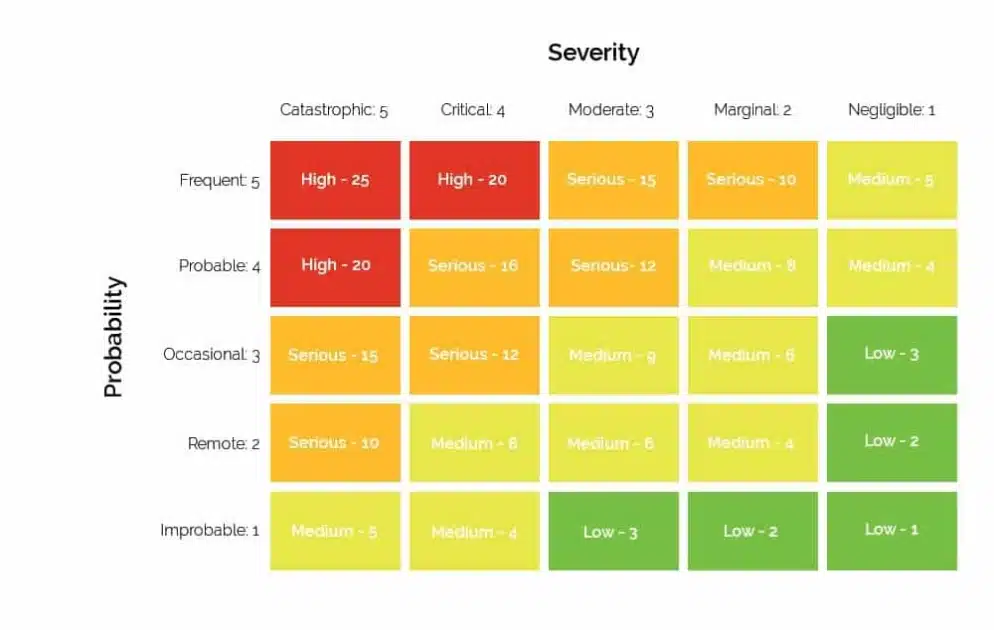
A 5×5 risk matrix contains 5 levels of probability and severity.
Likelihood
- Improbable (unlikely to occur)
- Remote (unlikely, though possible)
- Occasional (likely to occur occasionally during standard operations)
- Probable (not surprised, will occur in a given time)
- Frequent (likely to occur, to be expected)
Severity
- Negligible (the hazard will not result in serious injury or illness, or has a remote possibility of damage)
- Marginal (the hazard could cause illness, injury, or equipment damage but its effects would not be serious)
- Moderate (the hazard can result in serious injury or illness, property or equipment damage)
- Critical (the hazard can result in serious injury or illness, property or equipment damage)
- Catastrophic (the hazard is capable of causing death and illness)
What are the benefits of using a 5×5 risk matrix?
Of the three matrix sizes, the 5×5 format allows EHS professionals to conduct risk assessments with the most detail and clarity.
What are the drawbacks to using a 5×5 risk matrix?
Some argue that a 5×5 matrix is too complex and too much work to use for smaller projects. For some tasks, it becomes questionable whether this level of granularity is really necessary.
Choosing the Right Risk Matrix Level
The right risk matrix depends on your organization’s needs, project management and project size, and the complexity of identified risks.
- A 3×3 risk matrix is best suited for small projects or teams that need quick, high-level insights.
- A 4×4 risk matrix offers more balance, giving medium-sized organizations enough detail to prioritize risks without adding unnecessary complexity.
- A 5×5 risk matrix is commonly used in high-risk industries where operational risks need thorough analysis to allocate resources effectively.
| Matrix Type | Best Use Case | Example Benefit |
| 3×3 Risk Matrix | Small projects, fewer risk events | Quick severity/likelihood overview |
| 4×4 Risk Matrix | Medium-sized operations, project planning | Balance between detail and simplicity |
| 5×5 Risk Matrix | High-risk industries, complex risk assessments | Detailed prioritization and resource allocation |
By matching the risk matrix template to your project’s scope and risk profile, you can create a more effective risk management plan.
Does one size really fit all?
Should an entire company employ a single common risk assessment matrix or should each department have its own specific one? The former allows for a consistent approach. But the latter allows for more highly targeted assessments. Ultimately, it’s best for an organization to be able to adjust the size and design of its risk matrix as needed.
Low/Medium/High Risk Matrix
Some organizations prefer a simple low/medium/high risk matrix to categorize identified risks quickly. This version doesn’t provide the same details as 3×3, 4×4, or 5×5 formats, but it works well for small projects or teams that need a fast way to prioritize risks without overcomplicating the process.
How can Safety Management Software help?
Risks pose real-time threats, and you have to be able to make informed decisions to mitigate them quickly. Trying to manage assessments using paper and spreadsheets is unwieldy and limits participation. Using safety management software (like Vector EHS!), you can continually update and easily modify your risk matrix to meet your specific operational needs.
By using a web-based matrix and assessment tool, it also becomes easier to share them across your organization’s locations.
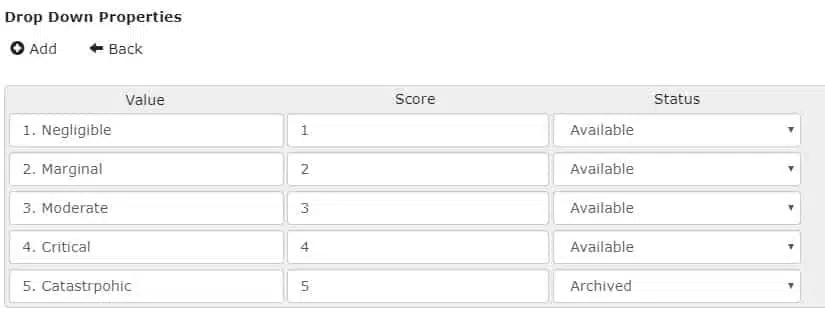
You can easily add as many levels to your risk matrix as you like and set probability and severity values and their scores. Adding or archiving levels can be accomplished with a simple click of the mouse.
Risk management software also allows you to get a clear picture of risks throughout your organization. You can roll-up the data to get a global perspective or zero in on a single facility or department, examining each and every significant hazard along with identified controls.
With safety software, there’s also less chance that your risk assessments will grow old and out of date. When assessing a new risk, you can determine the period in which the hazard will need to be re-evaluated and ensure that this is completed in a timely fashion.
Web-based risk matrices can automatically calculate a hazard’s risk after you choose its probability and severity, saving you time. After identifying steps to mitigate the risk, safety software can even help you take your assessment a step further by allowing you to calculate the hazard’s residual risk after controls are set.
Explore how Vector’s EHS Management Software helps teams prioritize risks, track impact, and manage compliance.