











August 20, 2025 5 min read
Fire Extinguisher Mounting Height, Signage & Location Requirements (OSHA)
Industry:
Solution:
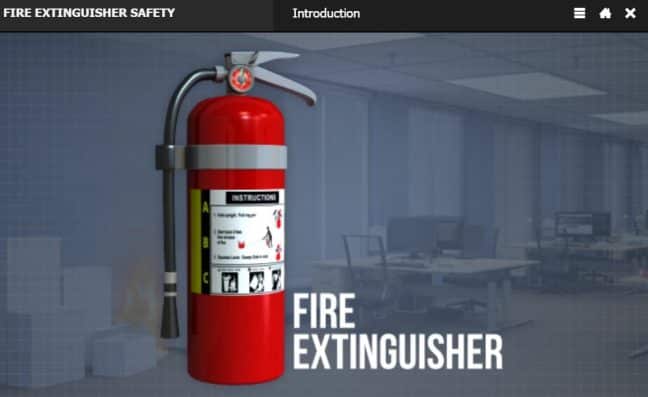
In some cases, OSHA requires employers to have fire extinguishers at work, and in other cases, employers will choose to provide them. In either scenario, if a company places portable fire extinguishers in the workplace, it’s important to understand fire extinguisher signage requirements, fire extinguisher mounting height, and fire extinguisher location requirements.
This article covers mounting, placement, and signage for OSHA compliance.
OSHA Fire Extinguisher Placement
The issue of fire extinguisher placement requirements from OSHA begins with cases in which OSHA requires the employer to have portable fire extinguishers or the employer decides to provide them.
If portable fire extinguishers will be present, 1910.157(c)(1) lays down the first requirement:
“The employer shall provide portable fire extinguishers and shall mount, locate and identify them so that they are readily accessible to employees without subjecting the employees to possible injury.”
So the key issue above is “readily accessible to employees without subjecting the employees to possible injury.” Please note this is assuming the employer allows employees to use the extinguishers.
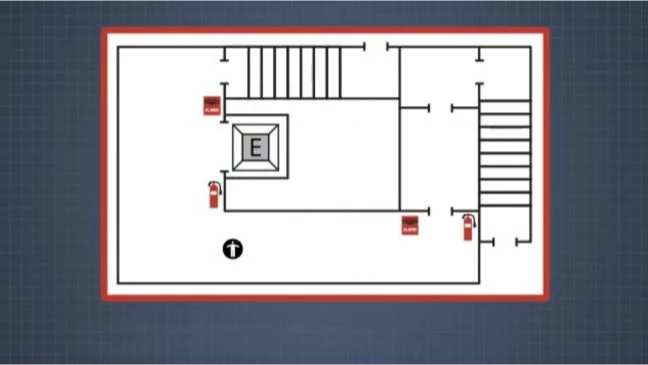
The next concern about fire extinguisher placement is the distance the employee has to travel to reach an extinguisher. This is based on the type of extinguisher (and/or the Class of fire it can put out), as listed below.
Placement of portable fire extinguishers for Class A fires
Portable fire extinguishers must be placed so that the travel distance for employees to any extinguisher is 75 feet or less. — see 1910157(d)(2)
Note: These distances are consistent with OSHA and NFPA 10 (2010); the NFPA 10 (2018/2021) edition includes minor updates to spacing and hazard classification for certain industrial applications.
Placement of portable fire extinguishers for Class B fires
Portable fire extinguishers must be placed so that the travel distance for employees to any extinguisher is 50 feet or less.– see 1910.157(d)(4)
In addition, here’s what an OSHA Evacuation Plans and Procedures eTool (on the Extinguisher Placement and Spacing page) says regarding extinguishers for Class B fires:
| Hazard | Extinguisher | Spacing |
|---|---|---|
| Light (Low)
Small amounts of flammable liquids used for copy machines, art departments, etc., that are stored safely and kept in closed containers. |
5-B | 30 feet |
| Light (Low)
Small amounts of flammable liquids used for copy machines, art departments, etc., that are stored safely and kept in closed containers. |
10-B | 50 feet |
| Ordinary (Moderate)
The total amount of flammable liquids are present in greater amounts than expected under low-hazard locations. This can include garages, workshops, or support service areas. |
10-B | 30 feet |
| Ordinary (Moderate)
The total amount of flammable liquids are present in greater amounts than expected under low-hazard locations. This can include garages, workshops, or support service areas. |
20-B | 50 feet |
| Extra (High)
Locations where flammable liquids are present and used in large quantities. This includes areas used for storage, production, woodworking (finishing), vehicle repair, aircraft and boat servicing, or where painting, dipping, and coating, operations are performed with flammable liquids. |
40-B | 30 feet |
| Extra (High)
Locations where flammable liquids are present and used in large quantities. This includes areas used for storage, production, woodworking (finishing), vehicle repair, aircraft and boat servicing, or where painting, dipping, and coating, operations are performed with flammable liquids. |
80-B | 50 feet |
OSHA notes they’ve adapted this information above from “Standard for Portable Fire Extinguishers,” NFPA 10 (2010), Table 6.3.1.1, Fire Extinguisher Size and Placement for Class B Hazards
Placement for Class C, D & K Fires
- Class C: Distributed based on existing Class A or B hazards. [1910.157(d)(5)]
- Class D: Travel distance must be 75 feet or less in combustible metal areas. [1910.157(d)(6)]
- Class K: For cooking hazards, must be within 30 feet. [NFPA 10, Section 6.6]
NOTE: Uniformly spaced hose stations or sprinkler systems can sometimes replace Class A extinguishers if coverage and employee training requirements are met.
NFPA 10 (2018/2021) provides additional guidance on placement in commercial kitchens, though the 30-foot travel distance remains a widely accepted standard.
Need Fire Extinguisher Safety Training?
Ensure your workplace meets OSHA standards with our Fire Extinguisher Safety course.
View Course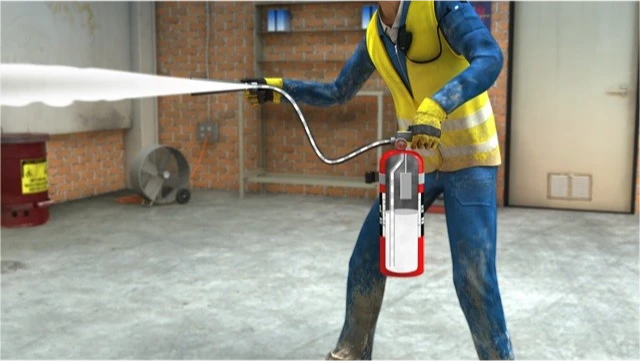
OSHA Fire Extinguisher Mounting Height Requirements
Now let’s turn our attention to fire extinguisher mounting height requirements.
If you go back to 1910.157(c)(1), you’ll see all the OSHA regulation has to say on the issue of mounting height:
“The employer shall provide portable fire extinguishers and shall mount, locate and identify them so that they are readily accessible to employees without subjecting the employees to possible injury.”
To prevent fire extinguishers from being moved or damaged, OSHA’s eTool recommends mounting on brackets or in wall cabinets, with carrying handles 3 to 5 feet above the floor. Larger extinguishers should have the carrying handle about 3 feet from the floor. This also aligns with general fire extinguisher mounting requirements.
These mounting height recommendations are aligned with OSHA and NFPA 10; the 2018/2021 NFPA 10 edition provides slightly updated guidance for larger extinguishers and special workplace environments.
Fire Extinguisher Cabinet Height Guidelines
Placing extinguishers in cabinets helps protect them and makes sure they’re at the right height for easy access. Cabinets also keep them from getting bumped or damaged and make them easier to see and grab in an emergency. Keeping fire extinguisher cabinet height in mind is key for accessibility, and making sure nothing blocks the view helps employees find them quickly when they’re needed.
OSHA says fire extinguishers need to be mounted so employees can reach them without getting hurt. Bigger extinguishers should have the handle no more than 3 feet off the floor, and smaller ones can go up to 5 feet according to 1910.157(c)(1) and (d)(2) . Following these fire extinguisher mounting requirements and fire extinguisher height requirements keeps extinguishers easy to get to and helps you stay on the right side of safety rules.
Fire Extinguisher Sign Height Requirements
OSHA regulations only require that portable fire extinguishers be identified, but following best practices for fire extinguisher signage makes it much easier for employees to find them in an emergency. Place signs at a height where they can be seen from different angles and distances and make sure nothing blocks the view of the extinguisher or sign.
So here, you’re best off following good-old common sense. Place a sign or something similar that makes it easy for people to know where an extinguisher is/extinguishes are. Consider placing it so it can be seen well from up close, at a distance, and from different angles. And make sure there’s nothing that obstructs a person’s view of the extinguisher and/or the sign (such as a pile of boxes, machinery, or an open door).
Americans with Disabilities Act & Fire Extinguisher Placement
Although we’re focusing on OSHA regulations concerning fire extinguishers, remember that you may also have to consider things like local building codes, NFPA requirements, and even the Americans with Disabilities Act (ADA).
According to the ADA, if an object is mounted to the wall (like fire extinguishers often are), and their leading edges are located between 27 inches and 80 inches above the finished floor, the mounted object can protrude no more than four inches into walkways, corridors, passageways, or aisles. This is at least one reason why you’ll often see fire extinguishers inside recessed cabinets within a wall instead of mounted on the wall and sticking out into a traffic way.
The Wrap Up: OSHA Fire Extinguisher Mounting Height, Placement & Signage Requirements
We hope this answered some of your questions about fire extinguisher placement, signage, and mounting requirements. Please remember that fires are a real hazard, that every year people die from fires unnecessarily, and that with proper precaution and safety training we can all make sure a lot more people make it home from work alive and well.
You might also want to explore our online fire extinguisher safety training video. A quick sample is available just below.
Looking for OSHA-compliant Safety Training?
Our HSE training library offers a wide range of courses to help your team stay safe and meet OSHA requirements.
Download Course Catalog