











April 16, 2026 5 min read
What Is HazCom? OSHA’s Standard Explained
Industry:
Solution:
The OSHA Hazard Communication Standard (HCS) requires ongoing program management across every site, shift, and chemical change. That means building audit-ready records and defining clear retraining protocols. This article gives the practitioner-level detail to do just that.
Main Takeaways
- OSHA’s Hazard Communication (HazCom) requires employers to identify chemical hazards and communicate them through labels, Safety Data Sheets (SDS), and training.
- HazCom compliance includes a chemical inventory, SDS collection, and labeling system.
- Workers must complete HazCom training before their first exposure to hazardous chemicals.
- HazCom violation penalties can cost $16,550 apiece.
- Secondary containers require labels with product identifiers and hazard information.
Decode GHS Labels Faster Onsite
Build worker confidence at the point of use with a clear breakdown of pictograms, signal words, and hazard statements.
Read the GHS Chemical Label Guide
What is the OSHA Hazard Communication Standard?
OSHA’s Hazard Communication Standard is the federal rule requiring employers to identify workplace chemical hazards. Workers must receive this information through labels, SDS, and training. The Globally Harmonized System (GHS) for hazard classification aligns with HCS.
You may also know it as the “Right to Know Law.” That name dates back to the standard’s original intent: giving workers access to chemical information. OSHA has since reframed the concept as “Right to Understand.” The emphasis shifted from simply providing data to making sure workers can interpret and act on it.
Who Must Follow HazCom and GHS?
OSHA requires HazCom compliance from every employer where workers may encounter hazardous chemicals during routine operations or foreseeable emergencies. When the program works, there are fewer chemical exposures, faster emergency response, and lower citation risk.
Not every chemical or product on your site falls under HazCom. Several categories may be exempt depending on use and exposure level:
- Consumer products used in the same manner and duration as normal consumer use
- Wood and wood products
- Food, drugs, and cosmetics regulated under the Federal Food, Drug, and Cosmetic Act (FDCA)
- Hazardous waste regulated under The Resource Conservation and Recovery Act (RCRA)
If your facility only stocks household-grade cleaning products and employees use them the way a consumer would at home, those items may fall outside HazCom’s scope. But that depends on frequency, duration, and concentration of use.
Fast Fact: In 2024, there were 410 fatalities from exposure to harmful substances, according to the National Safety Council.
The 5 Required Elements of a HazCom Program
A compliant HazCom program rests on five components OSHA can evaluate and cite independently:
- Written HazCom program
- Chemical inventory
- SDS
- Labeling
- Training
A gap in any single area exposes your entire program during an inspection.
Written HazCom Program
Your written program is the operational foundation. It defines how your organization manages each of the other four elements. It should include:
- How you maintain the chemical list
- How employees access SDS
- Your labeling system for workplace containers
- Your training approach and schedule
- How you handle non-routine tasks and contractor coordination
Update the program whenever you add or remove chemicals, change processes, or modify site operations. Keep a copy accessible to workers on every shift.
Chemical Inventory
The chemical inventory is your master list of every hazardous chemical at each location. It sets the boundaries for which SDS you need on file, which containers need labels, and what training must address.
Add new chemicals to the inventory before they arrive on-site and remove discontinued products promptly. Review the full list at least quarterly, and whenever processes change.
Safety Data Sheets (SDS)
Each chemical in your inventory needs a matching SDS with detailed hazard, handling, and emergency information. The GHS-aligned format includes 16 standardized sections:
- Identification
- Hazard(s) identification
- Composition/information on ingredients
- First-aid measures
- Fire-fighting measures
- Accidental release measures
- Handling and storage
- Exposure controls/personal protection
- Physical and chemical properties
- Stability and reactivity
- Toxicological information
- Ecological information
- Disposal considerations
- Transport information
- Regulatory information
- Other information
Workers must be able to reach SDS during every shift. OSHA permits electronic access, but only when “no barriers to immediate employee access are created.”
For teams managing multiple sites, keeping SDS current and accessible is one of the most persistent program gaps. Vector EHS Management helps teams centralize SDS and chemical inventory data, so every location stays audit-ready without manual file management.
Labeling
Shipped containers must carry six standardized label elements:
- Product identifier
- Signal word (Danger or Warning)
- Hazard statement(s)
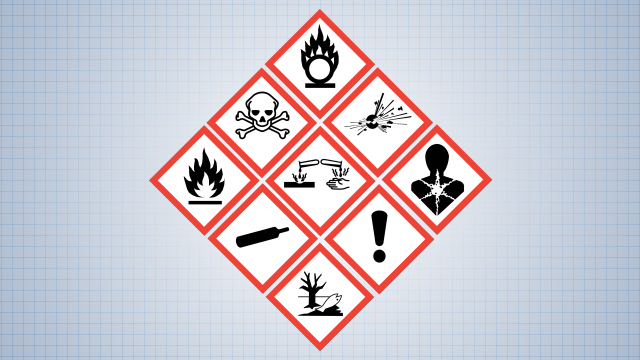
- Pictogram(s)
- Precautionary statement(s)
- Supplier identification
Workplace and secondary containers need at least the product identifier plus words, pictures, or symbols that communicate the same hazard information as the shipped label. Only a portable container for immediate use by the person who transferred the chemical doesn’t need a label.
Unlabeled spray bottles, transfer buckets, and small vessels are among the most frequent failures and citation triggers.
Training
OSHA requires employers to train workers at initial assignment and whenever a new chemical hazard enters their work area. Training must cover:
- How to detect the presence or release of hazardous chemicals
- Physical and health hazards of chemicals in the area
- Protective measures, including PPE
- Emergency procedures
- How to read and use labels and SDS
All five elements operate as a single system. An outdated or missing piece in any area can expose your entire program.
Centralize SDS and Inventory Control
See how one system can keep SDS current, tie them to your chemical list, and support inspections across multiple locations.
Explore Vector EHS Management
HazCom Training Requirements
Every worker who may encounter hazardous chemicals needs HazCom training. Training must happen before their first assignment where hazardous chemicals are present.
OSHA ties retraining to specific triggers, not a calendar cycle. It’s required whenever:
- A new chemical hazard enters the work area
- The written HazCom program is revised
- Labeling or SDS access procedures change
- An employee moves to a different task or area with different chemical exposures
If none of those conditions are met, there’s no regulatory obligation to retrain. Many organizations still build in periodic refreshers as a best practice, particularly for high-turnover roles.
Your written program should clearly assign responsibility for starting retraining. That’s typically the supervisor or EHS lead who manages the work area.
HazCom Training Requirements Documentation
During an inspection, OSHA will look for proof that training was delivered on time and addressed the specific chemicals present. To prove it, keep these records on file:
- Training rosters with dates and signatures, or electronic completion records
- The specific topics and chemicals covered
- The job role or work area the training applies to
- Confirmation that employees were shown where to find SDS and labels at their location
Managing this across multiple roles, locations, and rotating staff in spreadsheets and paper rosters is impossible. Vector LMS solves this through:
- Assigned, role-specific HazCom training
- Automated completion tracking
- Easy pulling of audit-ready reports
Trusted by more than 24,000 clients in critical industries, it replaces manual admin with consistent, visible documentation.
Common HazCom Violations and OSHA Penalty Exposure
Hazard communication has ranked among OSHA’s top-cited standards for nearly a decade. Current OSHA penalties reach $16,550 per violation. Penalties are assessed per instance, so a single walkthrough that finds several untrained employees compounds quickly.
The most common citation categories map directly to the program elements. Here’s how to prevent each and what documentation to have ready.
HazCom Violation Prevention
| Violation | How to Prevent It | Documentation Needed |
| No written HazCom program | Review and revise whenever chemicals, processes, or locations change; keep copies where employees can access them | Current dated copy of the written program; change log with review dates |
| Unlabeled containers | Conduct monthly secondary-container audits; train workers on the immediate-use exemption and when labeling is required | Label audit records; walkthrough inspection photos |
| Missing, outdated, or inaccessible SDS | Centralize SDS management; verify shop-floor access every shift; update the collection whenever the inventory changes | SDS access verification logs; chemical inventory cross-referenced against the SDS collection |
| Lack of training or missing records | Assign training before first exposure; automate retraining triggers linked to chemical or process changes; store records digitally | Completion records with dates, topics, and employee names; proof that training occurred before assignment |
None of these citations reflects a gap in safety knowledge. Each is a program maintenance failure. That means each gives you a specific, defensible line item to bring to leadership when you need time, budget, or better tools.
Prove HazCom Training Before Exposure
Confirm temps and new hires completed HazCom training before they started, and pull audit-ready records on demand.
Request a Demo
Keep Your HazCom Program Audit-Ready with Vector Solutions
This framework helps you sustain a HazCom program that holds up across changing inventories, staffing, and sites.
Vector Solutions is the single platform that unites:
- SDS management
- Chemical inventory tracking
- Training documentation
Every location remains audit-ready. Your team can spend more time on compliance. No need to chase spreadsheets or fix disjointed systems. Retraining triggers, completion records, and inventory updates automatically stay current.
Request a demo to see how Vector Solutions reduces admin time and keeps your HazCom program inspection-ready across every location.
FAQs about HazCom
Can I use a mobile app or tablet-based system to give employees access to SDS in the field?
Yes, as long as employees can access SDS right away during their shift without login delays, network outages, or other barriers. Offline-capable apps or cached SDS work well. Systems that need a live login or network connection may create barriers during emergencies.
What’s the fastest way to verify my HazCom program will pass an audit?
Run a 30-minute spot check to:
- Confirm your chemical inventory matches what’s on site.
- Verify all SDS are accessible from the shop floor.
- Audit secondary containers for labels.
- Pull training records for recent hires and chemical changes.
- Review the written program date.
If any element fails the spot check, that’s your priority fix before the next formal audit or inspection.