











Load Securement
The North American Cargo Securement Standard provides the basis for the rules and regulations covering load securement on motor vehicles in the United States and Canada. It applies to all vehicles which use public highways and have a gross vehicle weight of over 4,500 kg (10,000 pounds), and all cargo and hazardous materials (aka dangerous goods), including general freight, equipment carried for vehicle operation, and intermodal containers and their contents.
The cargo securement standard was created because unsecured or under-secured loads can lead to loss of life and/or load, cargo damage, vehicle damage, crashes, citations and fines for drivers and carriers, and vehicles being place Out-of-Service. This course covers the purpose of load securement, load preparation, methods of load securement (including tie-down assemblies), working load limits (WLL), tie-down types, and safety guidelines.




Demos + Pricing
Learn more about our courses, get pricing, and see our platform.
Course Details
Learning Objectives
At the end of this course, you will be able to:
- Specify where and when the North American Cargo Securement Standard applies
- List the three methods of load securement on a motor vehicle
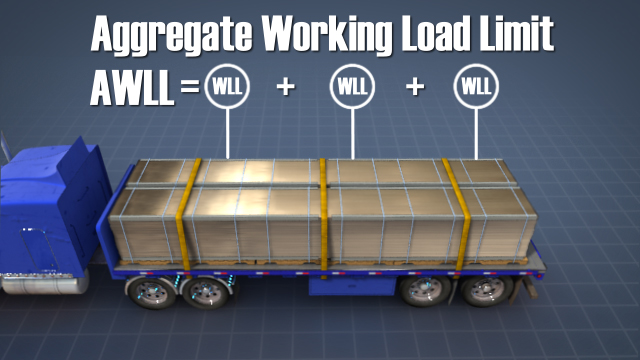
- Define working load limit (WLL) and aggregate working load limit (AWLL)
- Describe how the number of tie-downs required for a load is determined
- List safety guidelines related to cargo securement
- Identify when vehicles and load securement devices should be inspected during transport
- List commodities which have special load securement requirements
Specs
Frequently Asked Questions
What is the North American Cargo Securement Standard?
What are three ways that cargo can be secured for transport?
What is working load limit (WLL)?
What is aggregate working load limit?
How is the number of tie downs required for a load determined?
Which commodities have special load securement requirements?
Sample Video Transcript
There are three ways cargo can be secured for transport. One, fully contained. In this case, the cargo must not be able to shift or tip, and it must be restrained from sideways movement either by other cargo or a vehicle structure. Two, immobilized. The cargo can be immobilized by structures or a combination of structure, blocking, and bracing. Or three, secured on a vehicle. The cargo must be secured by tie-downs which can be accompanied by blocking, bracing, friction mats, other cargo, dunnage, or a combination of these. This course focuses on loads secured on vehicles using tie-downs and other securement devices.
Additional Resources
- US Government Publishing Office – http://www.gpo.gov
- GPO Cargo Securement Standard 49 CFR 393.100 – http://www.gpo.gov/fdsys/granule/CFR-2011-title49-vol5/CFR-2011-title49-vol5-sec393-100
- Federal Motor Carrier Safety Administration – http://www.fmcsa.dot.gov
- FMCSA Cargo Securement Rules – http://www.fmcsa.dot.gov/regulations/cargo-securement/cargo-securement-rules
- FMCSA Driver’s Handbook – http://www.fmcsa.dot.gov/regulations/cargo-securement/drivers-handbook-cargo-securement-introduction


