











DOT Hazmat – Placarding
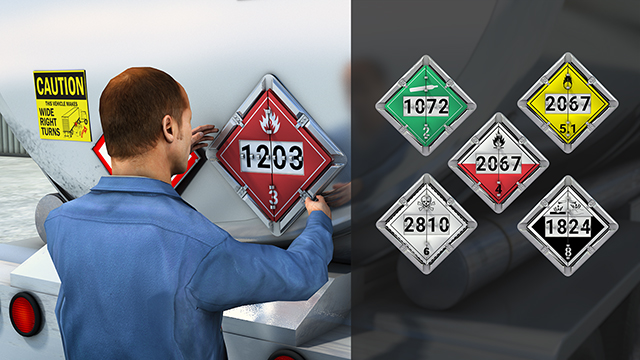
The DOT requires marking, labeling, and placarding of hazardous materials being transported in commerce to, from, or within the U.S. The term “placarding” refers to the placement of large durable versions of hazard labels on transport vehicles, bulk packages, freight containers, unit load devices, and rail cars. The purpose of marking, labeling, and placarding is to communicate the potential dangers of hazardous materials. Placards are especially important to emergency responders, who use this information to initiate protective actions after an incident or accidental release.



Demos + Pricing
Learn more about our courses, get pricing, and see our platform.
Course Details
Learning Objectives
• Define the terms “hazardous material,” “packaging,” “package,” “bulk” packaging, and “non-bulk” packaging, as defined in the Hazardous Material Regulations (HMR) • Identify the hazmat packaging employees who must comply with the HMR • Identify markings, labels, and placards on hazardous material shipments • Describe placards that are prohibited, including the exceptions that are allowed • Describe general placarding requirements for hazardous material shipments to, from, and within the U.S., including how to use the placarding tables in the HMR, and placarding provisions and exceptions
Specs
Frequently Asked Questions
Is it ok to replace the text on hazmat placards with ID numbers?
Can international placards replace HMR-compliant placards?
How can I determine if a material must be placarded?
What is the difference between the two placarding tables?
When can a DANGEROUS placard be used?
Sample Video Transcript
Placards may only be affixed or displayed on a packaging, freight container, unit load device, transport vehicle, or rail car if: • The material being offered or transported meets the definition of a hazardous material • The placard represents a hazard of the hazardous material being offered or transported • The placarding conforms to HMR requirements Placards that do not satisfy all three of these requirements are prohibited. Also, any sign, slogan, advertisement, or device that, based on its color, design, shape, or content, could be confused with any placard prescribed by the HMR is also prohibited.


