A training management system tailored for the fire service—track all training, EMS recerts, skill evaluations, ISO, and more for 100% of training in one place.
A training management system tailored for EMS services—EMS online courses for recerts, mobile-enabled skill evaluations, and more for 100% of training in one place.
Increase performance, reduce risk, and ensure compliance with a training management system tailored for your FTO/PTO and in-service training for 100% of training in one place.
Integrated solution purpose-built for modern regulatory demands. ArdentSky, delivers automated, integrated compliance solutions trusted by global gaming manufacturers, operators, and suppliers.
A Breakdown of the 4 Steps of a Job Safety Analysis (JSA)
Contents
Blog
June 11, 2024 4 min read
Share:
A Breakdown of the 4 Steps of a Job Safety Analysis (JSA)
Industry:
Commercial EnterpriseMultiple Industries
Solution:
Risk ManagementVector EHS Management
Share:
Job Safety Analyses (JSAs) are crucial in industries with high-risk environments, such as construction, manufacturing, and mining, where the potential for serious accidents and injuries is significant.
A job safety analysis (JSA), sometimes called a job hazard analysis (JHA), is a structured process used to identify and control potential hazards in the workplace. Completing a job safety analysis step by step helps teams break down tasks, uncover risks, and apply the right control measures before work begins. By conducting JSAs regularly, organizations can reduce injuries, improve compliance, and strengthen their safety culture.
The process of creating a job safety analysis report is generally broken down into four steps:
Choose a Job to Analyze
Break the Job Down into Specific Tasks
Determine Hazards and Risk Present in Each Task
Identify Preventative Controls and Residual Risk
This structure makes it easier to ensure you complete every portion of the requirements and reap the benefits a JSA offers. This article will give you a comprehensive overview of how to conduct a job safety analysis.
What is a Job Safety Analysis?
Before we dive into each step of a Job Safety Analysis, let’s first define what a JSA is.
A Job Safety Analysis is a systematic process to identify the dangers of specific tasks within jobs to reduce the risk of injury to workers. The primary goal of a JSA is to prevent workplace injuries and illnesses by implementing effective safety measures and controls.
When you complete a JSA, you’re taking crucial steps to protect your employees and ensure that your workplace complies with standard safety regulations.
JSA Step #1: Select the Job to Be Analyzed
OSHA encourages employers to conduct regular job safety analyses as part of their overall hazard prevention program to identify and control workplace risks before an incident occurs. You’ll need to prioritize which tasks to analyze first. Choose tasks with a higher potential for incidents or that have been involved in incident investigations. Consider non-routine jobs, new processes, or activities where new employees are assigned.
For example, in the construction industry, jobs involving fall protection can benefit significantly from a job safety analysis due to the high rate of fatalities from falls.
Accident frequency and severity: The frequency – or severity – of past injuries can suggest where to begin your JSAs.
Newly established jobs: Tasks that are new may present more risk because your workers are not yet accustomed to these jobs.
Potential for severe injuries or illnesses: Jobs that involve hazardous materials or dangerous conditions may have greater potential for accidents.
Infrequently performed jobs: Like new tasks, jobs that are performed infrequently may present greater risk because staff members don’t know which hazards to anticipate.
JSA Step #2: Break the Job Down into Steps
Once you’ve determined which job to analyze, break that operation into the specific tasks required to complete it. Breaking down the task into logical steps helps uncover where hazards may occur. Steps such as “set up equipment,” “perform the operation,” and “clean up work area” could be separate tasks in a machinery maintenance task. List every step from start to finish.
For example, operating a piece of machinery might include preparing for the job, turning on the equipment, performing the task, shutting down the machine, and completing any necessary clean-up.
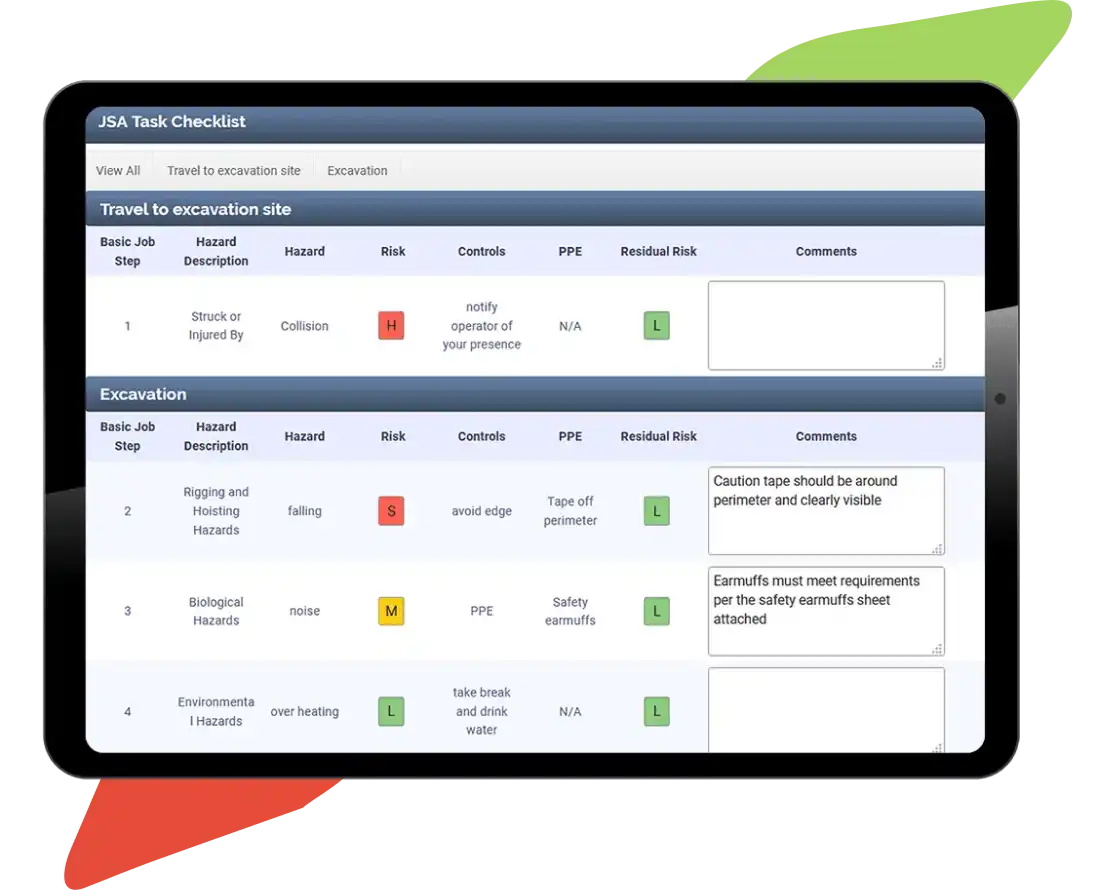
Breaking down a job into each step may seem tedious, but it is critical for properly analyzing the overall risk associated with the job. Job safety analysis software can streamline this process by allowing you to use a catalog of previous jobs. You can copy the tasks of a previous job and edit them to match the new job, saving considerable time when creating JSAs for jobs with similar tasks.
Numerous organizations throughout North America rely on Vector EHS Management Software to identify, analyze, and resolve job hazards throughout their worksites. Learn more about how we can help.
Transform workflows to reduce risk
Explore JSA software designed to safeguard your employees and ensure every task is executed safely.
Next, identify any hazards that may be present during each task. The Department of Labor emphasizes the importance of examining the entire environment to determine any possible hazard. The hazard might not necessarily be in the task itself but in the area where the activity is performed.
Identify hazards by observing the job, reviewing past incident investigations, and talking with experienced workers. This phase of the JHA should note both immediate and underlying causes like energy sources, motion, or environmental conditions.
When determining hazards, assess the risk of injury each hazard poses. Most safety professionals use risk matrix calculations of the probability and severity of the hazard to determine overall risk. Depending on how detailed you want your risk calculations to be, you may use different levels of a risk matrix.
If you’re unsure about this step, we’ve put together a guide on risk matrix calculations and hazard assessment to assist you. We also recommend using safety software to help automatically calculate risk through your defined levels of probability and severity. This way, you’ll have consistent risk calculations across your organization while streamlining the JSA process.
JSA Step #4: Develop Control Measures
The final step in a job safety analysis is to identify controls to prevent hazards from causing potential accidents. This includes documenting any personal protective equipment (PPE) that can help mitigate the identified hazards.
Once controls and PPE are considered, conduct another risk assessment for each hazard to determine the residual risk, using the same risk assessment matrix as before. Ideally, the probability and severity should be lower thanks to the controls and PPE.
If the hazard can’t be eliminated, find ways to change the job procedure or limit the risk as much as possible. This may involve providing tools such as a safety data sheet (SDS) that give information on the potential risks. Collect feedback from supervisors and employees who may identify additional controls or risks.
Use the hierarchy of controls to decide on control measures, starting with elimination or substitution, followed by engineering and administrative controls, and ending with PPE. Document the chosen controls so they can be reviewed and refined during future JSAs.
Once all controls and residual risk are calculated, determine the final overall risk of the job. This data helps identify which jobs pose the most risk to employees, even after controls are implemented, and if additional controls are needed to further reduce injury risk.
After completing these 4 steps, the Job Safety Analysis process is now finalized, providing a comprehensive understanding of the job’s risks and the measures in place to mitigate them.
Job Safety Analysis Frequently Asked Questions
What is a job safety analysis?
A job safety analysis (JSA) is a step-by-step process for identifying workplace hazards and implementing controls to prevent injuries and incidents.
How do you do a JSA step by step?
Follow four key steps: select the job, break the job into tasks, identify hazards, and develop controls. This ensures a consistent, thorough evaluation of each task.
What is the difference between a JSA and a JHA?
The terms job safety analysis (JSA) and job hazard analysis (JHA) are often used interchangeably; both describe a process for identifying and controlling workplace hazards.
What hazards does a JSA cover?
A JSA considers all hazards that could cause injury or illness, including physical, chemical, ergonomic, and environmental hazards.
Who should complete a JSA?
Supervisors, safety professionals, and workers familiar with the job should collaborate to ensure all risks and practical controls are identified.
What is JSA in safety?
In safety management, a JSA is a preventive tool that helps identify job-specific hazards before work begins and ensures appropriate controls are in place.
Simplify Job Safety Analysis with Vector Solutions
Vector EHS Management software is designed to protect employee health and safety by proactively identifying and addressing hazards, thus reducing risks and incidents. It is a valuable tool for organizations aiming to enhance their safety programs and ensure compliance with environmental, health, and safety regulations.
Vector EHS
Vector EHS includes Job Safety Analysis Software that offers a comprehensive solution to track potential hazards and calculate the risks of each hazard automatically. It allows user to:
Increase employee awareness of the hazards and risk mitigation best practices for specific tasks.
Integrate accepted safety and health procedures and best practices into a particular task or job operation.
Prioritize risks and address them by their probability and severity.