A training management system tailored for the fire service—track all training, EMS recerts, skill evaluations, ISO, and more for 100% of training in one place.
A training management system tailored for EMS services—EMS online courses for recerts, mobile-enabled skill evaluations, and more for 100% of training in one place.
Increase performance, reduce risk, and ensure compliance with a training management system tailored for your FTO/PTO and in-service training for 100% of training in one place.
Integrated solution purpose-built for modern regulatory demands. ArdentSky, delivers automated, integrated compliance solutions trusted by global gaming manufacturers, operators, and suppliers.
Since the Occupational Safety and Health Act of 1970, enforced standards have greatly improved worker protection in the U.S. Today, construction safety solutions are designed using modern technology to make it easier to identify risks, streamline inspections, and ensure safety protocols are followed during a crisis.
According to the National Safety Council, in the year 2022 alone, the sector witnessed 1,069 deaths, with an 8.4% increase from the previous year, and reported 167,600 nonfatal injuries in 2023, with an increase of 2.2 cases per 100 full-time workers. As a result, many organizations are seeking safety management software to meet their evolving compliance needs, strengthen their overall safety culture, and build strong safety program operations across job sites.
This guide explores how to choose the best safety management software for the construction industry, what features to prioritize, and how the right platform can effectively improve safety, compliance, and incident reduction.
Key highlights:
Construction safety software plays a crucial role in reducing risk, improving compliance, and fostering a safety culture across construction sites.
Streamlined safety processes enabled by technology lead to smoother communications, faster response, mitigation of hazards, and accelerated documentation.
Safety software for construction includes features such as incident reporting and documentation, risk management, compliance management, and predictive analytics, which are key in meeting safety compliance and industry standards.
Vector Solutions’ construction health and safety software delivers a scalable, centralized platform that helps construction teams align safety goals with long-term success.
What Is Safety Software for Construction?
Construction safety software or an Environment, Health and Safety (EHS) platform offers a suite of digital features that centralize and automate end-to-end activities of a safety program, including.
Identifying, assessing, and mitigating workplace hazards
Facilitating efficient communication of risks across job sites
Ensuring adherence to regulatory standards, e.g. OSHA, ANSI, etc.
Establishing consistent and accurate compliance reporting
The goal of construction health and safety management software solutions is to eliminate manual processes like spreadsheets or papers for tracking and reporting incidents, foster a safer work environment by proactively managing risks, and demonstrate a commitment to employee well-being. Many industries, from construction, transportation, and logistics to chemical processing, manufacturing, and pulp and paper, derive benefits from using safety management software.
Safety management software gives an organization the boost it needs to meet the growing demands of the economy while taking care of its employees.
Why Is Safety Management Software for Construction Important?
Integrating safety management software for construction is no longer about meeting compliance; it is part of an integral business system. With OSHA, ANSI, and multiple other regulatory bodies imposing strict requirements, companies that fail to track and manage safety activities effectively not only face legal fines but also risk their reputation.
Key reasons why safety management software is essential:
Proactive Risk Management: Software allows businesses to identify, mitigate, and prevent risks even before they happen. This is critical, as data from the Bureau of Labor Statistics shows that the construction industry represents only 6.5% of the total U.S. workforce, yet accounts for 20% of all workplace fatalities.
Data-Driven Decision-Making: Accessing real-time data and safety insights enables smarter planning and quicker decision-making to keep pace with evolving hazards and risks.
Improved Safety Culture: Safety management software allows involvement across functions and departments, empowering leaders and employees to take proactive measures together.
Technology enables standardized safety workflows across projects, reducing risk and exposure and improving construction project outcomes.
What Are the Benefits of Construction Safety Management Software?
According to OSHA and the U.S. Department of Energy, every $1 invested in workplace safety programs yields a $4-$6 return. By investing in safety management software, organizations commit to being safety-first, ensuring regulatory adherence and worker safety every step of the way.
The main benefits of construction safety management software include:
Reduced safety incidents, lowering claims, fines, and compliance risks
Elimination of data duplication and manual data entry
Consistent incident reporting across all job sites
Real-time visibility and transparency into safety performance
Increased employee engagement with safety programs
What Are the Key Features to Look for in Construction Site Safety Software?
Choosing the right construction site safety software is about more than checking boxes for compliance, it’s about equipping teams with the digital tools they need to prevent accidents, protect workers, and streamline safety processes across every project. The following key features highlight how modern safety platforms empower construction organizations to manage risks effectively, stay audit-ready, and build a stronger safety culture on-site.
Incident Reporting and Case Administration
A digital incident reporting and case management feature allows workers to submit reports directly via mobile or desktop. The system automates workflows for investigation, follow-ups, and resolution tracking. Further integration within HR systems allows for the processing of settlements in case outcomes.
Why it matters: Due to the nature of the construction industry, it’s imperative to establish strict reporting procedures in order to reduce safety risks. Many workplace injuries go undocumented due to a lack of trust in the resolution or due to fear of retaliation and or losing jobs.
Benefits: Centralized tracking enables faster investigations, corrective actions, and fair worker compensation, ultimately reducing future incidents and safety risks.
Compliance and Documentation
Construction safety compliance software modules help track OSHA and local regulatory requirements while maintaining safety records digitally. Automated alerts notify managers of upcoming inspections and documentation deadlines.
Why it matters: Safety compliance is a vital component of every project and protects worker well-being. Failure to comply can result in severe consequences, including hefty fines, legal action, and long-term damage to the organization’s credibility. Any workplace that is deemed non-compliant further increases the chances of hazards, risks, and injuries affecting worker morale and the financial stability of the organization.
Benefits: A centralized system stores permits, inspection logs, safety records, and safety data sheets. Construction firms can easily generate audit-ready reports, demonstrating regulatory adherence and boosting credibility across projects.
Audit and Inspection Tools
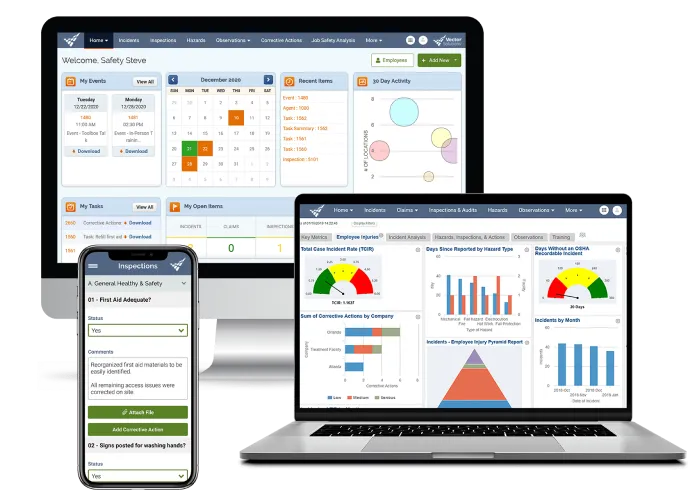
This feature enables digital inspections, hazard and observation checklists, and mobile data capture for easy documentation. Issues identified can automatically help generate corrective action tasks for responsible teams across job sites.
Why it matters: As the old saying goes, “Prevention is the best protection.” No organization wants to be caught off guard or blindsided by an injury. Part of preventive measures is always looking for hazards and fixing them before situations get out of hand. The International Labor Organization (ILO) reports that every 15 seconds, there is a worker death due to a work-related accident.
Benefits: Centralized documentation highlights recurring hazards, improving preventive measures. This leads to safer job sites, fewer injuries, and better regulatory compliance across all projects.
Analytics and Dashboards
Dashboards in an EHS Management software consolidate total recordable incident rate (TRiR), and inspection data into real-time visual insights. Custom reports track safety KPIs across multiple sites, providing tangible insights for organizational growth.
Why it matters: Collecting critical safety data empowers organizations to act proactively rather than reactively during a crisis. Analytics and a centralized dashboard enable data-driven decision-making by uncovering patterns, identifying trends, and addressing operational inefficiencies. It also supports workflow improvements across the board.
Benefits: Centralized analytics streamline compliance, enhance audit readiness, and improve accountability across job roles. Teams can measure safety performance, ensuring continuous improvement and safer project outcomes.
Training and Certification
Construction Safety Management Software that is integrated with learning management platforms offer opportunities to expand safety programs. Training programs like OSHA 10 Construction, slips, trips, and falls, fall protection, caught in-between, heavy equipment safety, and other critical online construction training topics support increased awareness to spot and mitigate safety incidents before they happen. A platform that also assigns, tracks, and manages certification status and sends reminders for renewals is a bonus.
Why it matters: With increasing fear of on-site safety, investing in worker safety not only helps meet compliance but also equips the workforce with skills to prevent workplace injuries. According to recent studies, workers reported feeling safer at job sites when management took initiatives to promote a safe working culture.
Benefits: Integrated training records ensure compliance and reduce liability. By standardizing construction safety management, companies minimize injuries, improve morale, and maintain a qualified, safety-conscious workforce.
A Buyer's Guide to Construction EHS Management Software
How Do I Choose the Best Construction Safety Software for my Organization?
When considering suitable construction safety software, it is important to look beyond product features. This helps the organization not only solve its existing challenges but also ensure its future holds steady growth and accommodates complex and continuous changes.
The following criteria help determine the best construction safety software to meet the needs of your team:
Criteria to Evaluate
Key Questions to Ask
User Experience
Is the system simple for both admins and field teams?
Are forms and buttons easy to find?
Configurability
Can you edit forms, checklists, and workflows without IT support?
Security and Access
Does the platform allow secure, role-based permissions for different users?
Workforce Organization
Can it handle job roles, departments, and sites, and connect with HR systems?
Mobile Functionality
Is there a mobile app for inspections, incidents, and photo captures for in-depth documentation? Does it work offline?
Scalability
Can the platform grow with your team, add new users, and handle more sites as you expand?
Customer Support
Does the vendor provide responsive support, training, and helpful resources?
Centralize Your Process with Vector’s Safety Management Software for Construction with Vector
Instead of relying on disconnected tools to meet evolving safety needs, choose Vector Solutions’ online construction safety management software. Our platform is designed to provide detailed visibility into day-to-day safety activities and tasks, enabling leaders to execute successful safety programs across the organization. At the same time, workers build skills and confidence to identify and prevent workplace mishaps, so safety isn’t just managed by one, but mastered by all.
Key features include:
Incidents, claims, and OSHA recordkeeping
Corrective actions
Dashboards, metrics, and reports
Inspections and observations
Risk management
Safety data sheets (SDS)
Book a demo today to see why Vector Solutions is the best construction safety management software for teams working to improve safety, compliance, and performance across every jobsite.