October 10, 2025 6 min read
Guide to OSHA Form 301: Understanding Requirements and Best Practices
Industry:
Solution:
Understanding the specifics of OSHA Form 301 is critical for maintaining compliance and ensuring a safe working environment, especially for those working in high-risk industries like industrial manufacturing and construction. OSHA Form 301, also called the Injury and Illness Incident Report, is one of the primary documents the Occupational Safety and Health Administration (OSHA) requires for tracking workplace injuries and illnesses.
Employers use the OSHA 301 form to record details of a recordable injury or illness, including what happened, how it occurred, and basic information about the employee involved. This form supports compliance with occupational safety and health standards while helping companies maintain accurate injuries and illnesses records.
This guide will deep-dive into OSHA Form 301’s requirements and was designed so employers can enhance their incident documentation and improve overall workplace safety.
What Is OSHA Form 301?
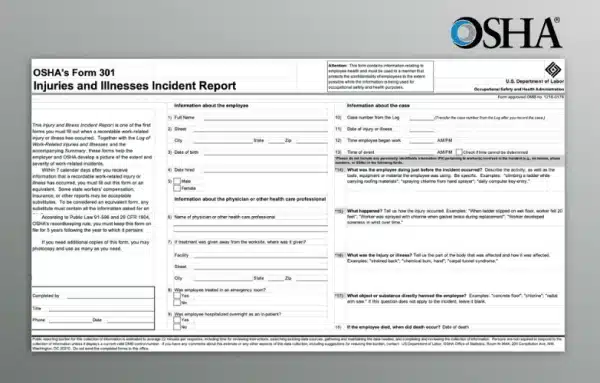
OSHA Form 301, also known as an Injury and Illness Incident Report, is a document used to record specific information about work-related injuries or illnesses. It provides a comprehensive account of each incident, including the injured employee’s details, the nature of the injury or illness, and the circumstances surrounding the incident.
Form 301 is a critical component of OSHA’s recordkeeping requirements, helping employers track workplace incidents and identify trends to improve safety protocols.
The OSHA Form 301 captures:
- Basic employee information (name, job title, department)
- Date and location of incident
- Description of the injury or illness (body part affected, type of injury)
- Description of how the incident occurred
- Medical treatment received (if any)
- Physician or health care provider contact information
See how Form 301 relates to the OSHA 300 and 300A forms.
The Ultimate Guide to OSHA Recordkeeping
Download Now
Why OSHA Form 301 Matters: Injury and Illness Reporting
OSHA Form 301 is a key part of workplace safety. It helps employers organize all the important details about every injury or illness, giving them the critical data they need to enhance workplace safety.
By analyzing Form 301 data, employers can spot patterns and identify potential hazards before they turn into more serious issues. This analysis makes it easier for employers to create plans and take actions that can prevent future incidents.

When Do Employers Need to Use an OSHA Form 301?
Employers with more than ten employees are generally required to complete OSHA Form 301 for each recordable work-related injury or illness unless they fall under an industry exemption for low-risk businesses. Recordable incidents include those that result in death, days away from work, restricted work, job transfer, medical treatment beyond first aid, or a significant diagnosis by a healthcare professional. Form 301 must be completed within seven calendar days of learning about a recordable injury or illness, and it serves as the incident-level detail behind the log of work-related injuries and illnesses.
Employers must ensure that Form 301 is readily available for review by OSHA inspectors upon request and is maintained for a minimum of five years following the end of the calendar year that the records cover.
Employer Requirements for OSHA Form 301
Employers must complete OSHA Form 301 no later than seven calendar days of receiving information about a work-related injury or illness to ensure compliance with OSHA for illness recordkeeping purposes. OSHA Form 301 includes multiple sections that require specific information:
- Information about the employee: This section captures the injured worker’s name, location, date of birth, gender, and date of hire, providing a personal profile for each incident.
- Information about the case: This section captures key information about the incident, including the date and time of the incident, the task the employee was performing, and a detailed description of how the injury or illness occurred. This helps in understanding the sequence of events leading to the incident.
- Information about the physician or other health care professional: This section includes details about the medical treatment received and whether the employee was hospitalized.
- Certification: The form must be certified by a company official, ensuring the accuracy and completeness of the information provided.
Employer requirements include:
- Completion timing – Fill out Form 301 within 7 calendar days of becoming aware of the incident.
- Retention period – Maintain the form for at least five years following the end of the calendar year.
- Confidentiality – Protect sensitive employee medical details and share only with OSHA or authorized representatives.
Also, Safety Incident Management Software can streamline this workflow by capturing incident details, supporting review processes, and helping identify trends across OSHA 301 and 300 records. Correctly completing OSHA Form 301 not only keeps companies in compliance, but also contributes to a safer workplace.
Safety Incident Management Software
Manage your safety program with tools to report and track safety incidents, address open issues, and prevent similar incidents before they happen.
Learn More
Differentiating OSHA Form 301 from Other OSHA Forms
While OSHA Form 301 is focused on individual incident reporting, it is typically connected with other OSHA forms as well:
- OSHA Form 300: This form logs all recordable work-related injuries and illnesses throughout the year. It serves as a summary document that aggregates data from Form 301.
- OSHA Form 300A: This form provides an annual summary of the incidents logged on Form 300. It must be posted in the workplace from February 1st to April 30th, allowing employees to review the company’s overall safety performance.
Some state plans allow equivalent forms instead of Form 301, provided they capture the same information; however, understanding the differences between these forms is important for accurate recordkeeping and compliance with OSHA regulations.
| Form | Purpose | Scope |
| Form 301 | Incident-level report | Each individual recordable injury/illness |
| Form 300 | Log of Work-Related Injuries and Illnesses | Running log of all incidents in a calendar year |
| Form 300A | Summary of Work-Related Injuries and Illnesses | Annual summary, posted for employees |
Common Challenges with OSHA Form 301
Many employers face similar challenges and make similar mistakes when it comes to properly completing and submitting an OSHA Form 301. The most common challenges include:
- Incomplete Data Entry: Missing or incorrect information can lead to compliance issues and affect the accuracy of safety data analysis. Employers should ensure that all sections of the form are filled out completely and accurately.
- Misunderstanding Recordable Incidents: Confusion about what constitutes a recordable incident can lead to underreporting. Training and resources should be provided to ensure that staff understand the criteria for recordable incidents.
- Timely Submission: Delays in completing Form 301 can result in non-compliance with OSHA’s seven-day requirement. Implementing a streamlined process for incident reporting can help prevent these delays.

Enhancing Compliance with Digital Tools
Utilizing digital tools and software solutions can simplify the process of completing and managing OSHA Form 301.
Platforms like Vector EHS Management, allow safety managers to digitally record incidents, automate data entry, and generate OSHA-compliant reports. This not only saves time but also reduces the likelihood of errors that could lead to compliance issues.
For more information on how to improve your OSHA recordkeeping and incident reporting, request a demo of our safety management software today.
OSHA 301 Frequently Asked Questions
What is OSHA Form 301?
OSHA Form 301, the Injury and Illness Incident Report, records details of each recordable injury or illness in the workplace.
Who must complete it?
Employers in most industries must complete the OSHA 301 form for every recordable injury or illness, unless specifically exempted.
What’s the difference between Forms 300, 300A, and 301?
Form 301 provides incident-level details, Form 300 is a log of all recordable injuries and illnesses, and Form 300A is an annual summary.
How soon must Form 301 be completed?
Within 7 calendar days of learning of the recordable incident.
What data goes on the form?
Employee details, incident date/location, description of the injury/illness, how it occurred, and medical information.
How long should employers retain it?
Employers must keep completed forms for 5 years following the end of the calendar year.