What Is a Safety Audit?
A safety audit is a structured, evidence-based review of your EHS programs, documents, and workplace conditions. Each audit measures against regulatory standards and your own internal policies. Unlike a quick floor walk, an audit examines the system behind the work:
- Written programs
- Training records
- Corrective action history
- Management commitment
Your industry may call it a workplace audit, an OHS audit, or an onsite health and safety audit.
Audits and inspections both protect workers, but they operate at different levels and on different timelines. Inspections catch hazards in the moment, while audits reveal whether your programs actually work over time. The table below breaks down the key differences.
Why Safety Audits Matter
Consistent auditing drives measurable drops in incident rates. The average medically consulted workplace injury costs $43,000, according to NSC Injury Facts. Preventing even a few injuries more than pays for the program.
Audits deliver outcomes beyond cost avoidance. They:
- Surface risks before they produce recordable incidents.
- Confirm compliance readiness ahead of OSHA inspections.
- Expose training gaps across roles, shifts, or sites.
- Generate the data you need to defend budget requests to leadership.
- Identify repeat patterns, so you can address root causes.
As of January 2025, OSHA penalties can reach $165,514 per willful or repeat violation. Proactive follow-through on audit findings is one of the most direct cost-avoidance measures you have.
Treating audits as a system-level evaluation gives you evidence to prove compliance and secure resources. That’s how you stop the same deficiencies from cycling back every six months.
Types of Safety Audits
Safety audits fall into three categories. Match the audit type to what you need: regulatory compliance, single-program performance, or system-wide effectiveness.
Compliance Audit
This measures your workplace against OSHA standards, state-plan rules, or industry-specific mandates. Run it before an expected OSHA inspection, after a regulation change, or when you’re bringing a new facility online.
Typical focus areas include:
Program Audit
This checks whether fall protection, confined space entry, or process safety is well designed and followed in the field. Do this when incident trends point to a specific program area. Benchmarking one program’s performance across multiple sites is another common use case.
Management System Audit
This evaluates your entire safety management system against a framework like ISO 45001. That includes:
Use it for certification or surveillance audits, or when leadership needs a top-down view of results.
Scoping each audit to a single layer keeps findings specific enough to assign, close, and verify.
How to Conduct a Safety Audit
A repeatable audit runs in three phases:
- Plan the scope and assemble your team.
- Execute against a structured checklist.
- Convert every finding into a corrective action with a named owner, a deadline, and verified closure.
Before the Audit
Start by locking down your scope. Identify which programs, locations, or processes you’re reviewing and which audit type you’re running.
Identify your audit team: who leads, who observes, and whether you need an outside auditor for independence.
Then pull together the documents you’ll need going in:
- Prior audit reports
- Open corrective actions
- Incident logs
- Training records
- Inspection history
- Regulatory updates since the last cycle
Your safety audit checklist is the set of criteria you’ll evaluate against, tailored to your scope. Build your checklist around OSHA’s top-cited standards:
- Fall protection
- HazCom
- Ladders
- Respiratory protection
- LOTO
- Powered industrial trucks
- Scaffolding
- Eye and face PPE
- Machine guarding
The table below shows a condensed example of what a structured checklist looks like in practice.
Safety Audit Items to Check
| Category |
Sample Audit Questions |
| PPE & Equipment |
Are employees provided with and properly using the required PPE? Are fit-test records current? |
| Work Areas |
Are aisles, exits, and storage areas clear and unobstructed? |
| Machinery & Tools |
Are guards, emergency stops, and LOTO procedures in place and documented? |
| Training & Records |
Are training completions documented? Have retraining triggers been addressed? |
| Emergency Procedures |
Are evacuation routes posted, exits marked, and drills recorded? |
| Incident Reporting |
Are incidents and near misses logged, investigated, and reviewed for trends? |
During the Audit
Walk the scope area with your checklist and focus on what’s actually happening. The gap between documented programs and field practice produces the most significant findings.
Talk to workers and supervisors about how they follow procedures daily. Ask open-ended questions that surface what reports don’t show:
- What safety hazards concern you most in your area?
- Are there procedures that are difficult to follow or unclear?
- Have you noticed any recurring issues that haven’t been addressed?
Note where their answers diverge from the written program.
Taking a collaborative approach matters beyond the questions themselves. Workers who feel heard during an audit are more likely to report honestly. Building that trust is part of what makes an audit program work over time.
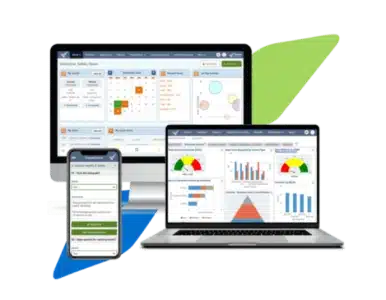
Capture evidence in real time. Digital smart forms cut rework significantly. Many teams use an EHS management platform to log findings, attach photos, and flag issues from a mobile device on the floor.
After the Audit
Every finding must become a corrective action built on four elements:
- What must change
- Who owns the fix
- When it’s due
- What evidence proves it’s done
Rank findings through your risk matrix by severity and likelihood. Address life-critical control gaps like fall protection, LOTO, and energy isolation before moving to administrative items.
Use prior findings to update safety policies, refresh training content, and adjust your checklist before the next cycle begins.
Metrics for Closure Verification
Verification requires someone other than the action owner to confirm the control is in place and working. Three metrics tell you whether your audit program is improving outcomes:
- Corrective action closure rate (percentage closed on time)
- Overdue actions (count and age)
- Repeat findings (the same issue surfacing across cycles)
When a finding exposes a training gap, tie the corrective action directly to a training assignment and track completion. Vector LMS integrates with its EHS management platform, triggering and monitoring that assignment in the same system. This ensures nothing falls through the cracks.
Package your results for leadership in a concise report with:
- Total findings by severity
- On-time closure rate
- Trends compared to prior cycles
- Cost avoidance tied to closed actions
This is how you defend the program’s value and secure resources for the next round.