







March 6, 2024 35:42 min read

How to Build a Robust Maintenance Training Program
Industry:
Solution:
With an estimated 3.4 million manufacturing jobs open, industrial manufacturers today no longer have the luxury of loose, ad-hoc training programs. Empowering maintenance techs to develop the skills needed to work successfully and safely in manufacturing is vital.

Presenter Michael Ojdana | Vector Solutions Chief Learning Officer
Michael leads the Content Team at Vector and has a rich background in all aspects of content development, including building state-of-the-art 3D animated courses, localizing content for many languages, and improving process workflows to smoothly bring courses from concept to market. In his role, Michael strives to guide his team to create engaging, innovative courses that meet customer needs, positively change behaviors, and help make employees safer.
Maintenance Training Program Webinar Learning Objectives
We’ll discuss the power of building a strong maintenance training program through onboarding and ongoing training, and courses like Shaft Alignment and Electrical Maintenance, to equip your teams for success.
You’ll learn the tools, training, and tips to:
- Build skills for current and new employees to address the skilled worker shortage
- Provide effective onboarding training and continuous skill development to reduce turnover
- Familiarize newly hired maintenance techs with their responsibilities, machinery, and equipment; empower them to become confident in the tasks they’re assigned; and perform tasks in a timely and safe manner
- Boost efficiency and time-to-competency with training
Also, you’ll get a preview of our Learning Path and our Competency Assessment tools that identifying skills and knowledge gaps faster and provide a clear roadmap for skills development.
Gamified Electrical Maintenance Training
Vector Solutions' Electrical Maintenance Escape Room course challenges learners to troubleshoot and resolve electrical problems within a set time, testing their knowledge of electrical theory.
Preview the course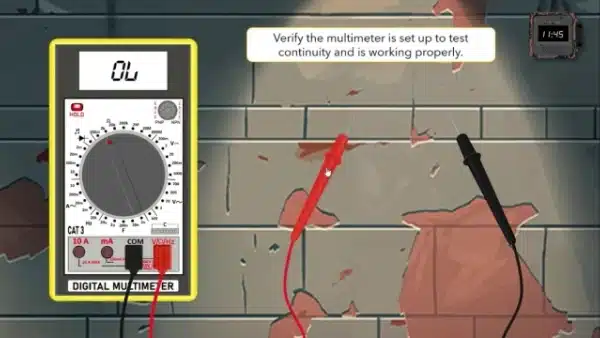
Video Transcript
Hello, and welcome to our Vector Solutions webinar, “How to Build a Robust Maintenance Training Program.” I’m Jordan Klein with Vector Solutions, and I will be serving as your webinar organizer today. We’re very excited to welcome you and provide this opportunity to learn the power of building a strong maintenance training program through onboarding, ongoing training, and more to equip your team for success.
About Vector Solutions
We are Vector Solutions, and we aim to make your organization safer, smarter, and better. If you’re not familiar with us, we make learning management systems, online training courses, and accredited continuing education for many industries. We also offer a risk intelligence and communication platform, as well as EHS and SDS management software.
Meet the Speakers
And now it’s my pleasure to introduce our speakers for today. Michael Ojdana, our Chief Learning Officer, and Annie Akehurst, our Director of Product Marketing for Commercial here at Vector Solutions. Thank you both for joining us today, and I’ll let you take it from here.
Michael Ojdana, Chief Learning Officer
Thanks, Jordan. Happy to be here. Hey everyone, Michael Ojdana. I am the Chief Learning Officer at Vector Solutions. I have a deep background and expertise in computer animation, as well as about thirteen years of experience creating industrial e-learning content with Convergence Training and Vector Solutions. As the Chief Learning Officer, I drive the strategic direction of our content, as well as lead our content management, accreditations, learning experience design, development, and delivery teams across all of our commercial, education, and public sectors. Using 3D animation to visualize how things work in industrial training is a huge passion of mine—has been for a long time—and I’m excited to be here to present to you today. So, Annie?
Annie Akehurst, Director of Product Marketing
Yeah, thanks, Michael. Hello, everyone. Happy to be here today. As Jordan said, I’m the Director of Product Marketing here at Vector. I have a little over fifteen years of experience in organizational communication and marketing. I’ve done a lot of work with organizations related to their strategic planning, facilitating workshops, and similar activities to help them, as Jordan said, become safer, smarter, and better, and to really look at the short-term and long-term objectives that they need to put in place to help ensure future success.
Webinar Overview
We’re going to discuss the role of learning paths in facilitating onboarding and improving employee retention. We’ll overview some of Vector’s latest industrial courses and the value and knowledge that they’re bringing to employees. Finally, we’re going to highlight some industry-specific training and how it can enhance operational efficiencies. So let’s go on to the next slide.
The Need for Maintenance Training
We want to really look at why there is this critical need for employee maintenance training. If we take a step back and look at it, of course, we acknowledge it’s totally crucial, but we know that there are also challenges going on that really elevate the need even further for effective maintenance training. All of these headlines really underscore many of the challenges that you’re perhaps facing every day, and how you need to rely on maintenance employees to hopefully help overcome some of these challenges.
So, first of all, experiencing downtime and production delays. This is, of course, not just a headache; it is a full-blown migraine. When there are equipment failures or production delays, this costs dollars. And an underlying issue is that many maintenance employees just don’t have the know-how to deal with the issues effectively. So, we’re going to dig into how to close some of those gaps, which brings us to another pain point, the skills gap.
Know that employees may have inadequate knowledge of maintenance job roles and responsibilities. It’s really difficult to get new employees in the door. And many times, once they are through, there are some serious skills gaps on the maintenance teams. It’s like trying to fix a leaky pipe with a roll of duct tape. It’s just not going to cut it. So employees need to know the right skills to tackle the increasingly complex maintenance tasks that are thrown their way.
Third, we know there’s a struggle to even find that skilled employee. If this is what you’re experiencing, you are not alone. There is a consistent battle to find the right talent. In fact, I read an article, National Association of Manufacturers, that they are reporting more than 4.6 million jobs are expected to be created in that sector over the next decade, but only about 2.5 million of those jobs could even get filled. The rest would remain unfilled due to the skills gap.
Then, the final challenge that’s driving this need for an enhanced maintenance training program is employee turnover due to a lack of career development. No employee wants to feel stuck at a job or feel like they’re not really getting the growth and career opportunities that they crave. So, creating a solid training program can keep them around. They experience firsthand the investment that an organization is making into their learning and development.
Components of a Learning Journey
“Learners may enter the workplace at different stages in their learning journey. A well-designed program meets them where they are.”
So, we’ll go ahead and move on. We wanna look a little bit first at the components of a learning journey. We acknowledge that everyone’s workplace is a bit different, and training programs are at different stages. So, some may be trying just to implement and formalize for the first time, while others have evolved and are looking to strengthen further. However, one aspect remains the same regardless of the status of the training program. Learners may enter the workplace at different stages in their learning journey. And we’re going to overview this journey today and then dig into a couple of aspects before I turn this over to Michael.
Pre-Learning Component
I’m gonna focus really on this pre-learning component. This is before employees even step through the door; there is an opportunity to begin to lay the groundwork for learning. You can start out with competency assessments. You may hear this referred to as knowledge checks. And again, we’re gonna dig into this deeper in the next few slides.
Once those knowledge assessments have taken place, you can also craft personalized learning that really sets the stage for the journey development and employee needs, meeting their needs from day one. So, if we go ahead and move on, we’re gonna look specifically at competency assessment first. And remember, this is part of that pre-learning piece of the journey.
Competency Assessments
“Competency assessments are the secret sauce for understanding how well each team member knows their stuff.”
The pre-learning assessment and creating a training approach that helps the employee close the skills gap and quickly reach proficiency in their job roles are just essential in a team member’s growth and success. We often refer to competency assessments as a knowledge check. This is really a tool that’s almost like the secret sauce for understanding how well each team member knows their stuff when it comes to the responsibilities that they need to achieve proficiency in their jobs. So, you can almost think of it as if they’re being assessed by a personal trainer to identify where improvements are needed to help that employee excel in their role.
For Vector clients, competency assessment is actually an integrated tool within our learning management system, Vector LMS. So, the assessment really connects to the training directly to enable the seamless uncovering of what skills gaps may be in place and then assigning the training to support the employee and the organization in meeting their goals. It can save a ton of time by going through a competency assessment because the training can be directly assigned to where the employee most needs to be met. So, you don’t need to assign training where they’re already proficient, for example. It can really be honed in to address their skills gap or upskilling needs.
On the next slide, there are a couple of different types of competency assessments. So, let’s go ahead and break that down. First of all, it can be used to evaluate job applicants. So, imagine you’re sitting at your office, you’re sifting through some resumes, some online job applications, hoping to uncover your next maintenance tech superstar. A prescreening evaluation, like a competency assessment, can really provide that sneak peek into candidates right off the bat. Essentially, you can use questions that you’ve tailored for your organization or questions that align with specific training courses that the employee may need. And you can learn who’s already got the basics down or who might need a bit more TLC in a certain area.
Oftentimes, the supervisors will bring in their own organization-specific questions as well into those knowledge checks, and they really use the results to figure out where the training is needed to support the techs so they can hit the ground running in their new role.
The second kind of assessment is a pre-training assessment. Some of you may already have existing employees that you want to upskill or transition into a management position. So, prior to just assigning a whole slew of courses or advanced maintenance training courses, the pre-training assessment really shows where each tech stands in terms of knowledge. So, when you’re armed with that individual intel, you can really tailor the training program to be spot on for the tech.
And the third is a post-training assessment. So, you did the pre-assessment, knowledge gaps were discovered, training was assigned, and then a post-training assessment can go back and assess that role-specific knowledge again and just validate how effective the training program was in filling those gaps. You may discover that extra support is still needed, and that’s fine. Again, this serves as almost like a safety net. It just catches areas where the tech may need a little extra support or reinforcement. And again, this is all part of that pre-learning journey, and it really leads right into you’ve assessed their knowledge, and now you can begin to create some learning paths.
Competency Assessment Tool for Industrial Skills
Vector Solutions’ Competency Assessment is a powerful tool to identify skills gaps and easily assign follow-up training to achieve your business’ learning goals.
Explore Competency Assessments
Learning Paths Explained
“A learning path is an employee’s personalized roadmap for skills development.”
So, what exactly do I mean by a learning path? On the next slide, you’ll see its dictionary definition. A learning path is basically an employee’s personalized roadmap for skills development. It guides them to quickly reach proficiency and the skills needed for their roles.
So, again, think back to that competency assessment for a second. You conduct the skills assessment. You know that it’s a new electrical technician you just hired. You discover that there are some gaps in knowledge as it relates to troubleshooting systems and circuits, and they lack some knowledge in reading electrical diagrams. So, you can also see that on the other side, they’re pretty proficient in electrical safety or how to use testing equipment. So, a learning path can really be created to specifically address those knowledge gaps. You could assign training for troubleshooting, for reading diagrams, and it provides that kind of targeted learning journey to address the specific requirements and learning needs. It’s all like getting the right training to the right employee at the right time.
Benefits of Pre-Learning Activities
“A learning path specific to an employee can really boost that confidence in assigning courses as well.”
There is also a lot of value in pre-learning activities as well. So, on the next slide, we kind of go through some of those pre-learning benefits. So, first of all, of course, you’re building job skills. Workers may lack the desired job skill experience. A learning path really creates that course journey that addresses the training that’s needed and closes that gap. Next, if we aren’t looking at individual training needs, we’re just throwing everything at them. So, a learning path specific to an employee can really boost that confidence in assigning courses as well. Again, it gets them the training they need to quickly become proficient and ultimately help your organization faster.
Third, it can create meaningful training for role-based skills. So, for an employee, it’s all about that kind of personalization. They can see firsthand that the company is investing in their professional growth from day one. And of course, it helps you with effective onboarding as well, putting into place knowledge assessment, learning paths, and it really shows that a good onboarding experience can immediately go into place. And actually, studies show that when an employee has a good onboarding experience, they are more willing to go above and beyond for the new company. So, when the learning path provides that straightforward approach to training, the employee knows their role, they can quickly address their training needs and become effective more quickly. And then finally, of course, we all want to impact employee retention and see improvements there. So, when a company is really taking into account the employees’ ability to meet their roles and responsibilities and develop their careers, that training plan can really guide the employees through continuous upskilling and even create opportunities for sustained career advancement.
I mentioned on the next slide that a learning path for Vector is integrated in our LMS. So here you kind of have a glimpse of what that looks like. Essentially, a competency assessment can be assigned for a very specific maintenance or operator job role. You can determine what gaps exist and then assign the training to address those gaps. With the learning path. So, for example, going back to that electrical technician example, you could assign online courses addressing tools, diagrams, circuits, and motors.
Then, on the next slide, you’ll see how there are also some people who choose to use a paper version of this. So, we have an Excel version here, and actually, it can be downloaded straight from your GoToWebinar panel. This is really just to kind of show you that visual of what a learning path could look like and what kind of tool it is. So, it basically gives you the ability to look across eight different operator and maintenance job roles and then quickly see the training and skills that are needed for those roles. And if there are gaps determined, you could quickly assign training to address those needs and get that employee proficient in their role.
Building and Implementing a Learning Path
“A combination of onboarding training, refresher content, just-in-time training, and coaching creates a robust learning path.”
Awesome. Thanks, Annie. Very informative stuff so far on those competence assessments and learning path.
What Should Be Included in a Learning Path?
So, now that you understand what your team knows and have a learning path framework to fill gaps and help them advance, what should be included in that learning path? Likely, it’s going to be a combination of onboarding training, refresher content, just-in-time training, and probably coaching as well. This industrial training content should help close skills gaps, which will result in reducing hiring costs and getting employees more fully productive and efficient. It will maximize production with less downtime and improved operational efficiency, and finally ensure that employees are trained similarly to the best practices used across all your sites.
Industrial Maintenance Learning Paths
Learning paths are customizable training plans for employees that can help fill knowledge gaps, onboard, and upskill employees. Learn about our powerful solution today.
Explore Learning Paths
E-learning increases retention rates and helps employees apply skills immediately.
The Value of Online Training
Several of these can be filled with online training. So, why don’t we start with why online training? Well, from a very high level, e-learning increases retention rates from 8–10% to as much as 60%. If you want your team to not only take training but also remember it in the future, online training is a great option here. It also helps improve productivity, as every dollar invested in online training results in a thirty-dollar increase in productivity. Employees are able to take the training, start their work back up faster, and apply skills immediately.
It also significantly reduces training costs. 85% of every dollar spent on classroom training is spent delivering it, and you likely have to continue delivering it over and over again to onboard and continually train. So, now that we know why online training can have a return on investment, let’s dive into how it should be built in order to maximize that retention.
Maximizing Retention: How People Learn
Information reaches our brain from our senses in different proportions. Hearing is about 11%, and sight is 83%. So, while training should appeal to as many senses as possible, because sight is so important, it must also include high-quality visuals that show and teach what is being discussed, not just tell or lecture. It’s also reinforced in this slide. The effectiveness of training not only includes receiving information but also being able to recall information. After two weeks, on average, only a percentage of what we learned can be remembered based on how it was learned.
Learners recall about 10% after reading. So, ideally, we’re doing more than just giving learners a wall of text. They recall about 50% of content that uses a combination of seeing and hearing, and then almost 90% in doing. As e-learning providers, we’re doing the seeing and hearing at the very least, as well as pushing towards application and doing. The rest also needs to be supplemented with on-the-job training. So, our philosophy is to design our content for maximum retention. Most of what people learn in online training is derived from what they see and hear. We’re dedicated to creating the highest quality audiovisual training content available that reinforces objectives with actions, so you can be sure that your employees are actually learning and retaining their training and not falling asleep. Remember that bad visual design makes for bad training.
Using 3D Animation in Industrial Training
“With 3D, we can illustrate points without risking people’s safety or shutting down expensive equipment.”
In order to do this, we use 3D animation to show rather than just tell. This is important because we get 83% of what we learned from our sense of sight versus the rest of the senses. With 3D, we have the ability to show very small objects like chemical reactions and mold, very large facilities like buildings, sites, large machines, very fast equipment like high-speed manufacturing lines, and areas you can’t normally see like equipment behind guarding walls and floors. So, we can illustrate points without risking people’s safety using 3D characters or shutting down expensive equipment. Given its proven efficacy, we can anticipate that the use of 3D technology to demonstrate more minute technical aspects of industrial training will continue to grow.
Our strategy is to incorporate it into all of our courses and also improve the amount of movement and action in those courses, as well, versus just static imagery. And this allows us to take old, outdated training that just shows static imagery outside of equipment and replace it with clear graphics and internal cutaways that will wow your learners.
Core Content for Learning Paths
“Baseline core industrial content allows anyone to be better prepared for onboarding and training.”
A learning path should start with baseline core industrial content that allows anyone walking off the street to be better prepared for onboarding and getting trained up quickly. Customers like DuPont count on our courses to teach a core level of consistent knowledge, saying that it’s difficult to train someone how to maintain a pump when you can’t look inside one to see how it operates. We have high-quality libraries for core industrial skills, electrical maintenance, mechanical maintenance, instrumentation and control, and also continuous improvement, including lean manufacturing at Six Sigma.
Investments in New and Updated Content
Now I’d just like to take a deeper dive into the kind of investments that we’ve been making and increasing the amount of new and updated content our customers are getting every year. In 2021, we built around 6,000 minutes; 2022, 11,500; and in 2023 over 13,000 minutes of content with even more coming in 2024.
Specifically, we’ve been focused on releasing new versions of our highly utilized industrial courses to increase engagement. Each of these series was reviewed, and new versions were written as a group so that they are not redundant and flow together to present all the necessary material on the topic.
New Releases and Upcoming Courses
In the past two years, we’ve released new pumps, plant science, pipes, bearings, and seals courses. In 2023, they released a new compressor series, new instrumentation and control courses, new valve series, new operator responsibilities, and a new rigging series as well. In 2024, we’ll have already released our new shaft alignment courses, and we’ll be turning our attention to a complete overhaul of our electrical maintenance library throughout the rest of the year. So, let’s take a look at those.
Course Development Principles
All of the courses I’m going to talk about today incorporate the principles already mentioned. We use high-quality 2D and 3D visuals to show how things work. We show the components inside pumps and valves so you can see how they operate, but I want to talk about some things we take into account when we develop our courses.
Shaft Alignment Series Spotlight
With our Shaft alignment series, for instance, we started the process with the goal of creating comprehensive training that builds foundational knowledge and facilitates on-the-job analysis and problem solving. We want everyone to have a certain understanding of what Shaft alignment is, why it’s important, and how it’s performed. Then, with this knowledge, you are able to know how to preemptively check for shaft alignment issues and know when something may be wrong. These are the issues one of our customers mentioned previously that DuPont was looking to address. Their current training was primarily written procedures; their employees didn’t have the fundamental knowledge or experience to fully understand those procedures. The operators and technicians agreed that starting with online training was a big help. By implementing our training, they were able to achieve consistent skill development plant-wide with minimal downtime for training.
Shaft Alignment – Tools and Methods Course
Explore our Shaft Alignment - Tools and Methods course and learn more about delivering Industrial Maintenance - Mechanical digital training for your organization.
Shaft Alignment Course
Importance of Shaft Alignment Training
This training is extremely important because when shafts are improperly aligned, it can lead to issues like broken bearings, vibration, broken seals, foundation, bolt failure, broken or cracked shafts, and more. According to research carried out by maintenance and reliability professionals on the most common causes of machine failures, shaft misalignment was the number one cause, causing 32% of all machine failures. So, let’s now take a look at what highlights some of the content from these courses.
2024: Focus on Electrical Maintenance
Very cool stuff there. So now, 2024 is also the year of electrical maintenance for us. We are committing to building and releasing roughly 25 courses into our electrical maintenance library, all using this combination of 2D and 3D graphics to ensure learners have the groundwork of knowledge to stay safe and decrease equipment downtime.
Electrical Maintenance Library Overview
Over one hundred courses, our electrical maintenance library is designed to improve electrical knowledge and skills in installing and maintaining common electrical components at your facility. It includes topics such as changes to the 2023 NEC code, AC and DC circuits and motors, electrical theory, wiring, fuses, grounding, relays, and electrical diagrams. And we just released new courses on system grounding, troubleshooting electrical circuits, electrical equipment such as AC and DC motors, and DC brush motor maintenance, and have upcoming content coming on electrical motor terminology and standards, and introduction to the NEC, equipment grounding, electric motor theory and operation, as well as Ohm’s law. It’s all the content that you need to get your team onboarded quickly before in-person training and refresh learners on the knowledge that they need on a yearly basis. Also, our troubleshooting courses can help when a problem occurs and your team needs help on how to do something at the time of need.
So, let’s check out another video example here. Again, really cool stuff there.
Looking Ahead: The Future of Training
“Expect to see more interactivity in all of our courses with increased application of real-world scenarios.”
And so, looking to the future now, your goal is to supply your workers with the knowledge and confidence to do a great job. Many of our courses help with the knowledge aspect, but confidence typically comes with practice and experience. So, while you are exploring ways to add more practice and application, we are too. One specific example in practice is our high-voltage switching simulator. We built using a real-time gaming engine to work through and practice a dangerous process without needing to put anyone in danger. Expect to see more interactivity in all of our courses with increased application of real-world scenarios. Our next step here is our ability to add video-based branching scenarios in our courses, so learners can create troubleshooting courses that take them down different paths depending on their different selections. This type of content allows users to apply knowledge, which is extremely important to their development. There’s much more in the works as well, but we’ll leave it there for now.
Key Takeaways
> “Fill your learning path with courses that close skill gaps, maximize production, and drive consistency.”
In review, you should fill your learning path with courses that close skill gaps, maximize production, and drive consistency. Our training provides in-depth, industry-specific knowledge and job skills developed by experts who know the industrial workforce. High-quality courses with 3D animations provide insights into intricate processes and reveal what the eye can’t see, so employees are better able to understand the equipment they are working with. Additionally, our courses are deeply relevant to specific job roles, providing the knowledge you need to do your job correctly and safely while enhancing employee competency.
Q&A Session
Thank you so much for taking the time today to check out what we’re working on and how it can help you build a robust maintenance training program. We’ll kick it back over to Jordan now to do some Q&A.
All right, thanks so much, Michael and Annie, for your insights. So, like Michael said, we’re just going to take some questions from our audience here. So, it looks like we have one question asking if one of their field supervisors wanted to know if it was possible to use training models as a learning tool during group safety and training meetings.
Health and Safety Micro Learning Courses
Yeah, go ahead, Katie. Oh, yeah. I provided a private chat with Michael, and I’m definitely interested in your take on it. I thought one suggestion for the supervisor would be health and safety micro learning courses. It’d be really useful in the field because it’s just quick refresher training, five minutes in length, that’s focused on retention, aligns with OSHA best practices, and other safety standards. But what are your thoughts on that one, too, Michael?
I think you hit the nail on the head there. I was really thinking about our safety case studies as well, which go beyond just the learning to refresher training that provides a really emotional impact as well, and really drives home points on why it’s important to be safe every day. But again, any of our courses can be pulled up in a classroom setting and shared with a broad audience as well.
Awesome. So, we got a lot of great questions coming here. We have another question.
“Is all of your content available in Spanish in addition to English?
Yes, all of our courses are currently available in Spanish and English. We use machine translations for 44 different languages, but I’ve also done human translations for a number of languages across about 16 languages as well. So, we have a lot of translation options there.
Awesome. Thanks, Michael. And then another question here.
“Does Vector partner with professional organizations such as ISA and the International Society of Automation for their training model content?”
From my understanding, we do not partner with them. We do have quite a few accreditations that we submit our courses to, and then they are approved for continuing education. I would need to dive deeper into whether ISA is one of those organizations that we have accredited. Jordan, maybe we can reach out to the person who asked that question after this, so we can see whether we have approved any of our courses for them. We don’t partner necessarily with them, though.
Yep, absolutely. We can totally follow up.
And another question here.
“Is there any plan to include VR in training course offerings?”
As I mentioned on the last slide, we are really focused on currently providing more engaging and interactive online course taking, so at your computer, that high voltage switching simulator that I mentioned, it has that kind of look and feel like a VR environment, but it can be fully taken as a SCORM course and to find out within your LMS, and then we’re also working on including more of those interactive pieces within our standard courses as well.
Awesome. And then we had another attendee ask.
“Where could I find the learning path template that Annie shared?”
Yeah, great. I’m glad somebody asked about that. So if you look in your GoToWebinar panel, you should see an area labeled handouts, and it actually can be downloaded right from the GoToWebinar panel.
Okay. And then it looks like we have a final question here.
“How do we get access to the industrial training library?”
Yeah, we can definitely follow up on that following the webinar and discuss how you get access.
Perfect. And I think I actually spoke too soon on a final question. Another question here.
“How can you get your older techs on board with online training?”
I think, yeah, I could jump. Yeah, I’ll go first. So, I would say first and foremost, get them involved, be really involved in that kind of selection and procurement to ensure that they have that buy-in and that the training not only is relevant to new hires but also provides them with more advanced training and opportunities for professional growth as well. I think if they help with that process, they’ll be much more likely to commit to taking those courses as well. I would also say to ensure that the system you’re using and the courses you choose to use are easy to use. This is applicable to all learners. Then finally if you have the skills on your teams to build your own online training, again get them involved with subject matter experts who know the most about your facility, how your facility operates and encourage them to pass that information down to other employees. And for them, there’s also nothing quite like being the star of your own e-learning course as well. So it would be cool to have them within those. So, I would say get them involved. That’s my recommendation.
Annie, did you have another?
Yeah, no, I love that suggestion. I like the mentorship aspect. The other tie to learning paths and competency assessment would be that you could even assess leadership skills. So you could kind of pinpoint, like, there are one or two employees that you’d like to see elevated into a more mentorship or managerial role. So you could assess those competencies as well. It doesn’t need to be just technical skills-based. It could be soft skills. Figure out if there are any learning needs related to that, upskill, and put them on the right path to really drive that mentorship program forward as well.
Industrial Skills Training Library
I was also thinking, Jordan, back to your question about the industrial training library, too. I’ll quickly pull a link here online, just to share with everyone. It’s a nice web page that gives an overview of the available industrial skills training.
Great, because I think that would help Annie, because we had another question come in, which I think could help as well.
“Is your content subscription based on where content is maintained automatically, or a one-time purchase?”
Yeah. All of our libraries are typically subscription-based. And so you’re typically paying a yearly fee per user, and we then add that content to that library all the time with new content and update that content on a regular basis as well. Hopefully, that answers that question.
And then it looks like we had another question come in on the assessment.
“Is the assessment feature included when you buy the industrial training packages?”
It is included with the LMS itself. Learning paths are also integrated within the LMS, and those are included for both some specific libraries and the LMS. And that’s at no charge. It was a great question.
Thanks, everyone.
Closing Remarks
Absolutely. Thank you again, Michael and Annie, just for the lively and educational discussion. Thank you to our attendees for joining us and engaging with us. And we know that everyone’s time is valuable, and we appreciate that you spent about the last hour with us to learn strategies for building a robust maintenance training program.
And as mentioned at the beginning of the webinar, this webinar recording will be sent to you along with the slides and resources. I hope everyone has a great day. Thank you again for joining us today.