September 25, 2026 4 min read
Who Is Responsible for Conducting a Hazard Assessment?
Industry:
Solution:
A safety manager owns the program, but they can’t personally sign every JSA on the floor. When no one has mapped out who documents what, compliance gaps grow in the space between roles.
OSHA places accountability squarely on the employer, but execution gets delegated every day to safety managers, supervisors, and outside consultants who identify, assess, document, and certify hazards in the operation. That gap between who’s ultimately accountable and who’s actually walking the floor is where most compliance exposure lives.
Responsibility splits into three layers: accountability, which the employer holds and can never transfer; execution, which is delegated down a defined chain; and participation, which extends to every worker who reports hazards and follows controls. Mapping that chain, from employer to competent person to supervisor, is what closes audit exposure before an inspector finds it.
Main Takeaways
- Responsibility splits into three layers: accountability, execution, and participation. The employer holds accountability and cannot transfer it, execution is delegated down a defined chain, and participation extends to every worker who reports hazards and follows controls.
- Delegation moves the work, not the liability. Whether the assessment goes to an internal safety manager or an outside consultant, the employer’s name stays on the written certification, and the employer faces any citation.
- A competent person must clear two bars under 29 CFR 1926.32(f): the ability to identify existing and predictable hazards, and the authority to take prompt corrective action. Spotting a hazard without the power to stop work does not qualify.
Hazard assessment identifies what could cause injury; risk assessment evaluates how likely and how severe it would be. Hazard assessment is the OSHA-mandated starting point. - Assessments are not one-time events. New equipment, process changes, incidents, staffing changes, and regulatory updates all trigger reassessment, and every assessment needs a written certification covering four specific elements under 29 CFR 1910.132(d)(2).
A Guide to Job Hazard Analysis
Break down tasks, identify hazards, and document controls with a repeatable JHA process.
Download the Guide
The Full Responsibility Chain: Who Identifies, Assesses, and Documents Hazards
Responsibility here isn’t one thing. It’s three: accountability, execution, and participation. Everyone from the employer to the front-line worker has a responsibility in identifying and assessing hazards, but each role carries a different duty, authority level, and OSHA basis. In practice, that means who is responsible for conducting a hazard assessment and who has the responsibility in identifying and assessing hazards aren’t always the same question. The first asks who performs the work; the second asks who is on the hook for making sure it happens at all.
Hazard Assessment vs. Risk Assessment
A hazard assessment is a systematic evaluation of the workplace to identify conditions or practices that could cause injury or illness, required under OSHA standards such as 29 CFR 1910.132(d)(1). A risk assessment is the follow-on step: it evaluates the likelihood and severity of harm from each identified hazard and prioritizes controls accordingly. Responsibility for both typically falls on the same chain of roles, but hazard assessment is the OSHA-mandated starting point; risk assessment layers on probability and consequence analysis on top of it. A qualified person, someone who possesses a recognized degree, certificate, or professional standing, or who has demonstrated knowledge and skill through experience, per 29 CFR 1926.32(l), brings the credentials to do this work. A competent person, covered in more detail below, must also carry corrective authority on top of that expertise.
The table below maps each role’s specific duty, the authority it carries, and the OSHA basis, so you can assign ownership inside your own organization. Who is responsible for evaluating chemical hazards follows this same employer-accountability model, with execution typically assigned to the safety manager, industrial hygienist, or similarly qualified person who manages SDS access and chemical inventories.
| Role | Specific Duty | Authority Level | OSHA Basis |
| Employer | Holds ultimate legal accountability; funds assessments; ensures written certification | Full; cannot be transferred | 29 CFR 1910.132(d) |
| Safety Manager / EHS Lead | Plans and executes assessments; selects methods; maintains records and SDS programs | Delegated by employer; operational authority | Employer designation + applicable standards |
| Supervisor | Enforces controls on the floor; reports new hazards; verifies worker compliance | Site-level corrective authority | Employer delegation; competent person where designated |
| Worker | Participates in walkthroughs; reports hazards; follows controls and PPE requirements | Reporting duty; no sign-off authority | OSHA Act Sec. 5(b); training standards |
| External Consultant / IH | Provides specialized evaluation (e.g., chemical exposure monitoring, ergonomic analysis) | Advisory; no employer liability transfer | Contractual; employer retains accountability |
Accountability stays with the employer regardless of how many roles participate in the process. Execution spreads across the chain, but the employer’s name goes on the written certification.
Authority level also shapes which controls get selected. Engineering and administrative controls typically require safety-manager-or-above authority and budget approval; PPE selection is more often delegated to the supervisor or worker level. The responsibility chain doesn’t just decide who assesses. It decides who’s positioned to fix what they find. In chemical-heavy settings, the employer typically assigns chemical hazard evaluation to a safety manager or industrial hygienist who manages SDS and chemical management workflows. But the employer remains the accountable party under HazCom (29 CFR 1910.1200). Hazard Communication ranked No. 2 among OSHA’s most frequently cited standards in FY 2025, underscoring persistent gaps in this area.
Each role in the chain carries a distinct duty and authority level, but the table only works as an accountability tool when the organization also defines how execution moves from employer to assessor, and what qualifies that assessor to act. Because execution spreads across multiple roles, the question shifts from who participates to what qualifies someone to carry out the assessment on the employer’s behalf, and what the employer still owns regardless.
Delegation, the Competent Person Standard, and What Employers Cannot Transfer
Employers can delegate the execution of hazard assessments to internal staff or outside specialists, but OSHA’s competent person standard sets a specific bar for who qualifies, and delegation never transfers the employer’s ultimate legal liability. This is where the distinction from the previous section matters most: who has the responsibility in identifying and assessing hazards is the employer, full stop, even when who is responsible for conducting a hazard assessment on any given day is a delegated safety manager, supervisor, or outside consultant.
What OSHA’s Competent Person Standard Requires
Under 29 CFR 1926.32(f), a competent person must be capable of identifying existing and predictable hazards in the surroundings and have authorization to take prompt corrective measures to eliminate them. Not one or the other, but both hazard-identification ability and corrective authority. A person who can spot hazards but lacks the power to stop work, order controls, or remove employees from danger does not meet the standard. A site supervisor who can halt a task when fall protection is missing meets both qualifications. A junior safety intern who flags the same hazard in a report, but has to wait for management approval before anything changes, does not.
Delegation transfers day-to-day execution, including walkthroughs, documentation, hazard identification, and control recommendations. It does not transfer legal accountability. If the assessment is incomplete, outdated, or uncertified, the employer, not the delegated person, faces the citation. OSHA penalties for serious violations can reach $16,550 per instance; willful or repeat violations up to $165,514. This applies equally whether the employer delegates to an internal safety manager or contracts an external industrial hygienist or consultant: the employer’s name remains on the certification either way.
To delegate effectively:
- Confirm the designee meets the competent person standard for the relevant hazard type.
- Document the delegation in writing.
- Verify the designee has the resources and authority to act.
- Maintain oversight through periodic review of completed assessments. A job hazard analysis process can structure this review by breaking each task down into its component hazard-and-control steps.
Organizations that manage hazard reporting, JSA, and inspections through Vector EHS Management can track delegation, flag overdue assessments, and maintain the audit trail that proves the chain of responsibility was followed. Delegation is how hazard assessments actually get done at scale, but it only holds up under scrutiny when the person doing the work has both the expertise and the authority OSHA requires, and the employer can prove it. Even a well-delegated assessment loses its value if it isn’t conducted at the right time or documented in a way that survives an audit.
Prove the Responsibility Chain Was Followed
Assign hazard reporting and inspections by role, track who completed what, and keep certifications retrievable.
Explore Hazard Management
When Reassessment Is Required and How to Document It
A hazard assessment is not a one-time event. OSHA expects reassessment whenever workplace conditions change, and every assessment must be backed by a written certification that meets specific content requirements. Knowing who is responsible for conducting a hazard assessment at the outset only covers half the obligation; the other half is knowing when to run it again.
Reassessment Triggers
Conduct an initial hazard assessment before employees begin work in any area or task where hazards may be present. Beyond that baseline, OSHA-grounded triggers for reassessment include:
- New equipment, materials, or chemicals introduced to the workplace
- Process or workflow changes that alter exposure profiles
- An incident, injury, or near miss indicating uncontrolled hazards
- Staffing changes that put workers in unfamiliar roles or environments
- Regulatory updates, for example OSHA’s 2024 HazCom rule, whose compliance dates now run from May 2026 (chemical manufacturers/distributors, substances) through May 2028 (employers, mixtures) after a January 2026 extension
- Findings from routine inspections or audits that reveal previously unidentified hazards
Documentation and Written Certification
Under 29 CFR 1910.132(d)(2), the employer must verify that the hazard assessment was performed through a written certification that includes four elements: identification of the workplace evaluated, the name of the person who certified the assessment, the date(s) of the assessment, and a statement that the document is a certification of hazard assessment. The person who conducts the assessment and the person who certifies it can be different people. For example, a supervisor performs the walkthrough while the safety director signs off on the certification.
Complete, current documentation is the employer’s primary defense during an OSHA inspection or informal conference. Missing or outdated certifications are a straightforward citation. The financial stakes back this up: work injuries cost an estimated $181.4 billion in 2024, with the average medically consulted injury costing $48,000. Documented assessments with timely corrective actions are a direct lever for reducing both injury frequency and cost exposure. If your team has a hazard assessment PDF to keep on hand during a walkthrough, that needs points to the same fix as audit readiness generally: consistent formatting. Every record should carry the date, location, assessor, hazards identified, controls selected, and certification sign-off, whether it lives as a printed PDF on a clipboard or inside a digital system.
The assessment itself identifies hazards, but the written certification is what proves it happened. Without both the right timing and the right documentation, even a thorough assessment leaves the employer exposed.
Put Your Hazard Assessment Responsibility Chain into Action with Vector Solutions
You now have a framework for assigning, delegating, and documenting hazard assessment responsibility across your operation, from employer accountability down to the competent person who walks the floor and the certification that proves it happened.
Vector EHS helps safety teams execute that responsibility chain at scale, connecting hazard reporting, JSA, inspections, and audit-ready documentation in one centralized platform. Every assessment is tracked, every delegated role is documented, and every reassessment trigger generates a corrective action you can follow from identification to close-out. You can prove responsibility was assigned and carried through when the audit comes.
See Vector EHS Management Software in Action
Hazard reporting, job safety analysis, and audit-ready documentation in one place, with a record of who was assigned what.
Request a Demo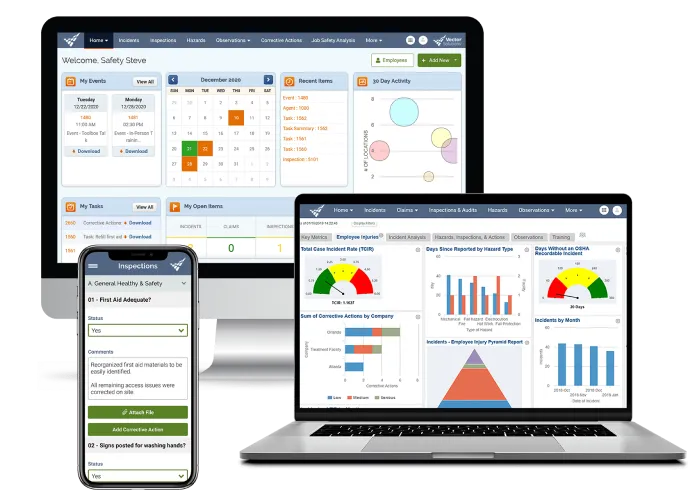
FAQs About Who Is Responsible for Conducting a Hazard Assessment
Who Is Responsible for Conducting a Risk Assessment?
The employer holds legal responsibility for both hazard assessment and risk assessment under OSHA, though risk assessment adds a probability-and-severity evaluation step after hazards are identified. In practice, the same safety manager or competent person who conducts the hazard assessment typically performs the risk assessment, often using a risk matrix to prioritize controls.
Can an Employer Hire an Outside Consultant to Conduct the Hazard Assessment and Transfer Liability?
No. An employer can hire an industrial hygienist, safety consultant, or other qualified specialist to execute the hazard assessment, but OSHA does not allow the employer to transfer ultimate legal accountability. The employer’s name must appear on the written certification, and the employer remains liable for any gaps, even if the consultant performed the work.
What Happens if the Person Who Conducted the Hazard Assessment Leaves the Company Before Reassessment Is Due?
The employer must designate a new competent person to perform the reassessment and update the written certification with the new assessor’s name and the reassessment date. The previous assessment remains valid until a reassessment trigger occurs, but the employer should document the change in delegation and verify the new designee’s qualifications before the next assessment cycle.
How Do I Know if My Site Supervisor Qualifies as a Competent Person Under OSHA?
A site supervisor qualifies as a competent person if they can identify existing and predictable hazards in the workplace and have the authority to take prompt corrective action to eliminate them, per 29 CFR 1926.32(f). Test both prongs: Can they spot fall hazards, electrical risks, or chemical exposures? Can they stop work, order controls, or remove employees from danger without waiting for approval?
Does Vector EHS Management Assign Hazard Assessment Roles Automatically, or Do I Configure the Responsibility Chain Myself?
You configure the responsibility chain yourself. Vector EHS Management lets you assign hazard reporting, JSA, and inspection tasks to specific roles or individuals, track who completed each assessment, and maintain the audit trail that proves delegation was followed. The platform does not auto-assign responsibility; it gives you the structure to document and enforce the chain you define.