September 18, 2026 4 min read

Facility Asset Management: Lifecycle, KPIs & Compliance
Industry:
Solution:
The audit notice arrives. You start pulling records from spreadsheets, filing cabinets, and a shared drive no one’s touched in months. Or a critical piece of equipment fails with no inspection history behind it. The gap between what you know and what you can prove grows fast.
Facility asset management closes that gap. It connects asset records, inspection logs, and lifecycle data so your team isn’t scrambling.
Done right, it’s your compliance backbone. You reduce unplanned downtime, defend maintenance calls in an audit, and make repair-or-replace choices with data.
Main Takeaways
- Facility asset management connects asset records, inspection logs, and lifecycle data across five stages: plan, acquire, operate, maintain, and dispose or replace.
- A Facilities Condition Index above 0.10 signals poor condition and should trigger replacement planning.
- Compliance frameworks like OSHA lockout/tagout, EPA refrigerant rules, and fire code inspections all require asset-level documentation tied to each piece of equipment.
- No single KPI tells the full story; declining mean time between failures alongside a low FCI can mean an asset is aging even when its condition score looks fine.
- Start with your highest-criticality assets. Establish one or two wins before expanding to lower-priority equipment.
Know the Difference Between Asset and Facility Management
The two disciplines overlap but serve distinct purposes. Knowing where each starts and stops helps you assign the right tools, roles, and KPIs to each.
Read the Asset vs. Facility Management Blog
The Asset Lifecycle: A 5-Stage Framework for Every Facility
Every physical asset moves through five stages. Each one produces data your team needs for the next choice.
- Plan
- Acquire
- Operate
- Maintain
- Dispose or Replace
Treating building asset management as a cycle, not a checklist, changes how data flows. Acquisition specs inform maintenance schedules. Maintenance logs feed condition assessments. Condition data drives capital budgets. Skip a stage, and the gap shows up later. It becomes a surprise failure, a missed audit, or a budget request you can’t defend.
Stage 1: Plan and Stage 2: Acquire
Planning begins with knowing what you have. Rank each asset by priority and current condition. Then produce a capital budget request with a timeline.
In construction contexts, align acquisition specs to lifecycle cost, not just up-front price. A cheaper unit that fails three years early costs more than the premium option.
Acquisition covers procurement, installation, and commissioning. The key step is capturing baseline data. Record the model number, warranty terms, useful life, and refrigerant type if needed. That record supports every maintenance choice, compliance check, and replacement analysis for the next 15 to 25 years. Miss it at install, and you’re rebuilding it from memory later.
Stage 3: Operate and Stage 4: Maintain
Once an asset is running, the focus shifts to daily monitoring. You track condition and watch for drift from expected thresholds. Create work orders when something shifts. Physical asset management depends on steady data capture here. Today’s readings become the trend lines that flag problems six months out.
Maintenance is where preventive schedules, predictive triggers, and inspection records build your evidence base. Completed PM work orders prove your plan is running. Inspection logs show compliance with fire code, OSHA, and EPA rules. Together, these records form the backbone of asset tracking. They give you the proof to defend a repair-or-replace call when leadership asks.
Stage 5: Dispose or Replace
The repair-versus-replace choice is where lifecycle data earns its value. An FCI above 0.10 flags poor condition. When repair costs approach replacement value, move the asset into your capital queue.
Disposal itself may carry regulatory needs. These include refrigerant recovery for HVAC equipment and hazardous material handling for older parts. Documented decommissioning applies to pressurized systems. Capital planning turns this lifecycle data into funded action.
What happens when teams skip this approach? At DoD joint bases, nearly all missed the 90% sustainment funding goal between FY2018 and FY2022. Officials now report that preventive maintenance is “no longer considered” for some infrastructure, per a 2026 GAO report. That’s the cost of chronic underfunding. Disposal choices become emergencies, and capital planning becomes triage.
Facility Asset Management Metrics for Repair-or-Replace Decisions
Five KPIs give facilities leaders the data to defend budgets and time capital replacements:
- Facilities Condition Index (FCI)
- Total Cost of Ownership (TCO)
- Mean Time Between Failures (MTBF)
- Preventive Maintenance Compliance Rate
- Work Order Resolution Time
Facilities Condition Index (FCI) is the ratio of deferred maintenance cost to current replacement value. The resulting decimal tells you whether continued repair is justified or replacement planning should begin. The formula is simple:
FCI = Deferred Maintenance ($) ÷ Current Replacement Value ($)
An FCI below 0.05 means good condition. Between 0.05 and 0.10, the asset is fair but warrants closer watch. Above 0.10, condition is poor. Start replacement planning. Once FCI climbs past 0.30, repair costs typically exceed the value of continued spending.
A building with a $10 million replacement value and $500,000 in documented deferred maintenance has an FCI of 0.05, just crossing into fair condition.
The table below shows each metric’s formula, a benchmark range, and what it signals.
| KPI | Formula / Calculation | Benchmark Range | What It Signals |
| FCI | Deferred Maintenance ÷ Current Replacement Value | < 0.05 Good; 0.05–0.10 Fair; > 0.10 Poor | Whether to repair or replace; capital budget priority |
| Total Cost of Ownership (TCO) | Acquisition + Operation + Maintenance + Disposal costs over useful life | Varies by asset class | Long-term cost comparison for procurement and replacement decisions |
| Mean Time Between Failures (MTBF) | Total operating hours ÷ Number of failures | Higher = more reliable | Asset reliability trend; flags assets approaching end of useful life |
| PM Compliance Rate | Completed PM work orders ÷ Scheduled PM work orders × 100 | ≥ 90% target | Whether your preventive maintenance program is actually executing |
| Work Order Resolution Time | Average time from work order creation to completion | Sector-dependent; track trend | Operational responsiveness; staffing adequacy signal |
No single metric tells the full story. A low FCI paired with declining MTBF suggests an asset is well-funded but aging. Start replacement planning even if the condition score looks fine.
High PM compliance alongside rising resolution time may point to staffing strain. The IFMA FM Workload Index of +43 confirms workloads are rising faster than staffing across the field. Your KPI reading needs to account for capacity limits.
Connect Inspections, Training, and Compliance in One Place
Scattered records make audits harder and preventive maintenance easier to miss. See how Vector Solutions supports facilities teams managing safety compliance and workforce readiness together.
Explore the Facilities Management Platform
Compliance and Software for Managing Facility Assets
Lifecycle data and KPIs are, at their core, a risk management practice. They only protect your team when they connect to compliance records and inspection workflows. Software must make the full picture easy to reach. When an auditor or emergency arrives, the question is simple. Can you produce the right records fast enough?
Compliance and Safety: What Auditors Expect
Compliance and safety rules shape facility asset management. They require asset-level records that link each piece of equipment to its inspection history and regulatory status. Without that link, your team can’t show compliance during an audit.
Common compliance frameworks that depend on asset records include:
- OSHA lockout/tagout procedures and training records
- ADA access needs for facility infrastructure
- Fire code suppression system inspection logs
- EPA rules for refrigerant tracking and hazardous waste disposal
Lockout/tagout ranked among OSHA’s most-cited violations in 2024. There were 2,443 violations that year. Maximum “serious” penalties reached $16,550 per violation in 2025, per NSC/OSHA data.
EPA’s HFC Technology Transitions rules add another layer. New HVAC and chiller equipment can no longer be manufactured with refrigerants above 700 GWP, with installation restrictions phasing in through 2026 and beyond depending on equipment type. Separately, new leak-repair recordkeeping requirements took effect January 1, 2026, under EPA’s HFC Management Rule. Meeting these rules requires asset-level data: model, refrigerant type, charge amount, and leak history. Only a maintained asset registry can provide that on demand.
Inspection records, condition assessments, and work order logs are what auditors review. When these records live in scattered spreadsheets, producing them under pressure is where teams fail. The goal is a single, searchable system. Every asset should link to its inspection history and compliance status.
Choosing and Implementing Asset Management Software for Facilities
Asset management software for facilities should bring together the workflows that matter most:
- An asset registry with condition fields
- Preventive maintenance scheduling
- Work order management
- Mobile inspection capture
- Compliance document storage
- Multi-site reporting dashboards
These aren’t nice-to-have features. They’re the backbone that turns your lifecycle framework and KPIs into daily practice.
Rollout friction is real. Ignoring it is why many projects stall. Start with your highest-criticality assets. These are the ones whose failure would cause a safety incident or a shutdown. Define one or two quick-win KPIs like PM compliance rate. Show progress early. Secure buy-in with those results, then expand in phases.
Platforms like Vector Check It and Vector EHS Management connect inspection workflows, asset data, and safety training records in one system, building the audit trail and visibility that scattered tools can’t provide.
Where It Matters Most: Industry Snapshots
Construction and capital projects: Asset management in construction starts at commissioning. Capture as-built data, warranty terms, and maintenance specs at handoff. Operations teams should inherit a usable asset record.
Utilities: High-consequence assets like transformers demand condition-based maintenance. Strict regulatory records are required. A single missed inspection can trigger both safety risk and compliance penalties.
K–12 schools: A yearly facilities funding gap of $85 billion makes every dollar count, per the 21st Century School Fund. Asset management drives fire code, ADA, and ventilation compliance in buildings where deferred maintenance affects student safety.
Healthcare: The average age of hospital capital investments increased 7.1% in 2023, per the AHA. That raises the urgency of replacement planning and TCO analysis for clinical equipment.
Government and military: The DoD’s roughly $147 billion Army maintenance backlog, per a 2026 GAO report, shows what happens when sustainment funding falls short. Officials report that key systems are “on triage.” Preventive maintenance has been dropped for some assets.
Put Your Facility Asset Management Strategy into Action with Vector Solutions
You now have a framework for tracking assets across their lifecycle. You can measure performance with the right KPIs and defend repair-or-replace choices with data. The gap between teams that scramble during audits and those that pass with confidence comes down to one thing. Do these pieces connect in practice?
We built Vector Check It and Vector EHS Management to make that connection work. Together, they bring inspection workflows, asset records, and compliance records into one system, giving your team the audit trail and visibility to act on problems before they grow.
Stop Rebuilding Audit Reports From Scratch Every Cycle
When certification renewals, inspection records, and training completions live in separate systems, audit prep eats hours your team doesn't have. Vector centralizes that data and keeps it current automatically.
Request a Demo Today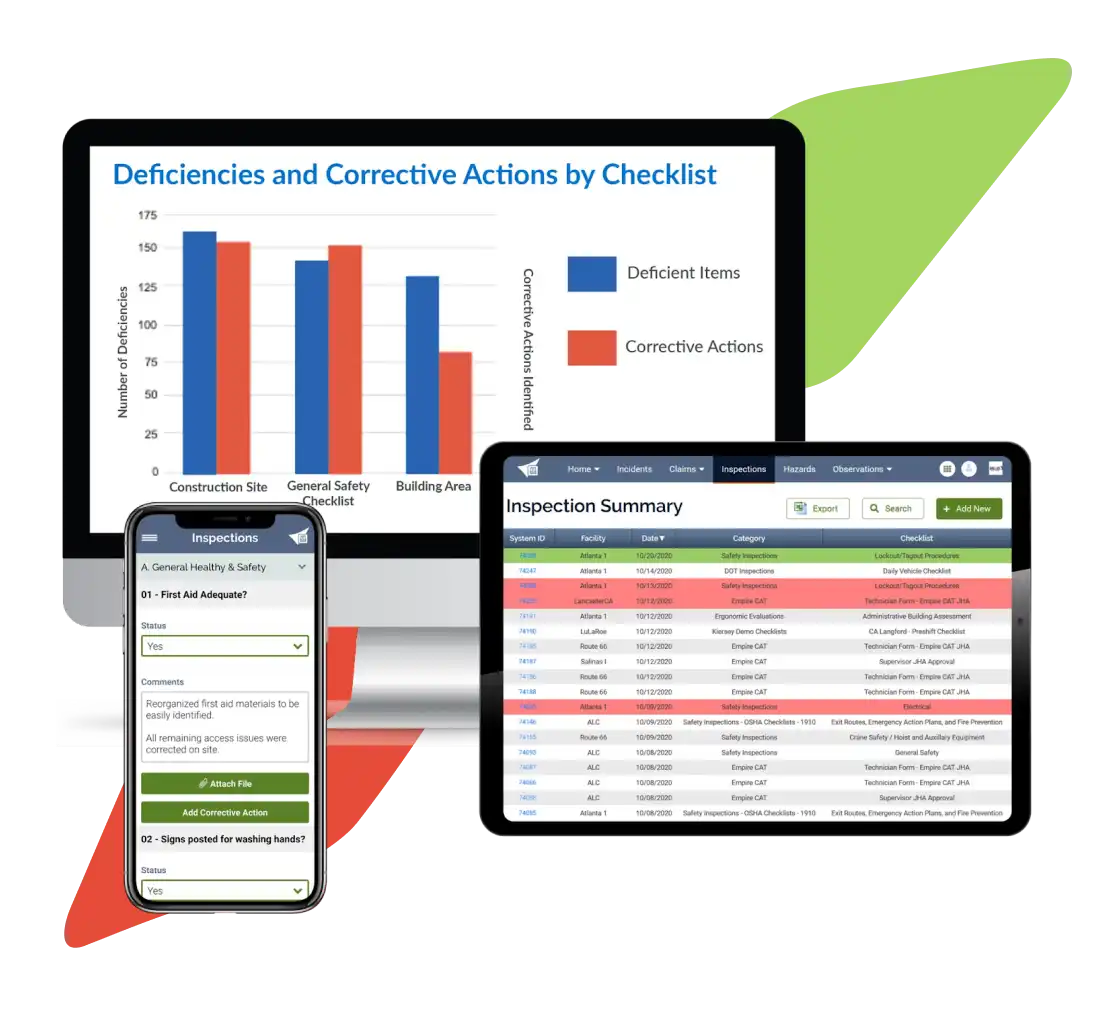
FAQs About Facility Asset Management
How Do I Decide Whether to Repair or Replace a Failing Asset?
Use the Facilities Condition Index. Compare repair cost to replacement value. An FCI above 0.10 signals poor condition. Once repair costs reach 30% of replacement value, schedule capital replacement. Factor in TCO across the asset’s full useful life. Weigh compliance risk and downtime impact too.
What Happens if My Preventive Maintenance Compliance Rate Stays Below 90%?
Scheduled maintenance isn’t running on time. That speeds up asset wear and increases unplanned downtime. Audit risk grows from incomplete inspection records. Low compliance often reflects staffing strain. The IFMA FM Workload Index of +43 confirms this trend. Focus on critical assets first. Track resolution time to find the bottleneck.
How Do I Build an Asset Inventory if I’m Starting From Scratch?
Start with a walk-through of your highest-criticality assets. Focus on those whose failure would cause a safety incident or shutdown. Capture model, location, condition, warranty status, and useful life for each one. Use mobile inspection tools so data goes right into your system. Expand to lower-priority equipment in phases.
Which Compliance Frameworks Require Asset-Level Documentation?
Several frameworks require asset-level records. Each links equipment to inspection logs and compliance status:
- OSHA lockout/tagout procedures
- ADA access standards
- Fire code suppression system inspections
- EPA refrigerant tracking
Lockout/tagout ranked among OSHA’s most-cited violations in 2024 with 2,443 violations. Penalties reached up to $16,550 per serious violation, per NSC/OSHA and OSHA. EPA’s HFC Technology Transitions rules require leak-repair records and refrigerant charge data by asset. These took effect January 1, 2026.
Can I Use Asset Management Software to Track Training and Safety Records Alongside Equipment Data?
Yes. Platforms like Vector Check It and Vector EHS Management connect asset data, inspection workflows, and safety training records in one system. Your team can link lockout/tagout training to the specific equipment each worker is approved to service. That removes the need to cross-check spreadsheets during audits. Look for software that supports offline mobile capture and multi-site dashboards.