October 7, 2026 4 min read

Management of Change: Process, OSHA Rules & Examples
Industry:
Solution:
Safety teams face every operational change unsure whether formal MOC applies. The replacement-in-kind exception sounds clear until you need to defend it.
Management of change (MOC) is OSHA’s required process for reviewing modifications to equipment, materials, procedures, and staffing in covered process-safety facilities. MOC requirements apply specifically to facilities covered by OSHA’s PSM standard or EPA’s RMP rule, generally those handling threshold quantities of any of the roughly 130 listed highly hazardous chemicals.
Effective MOC is a decision and documentation system with clear triggers and approval routing. It gives your team a defensible go/no-go framework and audit-ready records for every change.
Main Takeaways
- Management of change (MOC) is OSHA’s required process for reviewing modifications to equipment, materials, procedures, or staffing in facilities covered by the PSM standard or EPA’s RMP rule.
- Any change that alters process safety information triggers formal MOC review. The only exception is a replacement in kind, meaning an exact match to the original design specification with no change to function, capacity, or operating conditions.
- Organizational changes count. Staffing reductions, contractor changes, and maintenance budget cuts can trigger MOC when they affect safe operation, and NFPA 660 now names staffing and job tasks explicitly.
- A complete MOC runs seven steps: initiation, hazard and risk assessment, approval routing, planning, implementation, pre-startup safety review, and close-out with training. Each step’s output feeds the next.
- OSHA requires five documented pre-change considerations under 29 CFR 1910.119(l)(2), plus updated process safety information, procedures, and training records, before the modified process restarts. Each is a separate audit target.
PSM Compliance Checklist
Walk through the process safety management elements OSHA expects, including management of change.
Download the Checklist
When Is Management of Change (MOC) Required?
Under management of change OSHA rules, any modification to equipment, materials, procedures, staffing, or operations in a PSM-covered facility requires formal MOC review unless the change qualifies as a replacement in kind: a swap that matches the original design specification exactly, with no change to function, capacity, or operating conditions.
Why Unmanaged Change Leads to Incidents
Skipping MOC carries a real cost. The U.S. Chemical Safety Board’s (CSB) 2026 investigation of the Givaudan explosion in Louisville, KY (November 2024, two fatalities) found that the facility’s management of process safety was seriously deficient.
The TS USA case in Chattanooga (May 2024, one fatality) shows the same risk in a different setting. That facility was not subject to OSHA’s PSM standard because it did not handle PSM-covered chemicals. Asked about management of change, a manager told investigators the practice was skipped because it was “very expensive and very time-consuming.” This case shows that MOC discipline matters even where it isn’t legally required, not that the facility violated a regulation. Investigators reviewing a management of change incident like this one often find that the review was skipped or never documented.
When MOC is skipped or treated as optional, whether it is required by regulation or not, hazards go unreviewed and people get hurt.
MOC vs. Organizational Change Management
Process-safety MOC and organizational change management are different disciplines. MOC is a regulatory requirement under OSHA’s PSM standard that focuses on physical and procedural changes in industrial facilities. It is one part of a broader health and safety management system.
Organizational change management addresses how people adopt new business processes, roles, or strategies. It has no regulatory mandate and serves a different audience with different tools.
This article covers process-safety MOC exclusively.
Triggers and the Replacement-in-Kind Exception
Effective management of changes programs start with knowing when formal review applies. Replacement in kind is a narrow exception: a replacement that matches the original design specification exactly, with no change to function, capacity, or operating conditions. Anything that departs from that specification requires formal MOC.
The main categories of changes that trigger formal MOC include equipment, such as new machinery or modified piping; materials, such as chemical substitutions or catalyst changes; procedures, such as SOP revisions or operating-parameter shifts; operations, such as capacity increases or process-flow changes; and technology, such as new control system software, SCADA or safety-instrumented-system upgrades, or cybersecurity changes that affect process control. Temporary changes, such as bypasses or workarounds with a set expiration, also trigger MOC, as do permanent changes and personnel or organizational changes like staffing reductions, reorganizations, contractor changes, and maintenance budget cuts that affect safe operation. Temporary bypasses used for equipment isolation need the same documented review as permanent changes, just as any lockout/tagout procedure does.
NFPA 660 (2024), the combustible-dust standard, now explicitly includes staffing and job-task changes in its MOC scope. This confirms that organizational changes can be safety-significant.
The core test is simple: does the proposed change alter anything covered under process safety information (PSI)? If it does, MOC applies unless the change is a true replacement in kind.
Does This Change Require an MOC?
| Change Type | Example | Alters PSM-Covered Element? | Replacement in Kind? | MOC Required? |
| Equipment swap, same spec | Replacing a pump with identical model | No | Yes | No |
| Equipment upgrade, different capacity | Installing a higher-capacity pump | Yes | No | Yes |
| Chemical substitution | Switching to a different solvent | Yes | No | Yes |
| SOP revision | Changing startup sequence | Yes | No | Yes |
| Temporary bypass | Rerouting flow during maintenance | Yes (temporary) | No | Yes |
| Staffing reduction | Cutting one operator per shift | Potentially | No | Yes, evaluate |
| Like-for-like gasket replacement | Same material, same rating | No | Yes | No |
The replacement-in-kind exception is narrow. If anything about the change departs from the original design specification, formal MOC review is required.
Knowing that a change triggers MOC is the first decision. The next question is how your team moves that change from request to safe startup without losing steps or records along the way.
The 7-Step MOC Process
Within any MOC management of change program, a complete MOC process moves every proposed change through seven steps: initiation, hazard and risk assessment, approval routing, planning and scheduling, implementation, pre-startup safety review (PSSR), and close-out with training. Each step has clear ownership, defined roles and responsibilities, and documentation outputs.
Steps 1-3
Step 1: Initiate the change request. The requester submits a written request that describes what will change, why, and which PSI is affected. Step 2: Conduct a hazard and risk assessment. The team reviews the change using a what-if analysis, HAZOP, or risk matrix scaled to the complexity of the change. Teams can draw on job hazard analysis, risk management basics, and the hierarchy of controls at this stage to identify and rank safeguards. Step 3: Route for approval. Subject-matter experts review the change, and the team documents who approved it, when, and any conditions attached to approval. Clear approval routing with defined roles and responsibilities prevents changes from moving forward without the right review.
Steps 4-5
Step 4: Plan and schedule implementation. The plan defines scope, responsibilities, timelines, and temporary safeguards. For temporary changes, it also sets the authorized duration. Step 5: Implement the change. Teams execute the change according to the approved plan and update PSI, P&IDs, and procedures as the work progresses.
Steps 6-7
Step 6: Complete a PSSR before startup. Before startup, confirm that construction matches the design, procedures are updated, training is complete, and all MOC requirements are satisfied, as required under 29 CFR 1910.119(i). Step 7: Close out and train affected employees. Train the people affected by the change and file the complete MOC package as a single, audit-ready MOC document.
Skipping or combining steps is where MOC programs break down. Each step’s output feeds the next, and a missing record at any stage becomes the gap an auditor or investigator finds first.
Knowing the steps is one thing. Knowing exactly which records to keep and which OSHA subsections apply is what keeps your program audit-ready.
MOC Documentation Requirements and OSHA Compliance
OSHA’s PSM standard at 29 CFR 1910.119(l) requires five specific pre-change considerations and mandates that you update process safety information, operating procedures, and training records before the modified process restarts. Each of these is a discrete audit target.
What OSHA and EPA Require You to Document
Under 29 CFR 1910.119(l)(2), OSHA requires five pre-change considerations: the technical basis for the change, its impact on safety and health, modifications to operating procedures, the time period for temporary changes, and authorization requirements. Paragraph (l)(4) requires updating PSI, and paragraph (l)(5) requires updating operating procedures and training.
EPA’s RMP rule (40 CFR 68) mirrors these requirements. The 2024 Safer Communities rule added root-cause analysis and third-party audit expectations, but EPA proposed rescinding or narrowing several of those provisions in February 2026, and the outcome is unresolved. Treat RMP obligations as subject to change, and confirm current requirements directly with EPA.
Use the table below to organize your MOC documentation by record type.
| Record Type | OSHA Reference | What to Include |
|---|---|---|
| Technical basis | 1910.119(l)(2)(i) | The engineering justification for the change |
| Safety and health impact | 1910.119(l)(2)(ii) | Hazards introduced or altered and how they are controlled |
| Operating procedure modifications | 1910.119(l)(2)(iii) | Revised procedures and the changes made to them |
| Temporary change time period | 1910.119(l)(2)(iv) | The authorized duration and expiration date |
| Authorization | 1910.119(l)(2)(v) | Who approved the change, when, and under what conditions |
| Updated PSI | 1910.119(l)(4) | Revised P&IDs, chemical data, and equipment information |
| Updated procedures and training | 1910.119(l)(5) | Revised procedures and records showing affected employees were trained |
How Digital Tools Keep MOC Audit-Ready
Paper-based MOC systems often break down in predictable places. Records get scattered across departments, required fields go blank, and temporary bypasses outlive their authorized period. Digital MOC workflows address these gaps, and the right tools and techniques make MOC documentation easier to maintain. Smart forms enforce required fields, automated approval routing keeps reviews on schedule, training systems flag affected employees, and expiration alerts prevent indefinite temporary bypasses.
The global PSM software market is projected to grow from $1.45 billion in 2024 to $3.07 billion by 2030, reflecting the shift from paper-based MOC to centralized platforms.
Vector EHS Management connects MOC documentation to incident tracking, inspections, and training records in a single platform, serving more than 24,000 organizations.
Audit readiness isn’t about more paperwork. It means every MOC produces the specific records OSHA expects, and those records are easy to find and connected to the people and processes they cover.
Keep Every Change Documented and Reviewable
Connect MOC records to incident tracking, inspections, and training so the audit trail is ready before it's requested.
Explore Vector EHS Management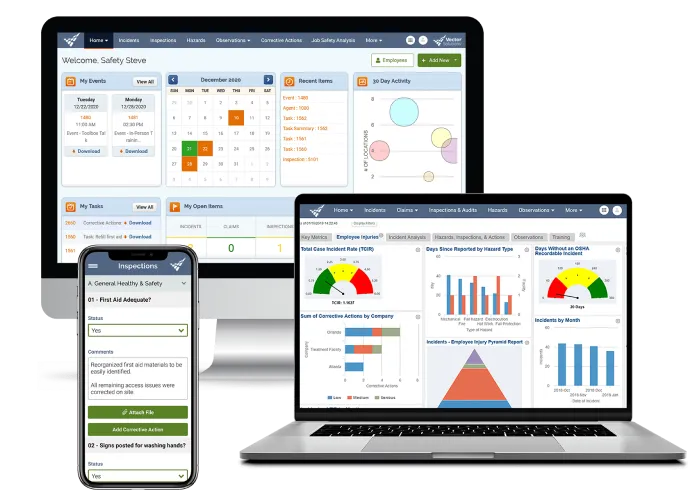
Put Your MOC Program into Action with Vector Solutions
You now have a decision framework for triggering MOC, a seven-step execution process, and the specific OSHA documentation requirements that keep your program audit-ready.
Vector EHS connects MOC documentation to the incident tracking, inspection scheduling, and training records your team already manages, so every change request produces a complete audit trail. Every location executes the same approval routing and PSSR checklist, and you can prove which employees were trained before the modified process restarted.
See Vector EHS Management in Action
Connect MOC documentation to incident tracking, inspections, and training records so every change request produces a complete audit trail.
Request a Demo
FAQs About Management of Change
What Do You Mean by Management of Change?
Management of change (MOC) is a structured process required by OSHA for evaluating, documenting, approving, and safely implementing modifications to equipment, materials, procedures, or staffing in facilities covered by the Process Safety Management (PSM) standard.
When Is an MOC Required Versus Not Required?
MOC is required whenever a proposed change affects process safety information, such as equipment capacity, chemical specifications, operating procedures, or staffing levels, unless it qualifies as a replacement in kind under 29 CFR 1910.119(l)(1).
What Documentation Is Required for an MOC?
OSHA requires five pre-change considerations under 29 CFR 1910.119(l)(2): technical basis, safety and health impact, operating procedure modifications, temporary-change time period, and authorization. Teams must also update PSI, procedures, and training records before restart.
How Long Does a Temporary Change Stay in Effect Under MOC?
OSHA requires you to specify and document the authorized time period for every temporary change under 29 CFR 1910.119(l)(2)(iv). The change must expire on that date or convert to a permanent MOC with full review.
Can Organizational Changes Like Staffing Reductions Trigger an MOC?
Yes. OSHA’s 2009 interpretation letter confirms that staffing reductions, reorganizations, contractor changes, and maintenance budget cuts can trigger MOC if they affect the safe operation of a PSM-covered process.