A training management system tailored for the fire service—track all training, EMS recerts, skill evaluations, ISO, and more for 100% of training in one place.
A training management system tailored for EMS services—EMS online courses for recerts, mobile-enabled skill evaluations, and more for 100% of training in one place.
Increase performance, reduce risk, and ensure compliance with a training management system tailored for your FTO/PTO and in-service training for 100% of training in one place.
Integrated solution purpose-built for modern regulatory demands. ArdentSky, delivers automated, integrated compliance solutions trusted by global gaming manufacturers, operators, and suppliers.
Assessing hazards in the workplace is an essential way to avoid risk and promote employee health and safety. A risk assessment matrix is one of the most valuable tools safety professionals use to identify, assess, and prioritize risks. It helps businesses evaluate the severity and likelihood of potential hazards, enabling them to allocate resources and implement safety measures accordingly. In this article, we’ll walk through how to use a risk assessment matrix, the different types, and the best practices for getting the most out of this essential safety tool.
What is a Risk Assessment Matrix?
A risk assessment matrix is a visual tool used to evaluate and prioritize potential hazards based on their likelihood of occurrence and the severity of their impact. This matrix simplifies complex risk management processes by grouping hazards into levels of risk, typically ranging from low to high. The main goal of is to allow safety professionals to quickly identify which risks require immediate attention and which can be monitored over time.
By organizing risks into a visual matrix, it becomes easier to focus resources on the highest-priority threats, ensuring that the most dangerous hazards are addressed first.
Steps to Create a Risk Matrix
Creating a risk matrix involves a clear and systematic approach to evaluating risks. Here’s a breakdown of the process:
Identify Hazards: Start by listing all the potential risks or hazards that could affect your project, workplace, or operations.
Evaluate Likelihood: Assign a score to the likelihood of each hazard occurring. This is often rated on a scale such as 1 to 5, with 1 being rare and 5 being almost certain.
Assess Severity: Determine the impact of each hazard if it were to occur. Severity is also rated on a scale.
Plot on the Risk Matrix: Position each identified hazard on the matrix by combining its likelihood and severity scores. For example, a risk with a likelihood of 4 and a severity of 5 would fall into the “high-risk” category.
Analyze Results: Review the matrix to pinpoint high-priority risks that need immediate action. Low-priority risks may only need monitoring or minor interventions.
Implement Controls: Develop and implement strategies to mitigate or eliminate the identified risks. This could include changes in processes, safety equipment, or training.
By using a risk matrix calculator, you automate the process, providing quick insights and actionable results. This saves time and enhances the accuracy of risk management decisions.
Types of Risk Matrices: 3×3, 5×5, and More
Risk matrices come in various configurations, with 3×3 and 5×5 matrices being the most common. These matrices differ in their level of detail and application.
3×3 Risk Matrix: This is the most basic type, with three levels for both severity and likelihood. It’s ideal for smaller organizations or less complex operations.
5×5 Risk Matrix: This more detailed matrix features five levels for both severity and likelihood. It allows for a more granular assessment and is particularly useful for larger, more complex organizations that need a higher level of detail.
Both matrices have their advantages, depending on the complexity of the hazards and the organization’s risk management needs. The 5×5 matrix offers a more precise risk categorization, while the 3×3 matrix provides a simpler and faster assessment.
Benefits of Using a Risk Matrix Calculator
Implementing a risk matrix calculator provides several key benefits for safety management:
Manage Hazards More Effectively: Risk matrices help uncover “hidden risks” that may not be obvious in daily operations.
Reduce Workplace Injuries and Illnesses: Identifying and addressing hazards early helps prevent serious accidents and injuries, reducing both the human and financial costs.
Increase Productivity: Some hazards can cause delays or downtime. By addressing high-priority risks, you can keep operations running smoothly and maintain productivity.
Make Informed Decisions: A risk matrix provides data-driven insights, allowing you to make smarter, more informed decisions about where to allocate resources.
Boost Your Reputation: Demonstrating a commitment to safety can help build your organization’s reputation, making it easier to attract and retain employees.
Risk Matrix Guide
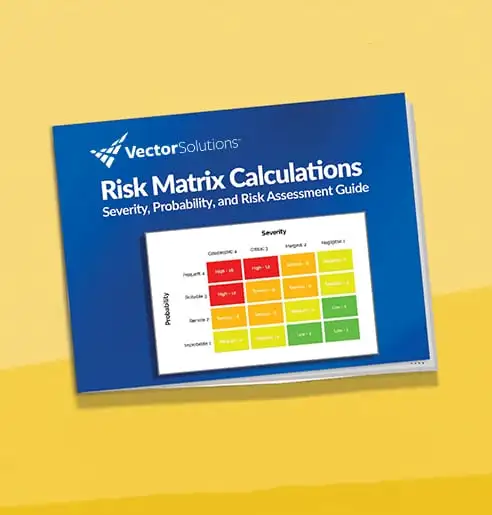
Understanding the components of a risk matrix will allow you and your organization to manage risk effectively. Download the guide for details on risk matrix calculations including severity, probability and risk assessment.
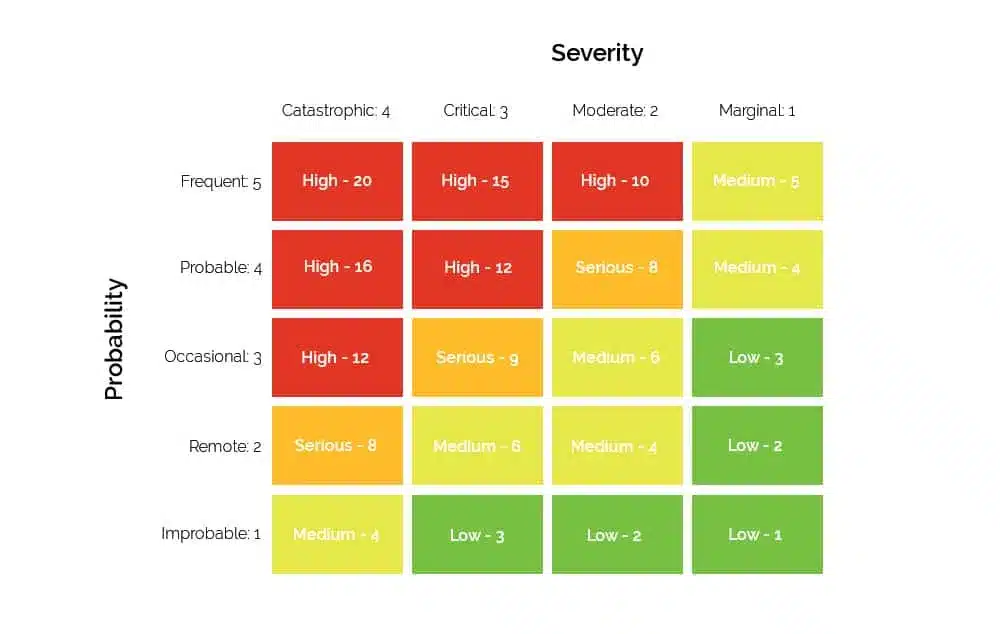
The risk matrix works by presenting various risks in a color-coded chart. On this chart, high risks are represented in red, moderate risks in orange or yellow, and low risks in green.
Risk matrices can come in many shapes and sizes, but every matrix has two axes:
One that measures the likelihood of a risk.
One that measures the risk’s potential impact on operations.
Using a risk matrix allows you to identify and focus your attention and resources on the highest risks, since these have the biggest impact and can result in significant losses.
Components of a Risk Matrix: Severity
Severity is the first axis of a risk assessment, and it measures the amount of damage or harm a hazard could create. Severity is often ranked on a four-point scale within a risk matrix.
The severity ranking goes as follows:
Negligible. Operating conditions are such that hazards will result in either no illness, injury, or system damage, or less than minor.
Marginal. Operating conditions may commonly cause minor injury or illness or minor systems damage without severe injury, illness, or major system damage.
Critical. Operating conditions are such that hazards may commonly cause severe injury or illness or major system damage thereby requiring immediate corrective action.
Catastrophic. Operating conditions are such that hazards may commonly cause death or major system loss, thereby requiring immediate cessation of the unsafe activity or operation.
Components of a Risk Matrix: Probability
Probability is the second axis of a risk matrix, and it measures the likelihood of the hazard occurring. Probability is often tanked on a five-point scale, with the least probable hazards assigned one point and the most probable hazards assigned five points.
The scale goes as follows:
Improbable: So unlikely, it can be assumed an occurrence may not be experienced.
Remote: Unlikely, but possible to occur in the life of an item.
Occasional: Likely to occur sometime in the life of an item.
Probable: Will occur several times in the life of an item.
Frequent: Likely to occur often in the life of an item.
Safety Management: Incident Investigation
This safety management course discusses reasons for incident investigations, the phases of an incident investigation, team leader responsibilities, and who comprises the investigation team.
A safety risk assessment matrix provides a clear framework for identifying, evaluating, and mitigating risks in the workplace. In this section we’ll provide a step-by-step guide to help you effectively calculate and reduce hazards.
Step 1: Calculate the Initial Risk Level
The first step in using the matrix is to calculate the initial risk level by multiplying the Probability value by the Severity value.
Example: A worker lifts heavy castings from a box on the floor and carries them to a grinding wheel, processing 20-30 castings per hour. Identified risks include the possibility of dropping the item on their foot or straining their lower back due to repetitive lifting and twisting.
Step 2: Assign a Probability Value
Next, evaluate how likely the hazard is to occur and assign a probability value based on the risk matrix scale.
Example: You determine that the likelihood of the worker dropping the item is “Occasional,” corresponding to 3 points on the matrix.
Step 3: Determine the Severity Value
Once the probability is set, consider the potential consequences if the hazard occurs and assign a severity value.
Example: If the worker strains a muscle or breaks a bone, they might miss shifts or be placed on restricted duty, impacting productivity. This is considered “Critical,” which corresponds to 3 points on the matrix.
Step 4: Calculate the Overall Risk Score
Using the assigned values, multiply the Probability and Severity scores to find the overall risk level.
Example: 3 x 3 = 9
With a score of 9, the risk is categorized as “Severe,” often represented in red on the matrix.
Step 5: Implement Controls to Reduce Risk
Once you understand the risk, develop and implement strategies to reduce its likelihood or impact.
Example controls include:
Moving the boxes closer to the grinding wheel to minimize carrying distances.
Equipping workers with steel-toed boots to protect against dropped items.
Step 6: Reassess the Residual Risk
After implementing controls, reassess the risk using the same process to account for the new safety measures.
Example: While the severity remains “Critical” (3 points) since the potential injury has not changed, the likelihood decreases to “Remote,” corresponding to 2 points.
Step 7: Evaluate the Residual Risk Level
Recalculate the risk score based on the updated probability and severity values.
Example: 3 x 2 = 6
A score of 6 shifts the hazard to the “Medium” category, represented in yellow on the matrix.
Step 8: Decide Next Steps
Finally, determine if the residual risk level is acceptable. If it is not, consider implementing additional controls or redesigning the task to further reduce the risk.
Example: To lower the risk even further, you might explore using a lift-assist device or adjusting task protocols for improved ergonomics.
By following these steps, you can systematically identify, evaluate, and manage risks, ensuring a safer workplace for everyone involved.
Best Practices for Using a Risk Matrix Calculator
Using a Risk Matrix Calculator effectively requires a strategic approach to ensure accurate assessments and improved workplace safety.
Best practices when using this tool include:
Regularly reviewing and updating your risk matrix. Your organization’s risks may change over time, so you should periodically review and determine whether you need to revise your risk matrix to better account for a changing risk landscape.
Monitoring operations. EHS managers should monitor day-to-day operations to confirm that safety protocols and control measures are being followed and that risks have been mitigated to an appropriate level.
Investigating incidents. Organizations should investigate incidents to determine their root causes and develop strategies to prevent similar incidents from occurring in the future. Root cause analysis can help you to uncover whether the controls that you’ve implemented to mitigate a hazard are falling short and need to be adjusted.
How Vector Solutions Helps with Risk Matrix
Risk management technology can save EHS professionals valuable time and resources. Risks pose real-time threats, and you must be able to make informed decisions to mitigate them quickly. Trying to manage assessments using paper and spreadsheets can be unwieldy and time-consuming.
At Vector Solutions, our EHS Management software saves organizations valuable time and effort in recording, tracking, and analyzing operational risks.
This software allows you to continually update and easily modify your risk matrix to meet your specific operational needs. By using a web-based matrix and assessment tool, it also becomes easier to share risk assessments and communicate hazard information across your organization’s locations.
Request a demo today to learn how our software can improve your risk management efforts
Frequently Asked Questions
What is a risk assessment matrix?
A risk assessment matrix is a tool used to assess, evaluate, and prioritize workplace risks by examining both their likelihood and severity.
How do you create a risk matrix?
To create a risk matrix, identify hazards, assign scores for probability and severity, plot them on the matrix, and analyze the results to take action.
What are the different types of risk matrices?
The most common types of risk matrices are 3×3 and 5×5 matrices. The 5×5 matrix provides more detailed risk assessments, making it suitable for more complex environments.
Why is a risk matrix important in safety management?
A risk matrix helps identify and prioritize the most critical risks in the workplace, allowing you to allocate resources efficiently and mitigate hazards before they lead to incidents.
How does a 5×5 risk matrix work?
A 5×5 risk matrix provides a more detailed risk categorization by using five levels for both severity and likelihood. It allows for a more granular analysis of risks.