










August 12, 2026 4 min read

Best Harassment Prevention Training Software: A Buyer’s Guide
Industry:
Solution:
You need harassment prevention training software that keeps your organization compliant. That sounds like a straightforward buying decision. It isn’t.
Say you want to confirm a platform meets California’s two-hour supervisor requirement. You dig through the vendor’s website, and the specifics are buried in a sales deck with no real proof behind them. Every platform says it’s compliant. Few show you what that actually means. Now multiply that uncertainty across every state where you have employees, each with its own rules, and the real challenge comes into focus. It isn’t finding a vendor. It’s telling the platforms that genuinely meet each jurisdiction’s requirements apart from the ones that just claim to.
That’s what makes this decision harder than it looks, and it’s why you need a real framework rather than a feature checklist.
Evaluate platforms against four factors:
- State compliance coverage
- Workforce type
- Clear pricing
- Outcomes beyond completion rates
Get this right and you cut compliance risk, build a business case leadership will approve, and select training your employees will actually finish.
Main takeaways
- Eight states and cities mandate harassment prevention training. Each sets different duration, renewal, and interactivity rules by role.
- Platforms must deliver separate course versions by jurisdiction and role. A single course applied across your workforce won’t work.
- Bystander intervention training is now legally required in multiple states. It’s a compliance filter.
- Per-user pricing typically runs $15 to $50 per year based on org size. Free state-provided courses lack tracking and multi-state coverage.
- Completion rates alone don’t measure program results. Incident trends, culture survey scores, and knowledge retention at 30, 60, and 90 days give a fuller picture.
Build a Stronger Harassment Prevention Program
Seven practical strategies help colleges and multi-location employers move beyond checkbox training and address harassment at every level of the organization.
Read the Harassment Prevention Guide
What a harassment prevention training program should include
A strong program covers the elements below. These are drawn from the EEOC’s 2024 enforcement guidance. They form the baseline every platform should cover:
- Definitions of harassment types, including sexual harassment
- Examples of banned behavior and gray-area scenarios
- Explanation of the employer’s anti-harassment policy
- Employee rights and complaint procedures
- Reporting methods and retaliation protections
- Bystander intervention training: what to recognize and how to act
- Supervisor and manager duties
- State-specific legal requirements, including duration and interactivity mandates
- Support needs and overlapping identity factors
- Regular schedule and refresher training plan
Why these elements matter more now
The EEOC received 88,531 new charges in fiscal year 2024. That’s a 9.2% year-over-year increase. The agency secured over $469.6 million in relief according to the EEOC’s 2024 Annual Performance Report.
Training that merely checks a box leaves your org exposed. Programs aligned to the EEOC’s guidance create a solid record of good-faith prevention efforts.
Bystander intervention training deserves close attention. Multiple states now require it by law. That makes it a real factor when you evaluate platforms.
Use these ten elements as a pass/fail filter. If a platform skips bystander intervention or lacks supervisor modules, it can’t meet EEOC standards.
Platforms differ sharply in how many of these elements they cover out of the box. Vector Solutions builds its harassment prevention courses to the full EEOC baseline, including bystander intervention and supervisor-specific modules, so the pass/fail filter above is a starting point rather than a gap to fill.
State-by-state sexual harassment prevention training requirements
Eight states and cities mandate this training. Each one sets different rules for duration, renewal cycles, role-based versions, and interactivity. Getting any single rule wrong creates audit exposure.
Requirements differ across four areas:
- Whether training is required
- How long it must last for employees and supervisors
- How often employees must retrain
- Whether the format must be interactive
These rules change over time. Check official state civil rights agency pages for current mandates. As of 2026, the table below captures what multi-state HR teams need to track.
| Jurisdiction | Required | Employee Duration | Supervisor Duration | Renewal Frequency | Interactive Required |
| California | Yes | 1 hour | 2 hours | Every 2 years | Yes |
| Connecticut | Yes | 2 hours | 2 hours | Every 10 years | Yes |
| Delaware | Yes | Required (no set minimum) | Additional modules required | Every 2 years | Yes |
| Illinois | Yes | Required (no set minimum) | Required (no set minimum) | Annual | No |
| Maine | Yes (15+ employees) | Required within 1 year of hire | Required within 1 year of hire | Not specified | No |
| New York (state) | Yes | Required (no set minimum) | Required (no set minimum) | Annual | Yes |
| New York City | Yes | Required (no set minimum) | Required (no set minimum) | Annual | Yes |
| Chicago | Yes | 1 hour (+ 1 hour bystander) | 2 hours (+ 1 hour bystander) | Annual | No |
If your workforce spans three or more of these areas, tracking versions creates real compliance gaps. Multi-state compliance automation becomes a key feature in your platform review. Without it, your team takes on that burden through spreadsheets and calendar reminders.
How to choose the best harassment prevention training software
Five criteria separate a strong platform from one that just looks good in a demo:
- State compliance coverage
- Content quality and engagement format
- Deployment for frontline and deskless workers
- Measurement beyond completion rates
- Pricing model fit for your org’s size
One differentiator separates the strongest platforms from the rest: whether training data connects to the systems where compliance actually gets proven. Most harassment-training vendors deliver courses and completion records and stop there. A smaller group, including Vector Solutions, runs harassment training inside an integrated LMS and EHS platform, so completions flow into the same system that tracks incidents and corrective actions. Keep that connection in mind as you work through the five criteria below, because it determines whether you can measure outcomes or only completions.
Start with compliance coverage. Does the platform auto-assign courses by jurisdiction and role? Does it update content when state laws change? Check vendor claims against the table above.
Say you have employees in California and New York. California employees need a one-hour interactive course. California supervisors need a two-hour version. New York staff need a separate annual interactive course.
Content quality matters just as much. Look for scenario-based learning with realistic workplace situations. Strong bystander intervention training teaches recognition and response through practice. A single definition slide signals shallow content.
Three buying models exist:
- Self-serve credit card checkout (typical for SMBs)
- Quote-based pricing (mid-market and enterprise)
- Free options from states like New York and California
Free state courses lack LMS integration, tracking, and multi-state coverage.
Average cost per learning hour is up 34% year over year to $165, according to ATD. Clear per-user pricing helps you build a solid budget request.
Deploying training to frontline and deskless workers
Deskless workers face bigger training challenges than office staff. That’s according to 79% of HR professionals surveyed by SHRM. When you evaluate platforms for frontline teams, look beyond “mobile compatible.” True mobile-first delivery includes:
- Multilingual course libraries
- Offline completion with sync
- Micro-learning formats that fit shift breaks
- SMS or push-notification reminders
Platforms built for safety-critical, deskless workforces tend to handle these requirements natively. Vector Solutions, for instance, developed its training for healthcare, manufacturing, construction, and public safety teams, where multilingual delivery and mobile completion are baseline expectations rather than add-ons.
Those same industries add another layer: supervisor-to-employee ratio compliance. Your platform must track who qualifies as a supervisor under each state’s rules and assign the longer training version automatically, without someone flagging it by hand.
Compliance-first vs. culture-first training: which do you need?
Compliance-first training focuses on audit readiness. Think completion certificates, policy sign-offs, state-mandate alignment, and legal-hold records. This is the floor.
Culture-first training goes further with scenario-based learning designed to shift behavior. It includes anonymous sentiment surveys and manager-specific modules. Analytics link training data to incident trends. Over 90% of Ethisphere’s World’s Most Ethical Companies provide dedicated manager training, according to Ethisphere’s 2026 E&C Metrics report.
Most orgs need both approaches. Start by asking whether your primary driver is passing an audit or reducing incidents. Then evaluate platforms against that priority.
Measuring training effectiveness beyond completion rates
Forty-one percent of risk and compliance practitioners rate their ability to measure training’s impact on behavior as “poor” or “fair.” Most orgs lack the data to prove their program works.
Five metrics give you a fuller picture:
- Incident report trend data: Are formal complaints declining quarter over quarter?
- Culture survey scores: Do employees feel safe reporting?
- Manager behavior assessments: Are supervisors stepping in earlier?
- EEOC complaint frequency: An external signal of program gaps.
- Knowledge retention scores at 30, 60, and 90 days.
Platforms that link training completion data to EHS incident records give HR teams a clearer view. Vector Solutions’ integrated LMS and safety management system is one example. It connects course completions to the same system tracking incidents and corrective actions.
Match State Requirements to the Right Course Version
Multi-state HR teams need role-specific, jurisdiction-matched courses that update automatically. See how Vector's harassment prevention training handles state-mandated requirements across your workforce.
Explore Harassment Prevention Training
Turn harassment prevention training into provable results with Vector Solutions
You now have a framework for choosing harassment prevention training software. Apply five criteria to any vendor’s pitch: state compliance coverage, content quality, frontline deployment, measurement tools, and clear pricing.
We built Vector Solutions to connect harassment prevention training to your broader compliance platform. Training completion data flows into the same system tracking EHS incidents and corrective actions. Every location completes the right state-specific version on schedule. You prove program impact with incident trend data your leadership team trusts.
Connect Training Completions to Incident Trend Data
Linking harassment training records to EHS incident data gives leadership the proof a program is working.
Request a demo today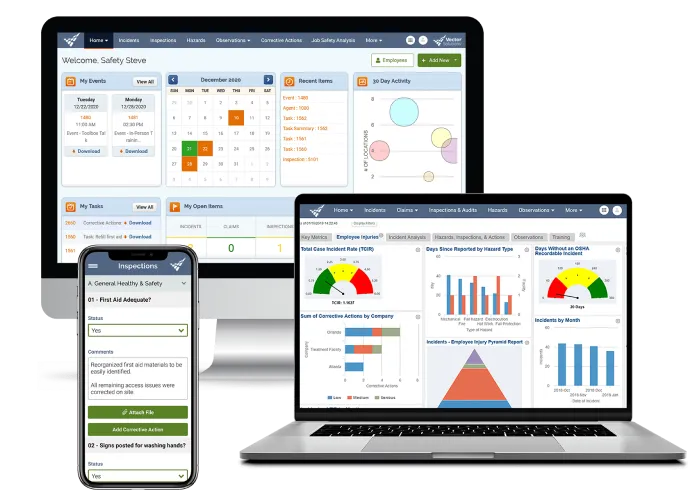
FAQs about best harassment prevention training software
Is harassment prevention training legally required?
Yes, in eight states and cities: California, Connecticut, Delaware, Illinois, Maine, New York, New York City, and Chicago. Each has different rules for duration, renewal, and role-based versions. Federal law does not mandate training. But the EEOC strongly recommends it as a preventive measure. Many employers use it regardless of state mandates. It helps reduce liability and build a solid compliance record.
How often should employees complete harassment prevention training?
Renewal frequency depends on your state. California and Delaware require training every two years. New York, Illinois, and Chicago require annual refreshers. Connecticut’s cycle is every ten years. If your workforce spans multiple states, track the shortest renewal cycle. Apply it as your standard to avoid gaps.
Can harassment prevention training be completed online?
Online delivery is allowed in every state that mandates this training. But California, Delaware, New York, and Illinois require an interactive format. Learners must engage with scenarios, branching questions, or decision points. Just watching a video isn’t enough. A passive slide deck with a final quiz won’t meet interactivity rules in these states.
What is the difference between compliance training and culture training?
Compliance training focuses on meeting legal mandates. That includes state-specific duration, policy sign-offs, completion certificates, and audit readiness. Culture training goes further. It uses scenario-based learning to shift behavior. Manager-specific intervention modules and analytics round it out. These tools link training data to incident trends and sentiment surveys. Most orgs need both. Start by asking whether your primary driver is passing an audit or reducing incidents.
How do you measure whether harassment prevention training is actually working?
Track five metrics:
- Incident report trend data: Are formal complaints declining quarter over quarter?
- Culture survey scores: Do employees feel safe reporting?
- Manager behavior assessments: Are supervisors stepping in earlier?
- EEOC complaint frequency: An external signal of program gaps.
- Knowledge retention scores at 30, 60, and 90 days.
Completion rates alone don’t prove results. Only 41% of risk and compliance practitioners rate their measurement ability above “poor” or “fair.” That finding comes from the NAVEX 2024 State of Risk & Compliance report. Most programs are flying blind on outcomes.