October 20, 2026 7 min read

Facility Maintenance: Types, Duties, and How It Works
Industry:
Solution:
An HVAC unit that fails overnight, or a broken lock that goes unreported for weeks. The team spends its days responding to whatever broke last. That reactive cycle is what facilities maintenance looks like without a system behind it.
Facilities maintenance is the proactive management and upkeep of the physical assets and infrastructure of a built environment. This includes the installation, inspection, routine maintenance, and repair of machines and equipment.
This critical profession encompasses a variety of tasks all aimed at ensuring the optimal functionality, safety, and efficiency of buildings, equipment, and surrounding spaces.
The scope of facilities maintenance work is vast, including commercial buildings, manufacturing facilities, educational institutions, healthcare centers, and data centers. In each industry, there are unique needs that facility maintenance teams need to account for.
This article covers the seven maintenance types and when each one applies, who owns which duties, how compliance requirements drive the schedule, and how to build a documented plan.
Main Takeaways
- Facilities maintenance covers the routine upkeep, inspection, and repair of a building’s physical assets. Facilities management is the broader strategic function that sits above it.
- Maintenance work falls into seven types, from preventive and predictive through emergency and compliance-driven. Most teams run three and have gaps in the rest.
- Duties split by role: technicians execute inspections and repairs, supervisors coordinate and verify, and managers own frequencies, budgets, and KPIs. In small teams one person covers all three, which makes documented process more important, not less.
- Compliance obligations from OSHA, NFPA, ADA, and the EPA are scheduling inputs, not afterthoughts. Each becomes a recurring work order with an owner and a record.
- Deferred maintenance compounds. Federal building repair backlogs more than doubled to $370 billion between FY2017 and FY2024, showing what postponement costs at scale.
The Power of Online Maintenance Training Guide
Uncover the impacts on hiring, skills development, performance and productivity.
View Guide
The 7 Types of Facility Maintenance
Facility maintenance programs use seven distinct maintenance types, each triggered by different conditions and serving a different operational purpose.
Most teams default to three types (preventive, corrective, and predictive), but a complete program recognizes at least seven. The list below defines each type with a concrete example so readers can identify which ones their program already runs and where the gaps are.
- Preventive maintenance. Scheduled servicing performed at set intervals to prevent failures, such as quarterly HVAC filter changes.
- Corrective maintenance. Repairs performed after a defect is found but before full failure, such as replacing a worn belt caught during inspection.
- Predictive maintenance. Sensor and data-driven monitoring that triggers work based on asset condition trends, such as vibration analysis on a motor.
- Condition-based maintenance. Work performed when a measured indicator crosses a set threshold, such as thermal imaging on electrical panels. Condition-based and predictive maintenance overlap; predictive uses trend analysis to forecast failure, while condition-based triggers at a fixed threshold.
- Emergency and breakdown maintenance. Unplanned response to sudden failure that threatens safety or operations, such as a burst pipe flooding a server room.
- Deferred maintenance. Known repairs intentionally postponed for budget or scheduling reasons, such as parking-lot resurfacing pushed to the next fiscal year.
- Compliance-driven maintenance. Inspections, tests, and servicing required by regulation regardless of asset condition, such as annual fire-alarm testing under NFPA codes.
Federal building deferred maintenance and repair backlogs more than doubled, from $171 billion to $370 billion, between fiscal years 2017 and 2024. GAO’s concern is that deferred assets deteriorate to the point of premature replacement, which costs more than the delayed repair would have.
Knowing which type applies to each asset lets you schedule proactively, budget accurately, and avoid the compounding cost of purely reactive work. Understanding the seven types tells you what work to schedule. The program only moves when specific people own each task.
Is Facilities Management the Same as Maintenance?
There’s a common misconception that the terms “facilities management” and “maintenance” are interchangeable. Although they are closely related, they represent distinct facets within the broader scope of facility operations.
- Facilities management encompasses a more comprehensive approach, including strategic planning, space utilization, workforce management and training, and holistic facility operations.
- Facilities maintenance specifically focuses on the routine upkeep, repairs, and preservation of physical assets.
Understanding this distinction is crucial for organizations seeking to establish effective facility strategies.
Facilities maintenance is the umbrella term for this profession, but there are nuances depending on the industry. Industrial maintenance refers to the maintenance of manufacturing and commercial facilities. Property maintenance refers to the maintenance of residential buildings.
What Is the Main Goal of Facility Maintenance?
The primary goal of facility maintenance is to guarantee the functionality and longevity of physical assets within a facility.
Achieving this involves a proactive approach to address potential issues before they escalate, ensuring that equipment, infrastructure, and systems operate at peak efficiency. By conducting routine inspections, implementing preventive measures, and swiftly addressing repairs, the main objective is to minimize downtime, reduce operational costs, and create a safe and optimal environment for occupants. Teams looking to make this shift often begin by cutting back on reactive maintenance.
Facility Maintenance Duties by Role
What does facility maintenance do day to day? Facility maintenance duties span inspections, repairs, vendor coordination, documentation, and emergency response, but the scope changes significantly from technician to supervisor to manager.
What Technicians Handle Daily
Facility maintenance technicians are deskless workers responsible for the hands-on tasks involved in maintaining and repairing physical assets. Their expertise spans many trades, allowing them to address a wide range of maintenance needs, including mechanical systems, HVAC, electrical, and plumbing. Their role involves:
- Routine inspections. Conducting regular assessments to identify potential issues and areas in need of maintenance.
- Repairs. Addressing equipment malfunctions, structural issues, and other maintenance requirements promptly.
- Preventive maintenance. Carrying out scheduled tasks that prevent breakdowns and extend the lifespan of assets.
- Documentation. Keeping detailed records of maintenance activities, inspections, and repairs.
- Lockout/tagout. De-energizing and isolating equipment before servicing, per OSHA 1910.147.
- Escalation. Routing issues beyond their skill level or authority to a supervisor rather than improvising a fix.
How Supervisors and Managers Differ
Supervisors sit between execution and program ownership. They coordinate shift coverage, run quality checks on completed work, schedule vendors, verify that technicians are current on required training, and complete first-pass compliance documentation.
Facility managers oversee and coordinate all aspects of facility operations. Their role involves:
- Strategic planning. Developing and implementing long-term plans to align facility resources with organizational objectives.
- Budgeting. Managing financial resources for maintenance, repairs, and facility improvements.
- Space utilization. Optimizing the use of available space for efficiency and functionality.
- Vendor management. Collaborating with external service providers for specialized maintenance tasks.
- Regulatory compliance. Ensuring the facility adheres to safety, health, and environmental regulations, including OSHA.
In smaller organizations, one person may cover all three scopes, which makes documented processes and checklists more important, not less.
How to Build a Facility Maintenance Plan
An effective facility maintenance plan connects four things: a prioritized asset inventory, compliance-driven schedules, clear role ownership, and KPIs that show whether the program is working.
Facility Maintenance Plan Framework:
- Inventory every maintainable asset. List each piece of equipment, system, and structure that requires upkeep.
- Assign criticality tiers. Rank each asset as safety-critical, operations-critical, or comfort and aesthetic.
- Set maintenance frequencies. Base each interval on the asset’s tier and manufacturer specifications.
- Define work-order triggers. Specify what initiates each maintenance type described above.
- Assign ownership by role. Use the technician, supervisor, and manager scopes defined above.
- Track KPIs. Measure work-order completion rate, mean time to repair, and preventive-to-reactive ratio. For more on choosing these metrics, see our guide to reliability and maintenance KPIs.
For example, a campus chiller rated safety-critical gets monthly refrigerant checks, quarterly performance testing, and an annual third-party inspection. Each task is assigned to a specific role with a documented trigger.
Cost pressure makes prioritization essential. 84% of facilities management leaders cite budget constraints and escalating operating costs as a top concern.
How Compliance Shapes Your Facility Maintenance Schedule
Compliance obligations are scheduling inputs, not afterthoughts. Each regulatory requirement becomes a recurring work order with a defined frequency, an assigned owner, and a documented record.
Compliance requirements touch nearly every system in a facility. OSHA rules cover lockout/tagout, machine guarding, and hazard communication. NFPA codes govern fire-alarm testing, sprinkler inspections, and emergency lighting. The ADA requires maintenance of accessible paths and elevator servicing. The EPA regulates refrigerant leak repair for systems with a 15-pound or greater HFC charge under the 2024 ER&R rule. Local building codes add requirements for occupancy permits and structural inspections. For a broader look at managing these risks, read our guide to risk management in facilities.
Two data points show why this matters:
- Lockout/tagout ranked #4 on OSHA’s Top 10 most-cited standards in FY 2025.
- OSHA’s maximum penalties currently reach $16,550 per serious violation and $165,514 per willful or repeat violation, unchanged for 2026.
A compliance-driven program ties every recurring task to a regulation, an owner, and a documented record. This shifts the team from reactive firefighting to scheduled, auditable work.
A Learning Path for New and Current FM Employees
This user-friendly learning path template takes the guesswork out of designing your training program by providing pre-selected courses from Vector’s extensive training catalog, Facilities Management, and Maintenance Library.
Download Template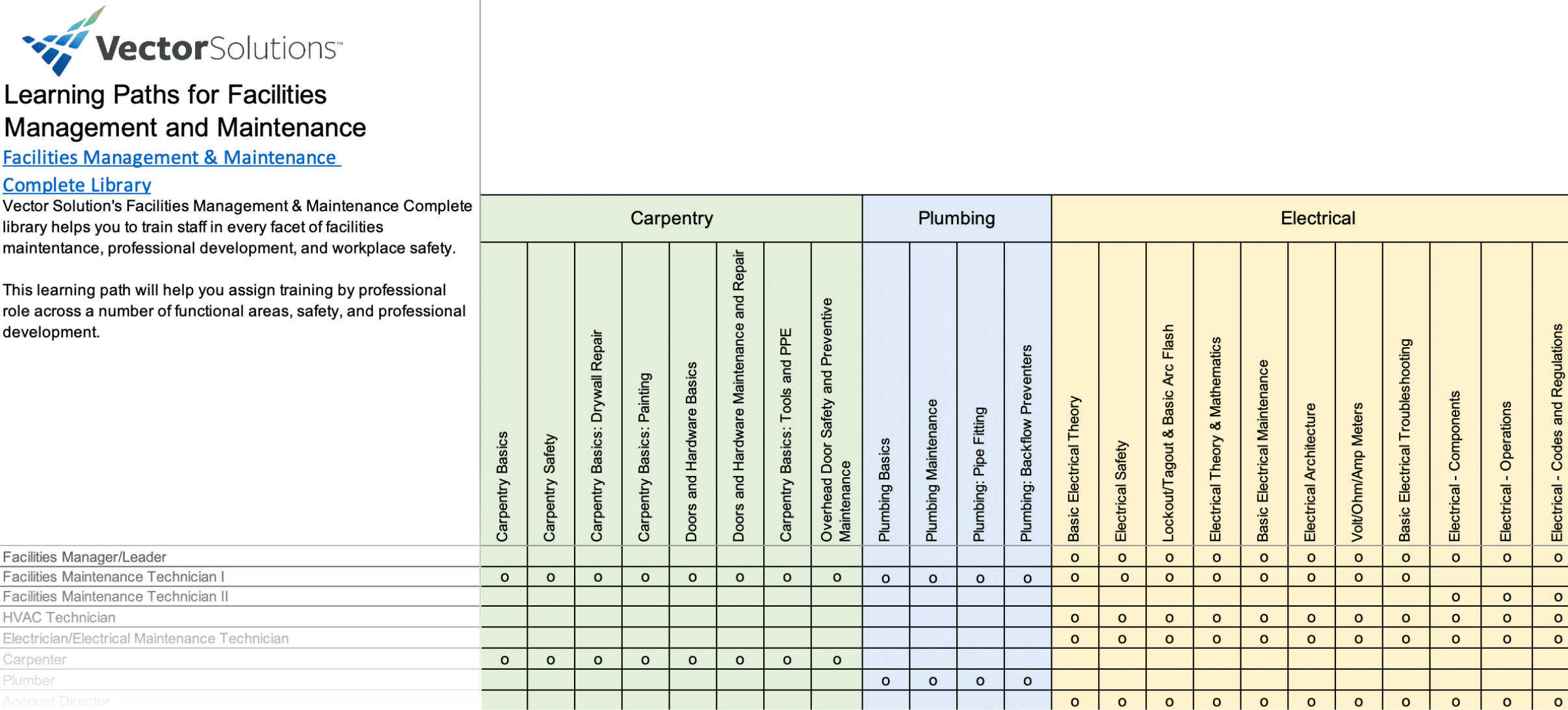
How Facility Maintenance Changes Across Industries
Maintenance priorities differ widely by sector. The same team that keeps a factory line running may manage a very different risk profile in a hospital or a school.
- Manufacturing. Production-line assets, compressors, and electrical systems are the focus. The highest-risk failure is unplanned downtime from a motor or conveyor. Compliance focus: OSHA lockout/tagout and machine guarding.
- Healthcare. HVAC systems support infection control, alongside medical gas systems and emergency generators. The highest-risk failure is generator failure during an outage. Compliance focus: Joint Commission environment-of-care standards and NFPA 99.
- Education. Roofing, boilers, and fire-suppression systems across aging campuses require constant attention. The highest-risk failure is heating loss in winter. Compliance focus: ADA accessibility and state fire-marshal inspections.
- Commercial real estate. Elevators, facade systems, and tenant HVAC zones demand regular service. The highest-risk failure is an elevator shutdown in a high-rise. Compliance focus: local elevator codes and energy benchmarking ordinances.
Facilities Maintenance Training and Certification
Facilities maintenance technicians require training on how to inspect, service, and repair electrical systems, cooling systems, heating systems, HVAC, hydronic systems, plumbing, water treatment, refrigeration, and fire systems and sprinklers. Other important topics include building automation, energy management, emergency power, work order management, and preventive maintenance. Building these skills across a whole crew takes a deliberate plan, and 7 facility management training tips can help structure one.
Certifications such as HVAC technician certification, electrical maintenance certification, and plumbing certifications validate expertise in specialized areas. For facility managers, the Certified Facility Manager (CFM) certification from the International Facility Management Association (IFMA) demonstrates comprehensive knowledge and proficiency in facility management practices.
Certification records double as compliance documentation. When an auditor asks whether the technician who serviced a system was qualified to do it, the training record is the answer.
Technology That Reduces Reactive Work
Facility maintenance software should centralize work orders, store asset history, let technicians document inspections on mobile devices in the field, track training completions and certifications, and surface data for KPI reporting. The goal is to shift the preventive-to-reactive ratio. Teams that can see overdue tasks, expiring certifications, and asset trends in one place spend less time in emergency mode.
For teams that need training records, EHS inspections, and compliance documentation connected, Vector Solutions offers purpose-built tools, including Vector LMS and Vector EHS Management, used by more than 24,000 client organizations.
Put Your Facilities Maintenance Program into Action with Vector Solutions
You can now identify which maintenance types their team runs, which compliance obligations shape the schedule, who owns each task, and how to document a plan that shifts work from reactive to planned.
Vector LMS and Vector EHS connect training records, inspections, and compliance documentation. This lets you show that every technician is current, every required inspection happened, and every asset has an auditable history.
The spreadsheet chase before an audit goes away. The data leadership needs to defend the maintenance budget is already in one place.
See Vector Solutions in Action
Training, inspections, and compliance documentation for facilities teams in healthcare, education, manufacturing, and critical infrastructure, in one connected system.
Request a demo
FAQs About Facilities Maintenance
How Is Facility Maintenance Different From Facility Management?
Facility maintenance is the hands-on execution of repairs, inspections, and servicing that keeps buildings and equipment operational. Facility management is the strategic layer above it, covering budgets, vendor contracts, capital planning, and policy. Maintenance teams execute work orders, while management teams set priorities and allocate resources.
What Certifications Help You Advance in a Facilities Maintenance Career?
Technicians benefit from OSHA 10 or 30-hour cards and trade licenses in HVAC, electrical, or plumbing. Supervisors and managers typically pursue IFMA’s Facility Management Professional (FMP) or Certified Facility Manager (CFM), Building Operator Certification (BOC), or EPA Section 608 refrigerant handling, where relevant to their asset mix.
What Happens if You Defer Facility Maintenance Too Long?
Deferral compounds in three ways. Minor issues escalate into emergency failures that cost far more to fix, regulatory violations accumulate when required inspections are skipped, and asset life shortens when preventive tasks are postponed, forcing earlier capital replacement.
How Do You Know if Your Preventive-to-Reactive Ratio Is Healthy?
A commonly used rule of thumb is 80/20: roughly 80% of maintenance labor hours go to planned preventive work and 20% to reactive work. Falling below about 70% planned is a signal that the program has tipped into reactive-heavy operation. Calculate the ratio using labor hours rather than work-order counts, since a 30-minute inspection and a 10-hour emergency repair are not equivalent.
Can One Platform Track Both Training Records and Maintenance Inspections?
Yes. Vector LMS handles training assignment, completion tracking, and certification records, while Vector EHS Management covers inspections, incident reporting, and compliance documentation. Together they let teams verify technician qualifications and inspection history without switching between spreadsheets and disconnected tools.