July 8, 2025 6 min read

Best Engineering Continuing Education Courses
Industry:
Solution:
The demands on your engineering team never slow down. New technologies, safety protocols, and regulations are imperative for success, and yesterday’s knowledge can quickly become outdated. In fact, according to the Association for Talent Development (ATD), companies that invest in training have a 24% higher profit margin than those that do not. This highlights why many engineering firms are prioritizing continuous learning and training for their engineers.
At Vector Solutions, we understand the unique challenges engineering teams face. That’s why we’ve developed expert-led, International Association for Continuing Education and Training (IACET)-accredited online training programs designed to meet compliance requirements, satisfy continuing education requirements for license renewal, boost technical knowledge, and support career advancement.
Let’s review the best engineering continuing education courses and topics designed to help keep your workforce up‑to‑date and compliant with industry standards.
| Top Engineering Topic | Engineering Discipline | Key Learning Outcomes |
| Engineering Ethics | Civil Engineering |
|
| National Electric Code (NEC) | Electrical Engineering |
|
| Asset Condition Management | Industrial Engineering |
|
| Fuel & Combustion Systems | Petroleum Engineering |
|
| Predictive Project Management | Project Management |
|
Top 20 Engineering Continuing Education Courses from Vector Solutions
To stay competitive and compliant in today’s rapidly evolving engineering landscape, it’s crucial for professionals to continuously enhance their skills and knowledge. At Vector Solutions, we offer the best engineering continuing education courses that are designed to meet the specific needs of engineers across various disciplines. These courses provide not only the latest technical knowledge but also ensure that your team remains up-to-date with industry standards and regulatory requirements. Explore these top-rated courses to advance your team’s expertise and support their professional growth.
Ethical Decision Making for Engineers #1
This course examines the NSPE Code of Ethics. It reviews cases ruled upon by the NSPE Board of Ethical Review, which will be key to helping engineers determine how they should act when faced with ethical decisions.
Upon completion, your employees will be able to:
- List the six Fundamental Canons of the NSPE Code of Ethics.
- Describe the NSPE Code of Ethics Rules of Practice
- Recall the NSPE Code of Ethics Professional Obligations
- Explain what it means for an engineer to be in “responsible charge.”
Ethics for Engineers – A Moral or Legal Responsibility?
This course will teach your engineers the critical differences between legal and moral responsibilities in engineering practice, helping them navigate ethical challenges.
By the end of the course, your engineers will be able to:
- Compare government and private engineering agencies.
- Understand the history behind ethical standard development.
- Define societal expectations for licensed professionals.
- Analyze real-world cases, distinguishing legal and moral responsibilities.
Making Practical Use of the NSPE Code of Ethics for Engineers
This course will teach your engineers how to apply the NSPE Code of Ethics in their professional practice, with a focus on public welfare and legal compliance.
By the end of the course, your engineers will be able to:
- Describe the NSPE Code of Ethics and its impact on public welfare.
- Define the significance of public health, safety, and welfare.
- Identify legal interpretations of ethical codes.
- Examine real-world examples of ethical practices benefiting the community.
Commercial HVAC Systems Essentials
This course will teach your engineers the fundamentals of commercial HVAC systems, focusing on refrigeration, space heating, boilers, and controls.
By the end of the course, your engineers will be able to:
- List technical terms and basic concepts related to HVAC systems.
- Recognize HVAC equipment and understand its operation.
- Discuss critical design requirements for HVAC systems.
- Identify key principles for system installation, operation, and maintenance.
- Understand the safety and health impacts of HVAC systems.
- Identify relevant codes and regulations for HVAC systems.
HVAC – Air Side: Air Handling in Commercial Buildings
This course will teach your engineers about the key components and operation of air handling systems in HVAC.
By the end of the course, your engineers will be able to:
- Recognize the primary components of an air handler.
- Describe how an air handler operates.
- List methods for maintaining air handlers.
- Identify different types of air handling systems.
- Troubleshoot common issues with air handlers.
HVAC – Air Side: Variable Air Volume (VAV) Systems
This course will teach your engineers about Variable Air Volume (VAV) systems and how they enhance HVAC system efficiency.
By the end of the course, your engineers will be able to:
- Understand why HVAC zoning is necessary.
- Explain the principle behind VAV systems.
- Describe the operation of series fan-powered VAV boxes.
- Describe the operation of parallel fan-powered VAV boxes.
ASHRAE Essentials – 62.1‑2016 Ventilation for Acceptable Indoor Air Quality
This course will teach your engineers about the ASHRAE 62.1-2016 ventilation standard and its role in maintaining healthy indoor environments.
By the end of the course, your engineers will be able to:
- Identify building types where the ASHRAE 62.1-2016 Standard applies.
- Understand the purpose of the standard and its impact on air cleaning solutions.
- List ventilation requirements crucial for maintaining a healthy indoor environment.
- Understand the construction and start-up activities required by the standard to benefit human health and performance.
Commercial Plumbing Systems Essentials
This course will teach your engineers the essentials of commercial plumbing systems, focusing on water supply, drainage, fixtures, and backflow compliance.
By the end of the course, your engineers will be able to:
- List technical terms and concepts related to plumbing systems.
- Recognize plumbing equipment and understand its operation.
- Discuss critical design requirements for plumbing systems.
- Identify key principles for system installation, operation, and maintenance.
- Understand the safety and health impacts of plumbing systems.
- Identify relevant codes and regulations for plumbing systems.
Land Development Projects: Design of Infrastructure
This course will teach your engineers how to optimize infrastructure design for land development projects, drawing from guidelines of public and private organizations.
By the end of the course, your engineers will be able to:
- Apply recommendations from due diligence or feasibility studies.
- Recognize areas where additional technical information is needed.
- Identify sources for information on private and public utilities.
- Understand basic principles of stormwater management.
- Determine the operational transportation needs for specific projects.
Design of Utility Infrastructure
This course will teach your engineers the design criteria for various utility infrastructures, from gravity to pressurized flow facilities.
By the end of the course, your engineers will be able to:
- Recall the operational needs for sizing utility lines.
- Identify existing facilities using subsurface utility engineering techniques (ASCE 38-02).
- Determine the capacity of existing facilities and how to supplement them.
- Describe key elements in designing gravity and pressurized flow facilities.
- Identify software for the analysis and design of utility infrastructure.
- Specify horizontal and vertical separations between utility lines.
- List as-built survey requirements when constructing new facilities.
Soils and Foundations: The Low Down on Dirt
This course will teach your engineers the critical relationship between soil conditions and successful construction, focusing on soil challenges and best practices for soil compaction and water management.
By the end of the course, your engineers will be able to:
- List soil conditions and describe how soils react to the environment.
- Recall tools and processes used to prevent failures from improper soil preparation.
- Identify common soil-related problems and methods to avoid them.
- Describe processes to reduce settlement-related failures.
Retaining Wall Design – Part 1
This course will teach your engineers how to analyze and design cantilever retaining walls, focusing on soil mechanics and stability evaluation.
By the end of the course, your engineers will be able to:
- Describe what a retaining wall is and its purpose.
- Calculate active and passive soil pressures on retaining structures.
- Determine the footing size required to resist forces on a cantilever retaining wall.
- Evaluate the stability of retaining walls.
Structural Design Philosophies ASD & LRFD
This course will teach your engineers the key differences between ASD and LRFD, two design philosophies used in structural engineering.
By the end of the course, your engineers will be able to:
- Explain the background of ASD and LRFD.
- Compare the forces developed by both approaches and their effects on capacity, including load combinations.
- Identify the traditional uses of ASD and LRFD for different materials.
- Define the shift from allowable stress design to allowable strength design (AISC Steel).
- Discuss the implications of choosing between ASD and LRFD in new designs or renovations, considering safety, cost, and constructability.
Hydraulic System Basics
This course will teach your engineers the fundamentals of hydraulic systems, focusing on theory, components, and fluid contamination.
By the end of the course, your engineers will be able to:
- Describe hydraulic theory and its principles.
- Identify common hydraulic system applications.
- Recognize basic hydraulic system components.
- Explain mechanical advantage in hydraulic systems.
- Understand the purpose of hydraulic fluid.
- Identify the causes and effects of fluid contamination.
Power Boiler Air and Combustion
This course will teach your engineers the essential aspects of combustion in power boilers, focusing on safety, air systems, and fuel requirements.
By the end of the course, your engineers will be able to:
- Identify safety hazards and guidelines related to power boiler air and combustion.
- Define combustion and explain its role in power boilers.
- Describe the two basic air systems for power boilers.
- Recognize major components of power boiler air systems.
- Understand primary process flows in power boilers.
- Identify factors affecting the combustion process.
- Differentiate firing techniques needed for good combustion based on fuel type.
Computer Room Air Conditioning (CRAC) Systems: Design and Operation
This course will teach your engineers the basics of computer room A/C systems, including temperature and humidity control, system types, and safety protocols.
By the end of the course, your engineers will be able to:
- Recall ideal temperature and humidity ranges for a computer room.
- Compare different types and manufacturers of computer room A/C systems.
- Describe the effects of humidity in a computer room and how to control it.
- Assess the size and placement of A/C systems within a computer room.
- Explain thermostat placement and usage in a computer room.
- Understand how to ensure safety in data centers.
- Describe actions taken by A/C systems in the event of a fire.
Cogeneration Systems Essentials
This course will teach your engineers the fundamentals of cogeneration systems, focusing on their efficiency, economic benefits, and environmental impact.
By the end of the course, your engineers will be able to:
- Distinguish between different types of cogeneration systems.
- Categorize systems and applications based on customer needs.
- Compare regulatory changes and trends in cogeneration systems.
- Identify the environmental and economic limitations of cogeneration systems.
Cost Estimating: Fundamentals
This course will teach your engineers the fundamentals of cost estimating, focusing on methods, uncertainties, and adjustments for inflation.
By the end of the course, your engineers will be able to:
- Understand where cost estimates are used in a project.
- Recognize different types of cost estimates.
- Identify the best time to use each type of cost estimate.
- Discuss common pitfalls in cost estimating.
- Recognize the need for contingency planning.
- Explain how to adjust cost estimates for inflation.
Construction Cost Estimating: Resources and Processes
This course will teach your engineers the processes and resources involved in accurate construction cost estimating.
By the end of the course, your engineers will be able to:
- Sequence the steps involved in completing an estimate.
- Identify sources of error in an estimate.
- Describe the CSI Master Format Work Breakdown Structure and how it is used.
- Explain different methods for determining overhead.
- Define Value Engineering (VE) and its application in cost estimating.
Construction Cost Estimating: Types and Purposes of Estimates
This course will teach your engineers the different types and purposes of construction estimates, helping them understand the methods for accurate estimation.
By the end of the course, your engineers will be able to:
- State the purpose of an estimate and the contractor’s primary objective when preparing one.
- List the various types of estimates.
- Define the terms “assembly” and “escalation” in estimating.
- Identify the characteristics of the five class types in the Cost Estimate Classification Matrix.
- Recall the primary purpose of performing a Cost and Schedule Risk Analysis (CSRA).
- List items included in a GMP (Guaranteed Maximum Price) on a Design/Build project.
- Identify items to evaluate in a change order proposal.
- Describe how a contractor’s monthly payment on a contract is determined.
Explore our Online Engineering CE and PDH Training Courses
View Courses
Explore Vector’s Best-in-Class LMS & Continuing Education Courses for Professional Engineers
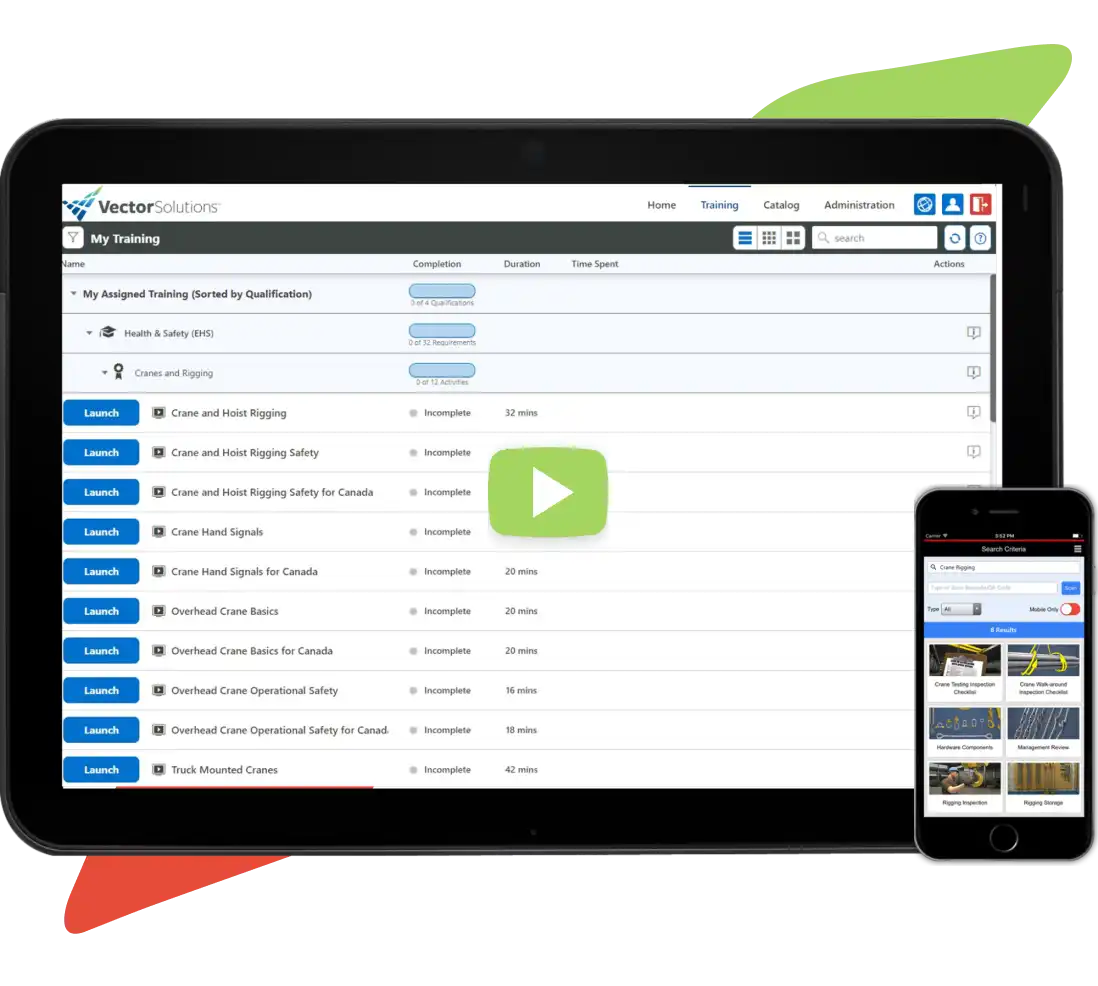
Serving the industry for over 25 years, Vector’s online training programs and learning management system, Vector LMS, are built for the compliance needs of engineering teams looking to streamline compliance training, manage continuing education, and enhance employee onboarding.
Our solution helps teams:
- Manage engineering training and continuing education requirements
- Ensure your engineers’ licenses are always up-to-date
- Minimize administrative workload
- Improve employee retention
- Ensure project and worksite compliance
Book a demo today and see how Vector’s continuing education engineering courses can benefit your workforce.

Frequently Asked Questions
Q: What Should I Look for in an Engineering Continuing Education Course?
A: When choosing an engineering continuing education course, look for programs that are industry-recognized, accredited for Continuing Education Units (CEUs) and Professional Development Hours (PDHs) credits, and tailored to your specific discipline. A strong course will cover relevant regulations, technologies, or practices and be delivered by knowledgeable instructors.
Flexibility, especially through online learning options, can also make a big difference for busy professionals.
Q: Who Should Take Online Engineering Continuing Education Courses?
A: Engineering continuing education courses are built for licensed professional engineers and experienced engineers looking to stay up-to-date with industry best practices. Employers often use these courses to ensure their teams remain compliant and current.
Q: What Makes a Good Continuing Education Course for Engineers?
A: A good continuing education course for engineers provides clear learning objectives, practical knowledge, and real-world applications. It should align with your state’s licensure board requirements and offer PDH or CEU credits.
Explore our engineering training course library.
Q: Why Are PDH Credits Important for Engineering Continuing Education?
A: PDH credits are essential for engineers to maintain an active Professional Engineer (PE) license in many states. Licensing boards typically require a specific number of PDHs annually or biannually.
Earning PDH credits through approved engineering continuing education PDH courses helps your engineers stay compliant and at the forefront of industry standards and emerging technologies.
Ready to Level Up Your CE Strategy?
Book a demo today and see how Vector’s LMS solution supports continuing education for engineers.
Request a Demo