September 3, 2026 4 min read

Business Case for EHS Software: How to Win Budget Approval
Industry:
Solution:
You know EHS software would reduce incidents and cut compliance risk. But knowing it isn’t enough to win budget approval. While you build the case in your head, incident costs keep growing. Premiums keep climbing. Another budget cycle passes.
A solid business case isn’t built on safety belief. It’s built on numbers your CFO already gets: cost savings, payback period, and what inaction costs over time.
Quantify incident costs, insurance impact, compliance gaps, and workforce readiness together. The case makes itself. Approval comes faster.
Main Takeaways
- A solid business case rests on five cost areas: incident costs, admin labor, compliance gaps, insurance impact, and ESG reporting effort.
- Connecting training completion to incident trends lets you show upstream risk reduction, beyond just post-incident costs.
- The three-year cost of doing nothing can top $400,000 for a mid-size employer. Inaction is its own financial choice.
- Your CFO, COO, and CEO each need the same baseline numbers. Frame them around the metric each leader already tracks.
- EMR gains take three years of loss history to show up. Starting sooner directly affects future premium costs.
Know What EHS Software Should Cost Your Organization
Selecting the right EHS solution starts with matching features to your actual risk profile. This guide walks through what to evaluate before you buy.
Read the EHS Software Guide
How to Quantify Your Current Safety Costs
A solid business case starts with numbers your finance team already tracks. Before you project savings, you need a baseline across five cost areas. These show up in existing budgets, claims records, and compliance logs.
Five Cost Categories to Baseline
Quantify these five cost areas using data your team already has:
- Incident costs: Pull your workers’ comp claims history, lost workdays, and medical spend. If your data is thin, the National Safety Council puts the average cost per medically consulted injury at $48,000 (2024 figure). That gives you a usable benchmark.
- Admin labor: Estimate hours your team spends on manual incident logging, OSHA 300/301 prep, and corrective-action tracking. OSHA’s own paperwork burden estimate averages 14 minutes per Form 300 entry and 22 minutes per Form 301 report, according to OSHA’s recordkeeping forms. That time adds up fast without automation.
- Compliance gaps: Estimate your citation risk using current OSHA penalty ceilings: $16,550 per serious violation and up to $165,514 per willful or repeat violation as of January 2026. Missed deadlines and gaps in records create both direct fines and indirect costs like more frequent inspections.
- Insurance and EMR impact: Your experience modification rate (EMR) is a multiplier on your base workers’ comp premium. It rises or falls based on your loss history. A 500-person employer with a 1.15 EMR pays 15% more than the industry baseline. Each prevented lost-time claim pulls that modifier down over three years. Lost-time claim frequency fell 5.9% in 2024. Yet indemnity severity rose 4.9% and medical severity rose 6.3%, per NCCI. Fewer claims don’t lower premiums when the rest cost more.
- ESG reporting effort: If your team faces disclosure needs under GRI 403 or SASB standards, hours go toward compiling safety data by hand. Finance already cares about this cost. It becomes a larger factor in the pitch covered below.
Listing all five areas in one baseline gives your CFO a familiar cost picture. It also gives you the raw inputs for ROI, payback, and cost of inaction.
How to Calculate EHS Software ROI, Payback, and Cost of Inaction
Your baseline costs are now set. The next step is projecting how much EHS software can reduce. Then convert the gap into ROI and payback numbers your finance team can approve.
Project Realistic Savings From Each Cost Category
Turn each baseline cost into a cautious savings estimate. For incident and claims reduction, a 15–25% drop in recordable incidents is a solid starting range. This applies when you move from manual to digital tracking. Software closes gaps in hazard follow-up and near-miss visibility. Label this as a modeling guess in your proposal.
For admin efficiency, estimate hours saved per week. Replace manual OSHA log entry and report creation with automated workflows. Then multiply by your loaded labor cost.
One ROI lever that standalone EHS tools miss is upstream prevention through training. Connecting EHS management to training completion reduces incidents before they happen. Workers finish required safety training. Certifications stay current. Skill gaps get flagged before someone takes on a high-risk task.
Vector Solutions combines EHS management with a learning management system. This lets you tie training records to incident trends. You can show which training investments actually reduce loss.
Run the ROI and Payback Math
To calculate EHS software ROI, subtract the total first-year cost (licensing, setup, training) from total projected annual savings. Then divide net savings by total cost. Multiply by 100 for your first-year ROI percent.
Payback (months) = (First-Year Cost ÷ Annual Savings) × 12
Here’s how the math works for a 500-person maker with a 1.15 EMR and two lost-time injuries per year. Start with current annual costs:
- Incident costs: $96,000 (two LTIs at $48,000 each)
- Admin labor: $18,200 (10 hours/week at $35/hour across 52 weeks)
- Compliance gaps: $16,550 (one serious citation risk)
- EMR surcharge: $30,000 (on a $200,000 base premium)
Total annual cost: roughly $160,750.
Now apply cautious savings guesses. A 25% incident reduction saves $24,000. Cutting admin time by 40% saves $7,280. A 50% drop in citation risk avoids $8,275. Improving the EMR from 1.15 to 1.05 saves $20,000 in premium costs. Total projected annual savings: roughly $59,555.
Against a first-year cost of $35,000 for SaaS licensing and setup, the ROI comes to ($59,555 − $35,000) ÷ $35,000 × 100 = 70%. Payback lands at ($35,000 ÷ $59,555) × 12 ≈ 7.1 months.
Copy the table below into a budget memo or slide deck. Each row maps a cost area to its current estimate, projected savings, and data source.
| Cost Category | Current Annual Cost | Projected Savings | Data Source |
| Incident costs | $96,000 | $24,000 (25% reduction) | Workers’ comp claims + NSC benchmark |
| Admin labor | $18,200 | $7,280 (40% time reduction) | Internal time study |
| Compliance exposure | $16,550 | $8,275 (50% risk reduction) | OSHA penalty schedule |
| Insurance / EMR | $30,000 | $20,000 (EMR 1.15 → 1.05) | Carrier mod worksheet |
| Total | $160,750 | $59,555 |
The choice here isn’t “invest or spend nothing.” It’s absorbing status-quo costs year after year while severity trends push them higher. Model the three-year cost of inaction:
- Recurring incident spend: $96,000 × 3 = $288,000
- EMR-driven premium overage: $30,000 × 3 = $90,000
- Total citation risk at one serious violation per year: $49,650
- Indirect costs: lost productivity and replacement labor
Cautious three-year status-quo cost: over $400,000. Compare that to a three-year software cost of roughly $90,000–$105,000. That covers year-one setup plus ongoing licensing. This is a choice between two cost paths. The numbers make it clear.
Connect Incident Data and Training in One Platform
When EHS management and training records live in separate systems, auditors see gaps and CFOs see risk. Vector EHS Management connects both workflows so you can show what changed after every finding.
Explore Vector EHS Management Software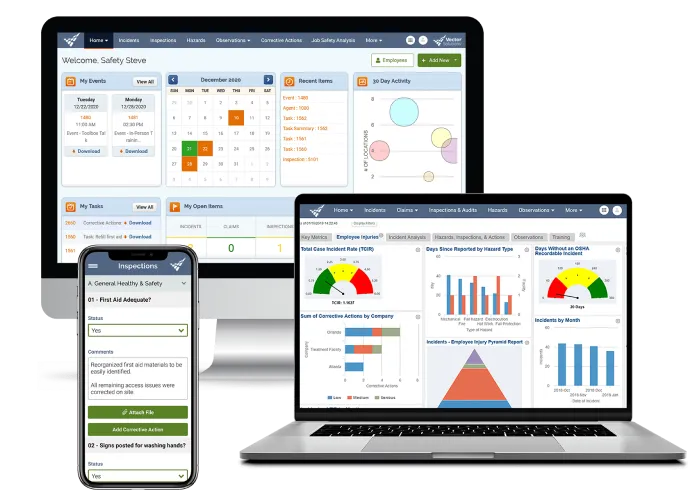
How to Pitch the Business Case to Every Executive in the Room
Your ROI model needs different framing for each person in the room. Your CFO looks at cost savings and payback. Your COO focuses on uptime and efficiency. Your CEO or board weighs enterprise risk and ESG readiness. The same baseline numbers support all three talks. Lead with the metric each person already tracks.
Before tailoring by audience, map your case to the goals leadership already follows:
- Uptime and labor efficiency
- Insurance cost and compliance gaps
- ESG tracking and workforce readiness
EHS software becomes a reporting tool for the whole business. It feeds data into frameworks like GRI 403 and SASB industry standards. Those frameworks need specific data fields: incident rates, severity metrics, corrective-action rates, and training hours.
ISSB/IFRS materials now point companies to SASB metrics like “Employee Health & Safety.” California’s SB 253 sets 2026 Scope 1–2 reporting deadlines. Both add pressure for audit-ready safety data.
Tailor the Pitch by Stakeholder
For your CFO, lead with the financial details. Open with the 7-month payback, the 70% first-year ROI, and the $400,000+ three-year cost of doing nothing. Stress EMR-driven premium savings and compliance costs you’re avoiding. Use the ROI summary table as a leave-behind. Keep the numbers in front of them after the meeting.
For your COO, lead with daily impact. Frame the software as a way to reduce disruptions from incidents and inspections. Key talking points that land here:
- 40% reduction in manual reporting time
- Real-time visibility into open corrective actions across sites
- Fewer stoppages from repeat incidents
Hours freed from admin work go back into operations.
For your CEO or board, lead with enterprise risk. Position EHS software as the system that protects your license to operate. A single willful citation carries a $165,514 penalty. GRI 403 and SASB disclosures require audit-ready data your current systems may lack. In 2024, 4,337 preventable workplace deaths occurred, per the National Safety Council. Safety remains a board-level risk.
When each person hears the metric they’re already tracked on, your business case stops sounding like a safety request. It sounds like a smart investment.
Put Your Business Case into Action with Vector Solutions
You now have a framework for quantifying incident costs, calculating ROI, and tailoring your pitch. The structure works whether you’re presenting for the first time or trying again after a past cycle.
Vector Solutions connects EHS management and training compliance in one platform. The business case gets stronger when you can prove upstream risk reduction alongside incident tracking.
Our data shows how training completion reduces incidents before they happen. Centralized dashboards cut admin time. Audit-ready records protect you from citation risk and premium creep.
See how Vector EHS Management Software connects safety data, training records, and compliance workflows to reduce risk.
Show Your CFO the Numbers Before the Next Budget Cycle
High-EMR operations and multi-site teams often recoup their investment within months. A demo maps Vector EHS directly to your incident costs and compliance exposure.
Request a Demo Today
FAQs About Business Case for EHS Software
What Are the Specific Cost Categories I Need to Quantify to Build a Credible Business Case?
Quantify five cost areas your finance team already tracks:
- Incident costs (the National Safety Council benchmarks $48,000 per medically consulted injury)
- Admin labor
- Compliance gaps (OSHA penalties reach $165,514 per willful violation)
- Insurance and EMR impact (from your carrier mod worksheet)
- ESG reporting effort
These five areas form the baseline for ROI, payback, and cost of inaction.
How Long Does It Typically Take to See Payback From EHS Software?
Most groups see payback in 7 to 12 months. That’s when they quantify incident reduction, admin savings, compliance risk, and premium impact together. The example in this article shows 7.1-month payback for a 500-person maker. It uses cautious guesses: 25% incident reduction and 40% admin time savings. Your actual payback depends on how many cost areas you can back with internal data.
What Does It Cost My Organization to Not Invest in EHS Software?
The cost of inaction is status-quo spending growing year after year:
- Recurring incident costs
- EMR-driven insurance surcharges
- Ongoing citation risk
- Admin waste that never gets recovered
For a mid-sized employer, that tops $400,000 across three years. Model it by multiplying your annual incident costs, EMR overage, and citation risk by three. Then add indirect costs like lost productivity.
How Do I Present the Business Case to Leadership Who Don’t Speak Safety Language?
Translate your ROI model into the metric each person already tracks. Give your CFO payback period and cost savings. Give your COO uptime and admin hours recovered. Give your CEO enterprise risk and ESG readiness.
Use the ROI summary table as a CFO leave-behind. Share uptime data with your COO. For your CEO, use governance language: audit-ready records and board-level risk. Lead with the business outcome.
What if My Business Case Gets Rejected and I Need to Resubmit?
If your proposal is rejected, ask which cost areas leadership questioned. Then tighten those areas with better internal data or third-party benchmarks. Look for a trigger event that adds pressure:
- An upcoming OSHA inspection
- A workers’ comp renewal
- A recent incident
- A new ESG reporting deadline
A concrete event gives leadership a reason to act now.