









July 23, 2026 4 min read
What Is the ROI of EHS Software? How to Calculate It
Industry:
Solution:
Every month your organization runs without EHS software, it’s paying for that decision. It shows up as inflated workers’ comp premiums, avoidable OSHA penalties, and admin hours that never improve a single safety outcome. Incident costs compound quietly in the background. The bill doesn’t arrive as a line item. It hides across departments, and most EHS managers never get the chance to add it up.
That’s the real challenge with calculating the ROI of EHS software. It requires measuring both what you’re currently losing and what you stand to gain. Most EHS professionals can make the case in general terms. What they need is a number their CFO can weigh against any other capital request.
That number is buildable. EHS software ROI comes from cutting current losses and capturing gains at the same time. With the right framework, you can calculate a solid payback figure and walk into that budget meeting ready.
Main takeaways
- Indirect costs stack on top of every direct dollar of incident cost, and run highest for the smallest injuries. Preventable incidents cost far more than most organizations realize.
- Your Experience Modifier Rate (EMR) directly multiplies your workers’ comp premium. An EMR above 1.0 can also block your organization from certain contracts.
- EHS software ROI is calculated by totaling annual incident costs, compliance exposure, and premium overpayment. Then subtract and divide by the software’s annual cost.
- Organizations with high incident rates or an EMR above 1.2 often recoup software costs within three to six months.
- Presenting your Total Addressable Loss to a CFO changes the talk from software cost to the cost of preventable losses your organization already carries.
Know What EHS Software Should Cost Your Organization
The right EHS solution covers its own cost. This guide walks through what to evaluate before you buy, so you can match features to your actual risk profile.
Read the EHS Software Guide
What your organization loses without EHS software
Before you can calculate what EHS software returns, you need to see what your operation already spends. Look at incidents, compliance penalties, wasted admin time, and inflated insurance premiums.
The national picture sets the scale. Occupational injuries cost the U.S. economy $181.4 billion in 2024, according to the National Safety Council. At the incident level, indirect costs stack on top of every direct dollar, and OSHA’s Safety Pays model shows the ratio runs highest for the smallest injuries: legal fees, production delays, retraining, and the morale hit after a serious injury.
A single $50,000 recordable incident can carry $100,000 or more in total cost once indirect costs are included. The damage isn’t only financial. Each lost-time injury case in 2024 resulted in a median of eight days away from work, according to the Bureau of Labor Statistics, direct capacity you don’t recover. These are costs you’re already absorbing. The only question is whether you can see them. Without EHS software, you’re paying the full price of preventable incidents.
Compliance penalties add another layer. OSHA’s 2026 maximums reach $16,550 per serious violation and $165,514 per willful or repeat violation, as published on OSHA’s penalties page. A facility with five unresolved serious findings faces $80,000 or more in potential fines before indirect costs enter the picture.
The efficiency costs hiding in manual processes
Teams managing safety through spreadsheets and paper forms spend hours every week on data entry, chasing signatures, and building audit files. That time produces no safety gains. Manual data errors add rework on top.
The workload is growing, too. OSHA’s 2024 electronic recordkeeping expansion now requires case-level 300 and 301 submissions for high-hazard employers with 100 or more workers. That increases both the volume of work and the public visibility of your data.
Add up audit hours, rework from manual errors, and the growing recordkeeping burden. That total is one of the largest costs most organizations never see.
How EMR inflates your workers’ comp premiums
The Experience Modifier Rate (EMR) is a multiplier your insurer applies to your base workers’ comp premium. It reflects your claims history relative to your industry average. An EMR of 1.0 means you’re average. Above 1.0, you pay more. Below 1.0, you pay less.
The math is simple. If your base premium is $500,000 and your EMR sits at 1.2, you pay $600,000. Drop that EMR to 1.0 and you pay $500,000. That’s $100,000 in annual savings from the same workforce doing the same work. The NCCI ABCs of Experience Rating walks through this formula in detail.
These savings grow more valuable over time. Workers’ comp medical severity rose about 6% in accident year 2024 even as claim frequency declined, according to NCCI. Each prevented claim saves more today than it did a year ago.
EMR is more than an insurance cost. Some prequalification programs require an EMR of 1.00 or lower to bid on contracts. An EMR above that threshold can block your organization from public and institutional work entirely. That turns a safety metric into a direct revenue limit.
How to calculate the ROI of EHS software
Calculating the ROI of EHS software means totaling your current annual losses from the categories above. Then subtract the software’s annual cost and divide by that cost. The result gives your CFO a percentage to compare against any other capital request.
The core formula is:
ROI (%) = [(Total Annual Savings − Annual Software Cost) ÷ Annual Software Cost] × 100
- Total your annual incident-related costs. Add direct costs (medical, indemnity, property damage) and indirect costs (use the indirect-cost ratios from the previous section to estimate legal fees, production delays, retraining, and morale impact).
- Add compliance penalty exposure and administrative time cost. Estimate the dollar value of hours your team spends on manual data entry, audit prep, and signature chasing. Include any outstanding or likely OSHA citation exposure.
- Add workers’ comp premium overpayment above EMR 1.0. Multiply your base premium by your current EMR, then by 1.0. The difference is what you’re overpaying.
- Sum these as your Total Addressable Loss. This is the annual cost your organization carries without EHS software.
- Subtract your annual software cost and apply the formula. The result is your projected ROI percentage.
Two worked examples show how this formula scales. Both use the same inputs. A mid-size manufacturer with 200 employees and a large multi-site operation with 1,500 employees produce different dollar outcomes with comparable ROI percentages. The following table uses sample figures to show the calculation in practice.
| Input/Output | Mid-Size Manufacturer (200 employees) | Enterprise Operation (1,500 employees) |
| Annual incident costs (direct + indirect) | $200,000 | $1,200,000 |
| Compliance/admin time cost | $45,000 | $250,000 |
| Workers’ comp premium overpayment | $75,000 | $350,000 |
| Total Addressable Loss | $320,000 | $1,800,000 |
| Annual software cost | $40,000 | $150,000 |
| Net annual savings | $280,000 | $1,650,000 |
| ROI (%) | 700% | 1,100% |
| Estimated payback period | ~2 months | ~1 month |
When does EHS software pay for itself?
The EHS software payback period is the time it takes for savings to exceed the total investment. How quickly you get there depends on your starting point.
Organizations with high incident rates or an EMR above 1.2 often recoup software costs within three to six months. Premium cuts and avoided incidents alone drive that return. Most mid-size operations reach full payback within 12 months once compliance time savings and productivity gains are factored in.
Over a longer period, Verdantix research found an average 239% five-year ROI for EHS software investments. That benchmark dates to 2018, but it remains the most widely cited figure in the industry. Confidence in EHS spending continues. A 2025 Verdantix survey found 28% of firms considering 10% or greater EHS spend increases for the coming year. The question for your CFO isn’t whether this pays off, but how quickly.
A solid ROI calculation uses your organization’s own data. The comparison table gives your CFO two concrete scenarios to benchmark against.
Cut Audit Prep Time and Close Corrective Actions Faster
Manual recordkeeping stretches compliance cycles and leaves documentation gaps. See how Vector EHS Management handles OSHA logs, incident tracking, and corrective actions in one system.
Explore OSHA Recordkeeping Software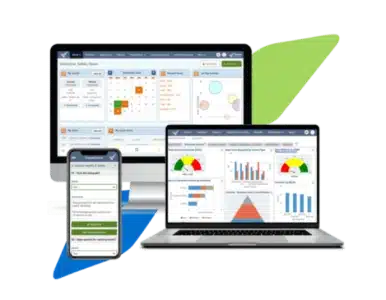
How to present your EHS software business case to a CFO
Winning budget approval means turning your ROI calculation into a three-part story. Frame safety costs as revenue protection. Convert safety KPIs into financial metrics. Answer the objections your CFO will raise.
Step 1: Frame cost avoidance as revenue protection. CFOs do not budget for “safety improvements.” They budget against risk. Present your incident costs, premium overpayment, and penalty exposure as uncontrolled liabilities the organization currently carries. Open with your Total Addressable Loss from the ROI calculation. That number changes the talk from “how much does the software cost?” to “how much are we already spending on preventable losses?”
Step 2: Translate safety KPIs into financial language. TRIR becomes “cost per 100 employees.” EMR becomes “annual premium multiplier.” Audit completion time becomes “hours of labor cost per compliance cycle.” Every metric you present should have a dollar sign attached. Your CFO evaluates investments in financial terms, so your safety data needs to arrive in that format.
Step 3: Handle the “we’ve never had a major incident” objection. Change the question. The issue isn’t whether an incident will happen. It’s what the financial exposure is when it does. A single willful OSHA violation at $165,514 plus indirect costs can exceed three years of software investment. The absence of past incidents isn’t a risk assessment. It’s false confidence, and your CFO understands that when it’s presented in dollar terms.
Organizations that combine EHS management with workforce training through an integrated platform add a second ROI stream. Training compliance reduces incident frequency. Fewer incidents reduce workers’ comp claims. Fewer claims lower EMR, which cuts premiums. Vector EHS Management paired with Vector LMS creates this effect across 24,000+ client organizations. A single-system ROI calculation underestimates the return because it misses this second stream entirely.
KPIs to track after implementation
Track these metrics quarterly to measure EHS software ROI after launch. Compare them against your pre-launch baselines:
- Total Recordable Incident Rate (TRIR) trend, the primary indicator of whether incident frequency is declining.
- Audit completion time (hours per cycle), measures the efficiency gain from centralized records and automated workflows.
- EMR year-over-year trend, tracks the insurance premium impact of your improved safety performance.
- Training compliance rate, the percentage of required completions finished on time. This connects training investment to incident prevention.
- Corrective action close-out time, days from hazard finding to resolution. This shows how quickly your team converts findings into fixes.
A 12-month before-and-after comparison across these KPIs gives your CFO proof that the investment delivered. Attribute savings to the software by isolating the change in each metric from the launch date forward.
Start building your business case with Vector Solutions
You now have a framework for measuring what your operation loses without EHS software. You can calculate a solid ROI number. And you can present it in the financial language your CFO expects.
We built Vector Solutions to serve exactly this moment. Our platform combines EHS management with workforce training in one system. That creates a stacked ROI that standalone tools can’t match. Organizations using Vector EHS Management and Vector LMS together see both incident reduction and training efficiency gains. These are two separate ROI streams that reinforce each other.
See Your ROI Before Your Next Budget Meeting
High-EMR operations and multi-site teams often recoup their investment within months. A demo shows exactly how Vector EHS Management maps to your incident costs and compliance exposure.
Request a demo today
FAQs about ROI of EHS software
What is a good ROI benchmark for a software investment?
Most enterprise software investments target a 3:1 return (300% ROI) within three years. EHS software often beats this benchmark. Verdantix research found an average 239% five-year ROI for EHS software investments. Payback periods often fall under 12 months. That return compounds over time as incident rates drop and EMR improves.
Can I calculate ROI if my organization has never had a major incident?
Yes. Calculate ROI using your current exposure costs rather than past incident costs. Total these items:
- Annual workers’ comp premium overpayment above EMR 1.0
- Admin time cost for manual compliance processes
- Potential penalty exposure from unresolved OSHA findings
These are real costs you’re paying today. Add a conservative incident cost projection using your industry’s average rate and median cost per case.
How long does it take to see measurable ROI after implementing EHS software?
Most organizations see returns within the first compliance cycle, typically 3 to 6 months. Audit time cuts and fewer admin errors drive early gains. Workers’ comp premium cuts tied to EMR take 12 to 24 months to show up. Insurers calculate EMR annually using a three-year claims window. Corrective action speed and training compliance gains become visible at the 6 to 12 month mark.
Does EHS software ROI differ by industry or company size?
The ROI drivers stay the same across industries:
- Incident cost avoidance
- Compliance efficiency
- Insurance savings
But the dollar amounts and payback speed vary. Your baseline incident rate, current EMR, and admin complexity all play a role. Construction and manufacturing operations with elevated EMRs or frequent recordables typically reach payback in under six months. Multi-site operations gain added ROI from centralized reporting and cross-location benchmarking.
Can I use Vector EHS Management for both incident tracking and training compliance?
Vector EHS Management handles incident tracking, corrective actions, inspections, and regulatory reporting. For training compliance, Vector LMS connects to the EHS platform. It manages course assignments and tracks completions. Training records tie to specific hazards or corrective actions. This creates a closed-loop system where training gaps found during incidents trigger assignments. You can report on both incident trends and training compliance from one system. That’s useful for audits and insurance reviews.