May 15, 2026 5 min read

Safety KPI Examples Every EHS Team Should Track
Industry:
Solution:
You track TRIR and DART every quarter. You report the numbers to leadership. But when your VP of Operations asks whether a 2.5 TRIR is good enough, you don’t have an answer. You don’t know your industry’s baseline. And you can’t prove whether last quarter’s training push caused this quarter’s incident drop. Most EHS teams measure safety KPIs without the context to read them or the direct links to justify the programs behind them.
Safety key performance indicators gain meaning only when benchmarked against industry standards. They must also connect directly to the activities that produce them. This article examines the safety metrics that matter alongside sector averages for your industry. You’ll learn how to turn raw safety KPI data into budget approvals and program ROI using an executive reporting framework.
Main takeaways
- Lagging indicators like TRIR measure outcomes that already happened. Leading indicators like near miss frequency rate measure prevention work you control now.
- A TRIR of 2.5 can signal strong results or a red flag depending on your industry. Manufacturing averages 2.8, utilities average 1.8.
- Sites holding daily toolbox talks saw about 81% lower TRIR compared to those holding them monthly, per industry data.
- SIF rate flags incidents that could cause death or lasting disability. Events that general recordable counts can bury next to minor cases.
- Executive dashboards should open with avoided costs. A 10% TRIR reduction at a site with 20 incidents cuts about $86,000 in direct injury costs.
Choose KPIs That Prove Prevention
Get a practical list of safety KPI options and when to use them, so your dashboard balances lagging results with leading prevention activity.
Download Safety KPI Guide
Lagging and leading safety key performance indicators to track
Every strong EHS program relies on two types of safety KPIs working together. Lagging indicators are reactive—they tally outcomes that already happened, like recordable injuries and lost workdays. Leading indicators are proactive. Sometimes called positive performance indicators, they measure the prevention work you control right now. You need both on your dashboard. One measures outcomes after the fact. The other tells you whether your prevention work is effective.
Lagging indicators (outcomes that already happened):
- Total Recordable Incident Rate (TRIR)
- DART rate
- Lost Time Injury Frequency Rate (LTIFR)
- First Aid Case Rate
Safety leading indicators examples (prevention work you control now):
- Near miss frequency rate
- Safety training completion rate
- Corrective action closure rate
- Safety compliance rate
OSHA’s recommended practices framework puts leading indicators first for a reason. They give you a window to act before a hazard becomes a recordable event.
Lagging safety KPIs
1. TRIR
TRIR is the baseline safety KPI most groups report. The formula is simple:
TRIR = (Number of OSHA recordable incidents × 200,000) ÷ total hours worked
Say your site logged 5 recordable incidents across 500,000 hours worked. Your TRIR is 2.0. For national context, the private-industry average total recordable case rate dropped to 2.3 per 100 full-time workers in 2024. That’s down from 2.4 the year before, per the Bureau of Labor Statistics.
2. DART rate
DART rate narrows the lens to cases with days away, restricted duty, or job transfer:
DART rate = (DART cases × 200,000) ÷ total hours worked
With 3 DART cases and 500,000 hours, you get a DART rate of 1.2.
3. LTIFR
LTIFR uses a different multiplier to adjust lost-time injuries across larger groups:
LTIFR = (Lost-time injuries × 1,000,000) ÷ total hours worked
Two lost-time injuries over 500,000 hours yields an LTIFR of 4.0. Both safety metrics carry added weight now. OSHA’s expanded Injury Tracking Application requires establishments with 100 or more workers in high-hazard industries to submit case-level Form 300 and 301 data. Accurate DART and TRIR records are now a regulatory must, not just an internal task.
4. First Aid Case Rate
First aid case rate tracks minor injuries requiring only first aid treatment, not medical attention beyond basic care:
First aid rate = (First aid cases × 200,000) ÷ total hours worked
Ten first aid cases across 500,000 hours yields a rate of 4.0. These cases don’t appear in TRIR or DART, but trends here often predict recordable spikes. Rising first aid rates flag emerging hazards before they escalate to reportable severity. Track this alongside TRIR to see the full injury spectrum, from minor cuts to lost-time incidents.
Leading safety KPIs (positive performance indicators)
5. Near miss frequency rate
Near miss frequency rate measures how often your workforce reports close calls:
NMFR = (Number of near misses × 200,000) ÷ total hours worked
Forty near misses across 500,000 hours gives you an NMFR of 16.0. A climbing NMFR is a good sign. It reflects a culture where people speak up, not a site where hazards are growing.
6. Safety training completion rate
Safety training completion rate measures whether your workforce finishes assigned training:
Training completion rate = (Employees who completed required training ÷ employees assigned) × 100
If 450 out of 500 assigned workers finish on time, you’re at 90%. That number matters more than most teams think. A 2024 peer-reviewed study in the Journal of Marketing Research found that safety training mandates cut injury rates by 0.54 percentage points and delivered an estimated 42% ROI.
Practice-level data supports the link. Contractors holding daily toolbox talks saw about 81% lower TRIR compared to those holding them monthly. New-hire sessions longer than three hours were linked to about 83% lower TRIR, per the ABC Safety Performance Report 2024.
7. Corrective action closure rate
Corrective action closure rate tracks whether fixes get done on time:
Corrective action closure rate = (Corrective actions closed on time ÷ total corrective actions assigned) × 100
ERM’s 2024 global health and safety survey ranked corrective-action closeout among the most useful leading indicators. It was cited by 18% of those surveyed. Many teams hit a wall here. Linking an open corrective action back to the incident that triggered it and the training that should prevent a repeat requires data in one place. Platforms like Vector EHS Management connect incident records, corrective actions, and training completion in a single system. That makes it possible to track these chains on their own, rather than combining spreadsheets after the fact.
8. Safety compliance rate
Safety compliance rate measures how well your workforce follows required safety procedures:
Compliance rate = (Safety actions completed ÷ safety actions required) × 100
Track compliance across training sessions, equipment inspections, PPE audits, and procedure adherence. If you require 50 monthly safety actions and complete 45, your compliance rate is 90%.
This leading indicator reveals whether your policies translate to daily practice. Low compliance rates flag gaps between written procedures and floor reality. Lagging indicators like TRIR won’t catch this risk until someone gets hurt.
SIF rate: The safety KPI TRIR can miss
SIF rate flags incidents that carried the potential for death or lasting disability. Your general recordable count can bury these events next to first-aid cases and minor strains. The formula follows the same adjustment you already use:
SIF rate = (SIF incidents × 200,000) ÷ total hours worked
High-hazard industries are moving toward this metric. Traditional frequency rates hide severe exposure. The worldsteel 2024 data report warns that TRIFR and LTIFR “correlate poorly with the severity of accidents.” Now 95% of reporting steel-industry sites run a potential-SIF (pSIF) framework. Utilities have followed suit, sharing SIF rate in SEC filings using the same 200,000-hour adjustment. A site can post a falling TRIR while high-energy exposures quietly build up unless SIF rate sits next to it on your dashboard.
The evidence linking leading and lagging performance is no longer guesswork. Frequent toolbox talks, training completion rates above 90%, and on-time corrective action closure each track with clearly lower TRIR. The activities you manage today are the strongest predictor of next quarter’s recordable numbers.
Unify Incidents, Actions, And Training
Stop reconciling spreadsheets by centralizing incidents, corrective actions, and training records. Compare real-time trends and closure rates across sites from one system.
Explore Vector EHS Management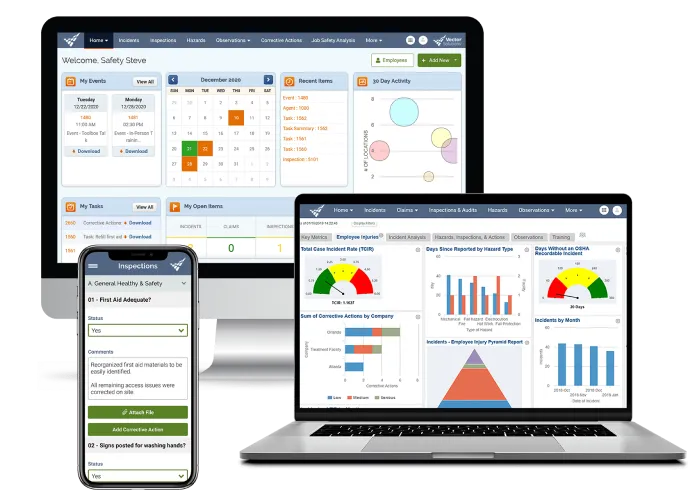
How to set up a safety KPI tracking program
If you’re building a safety metrics program from scratch or overhauling an existing one, follow this sequence:
- Identify your top three hazard exposures. Start with the hazards carrying the highest combination of severity and frequency. Machine guarding, falls, and powered industrial trucks appear on OSHA’s Top 10 every year. If those apply to your operations, they belong on your KPI dashboard.
- Pick 5-7 KPIs that connect to those hazards. Choose 2-3 lagging indicators (TRIR, DART, SIF rate) and 3-4 leading indicators (training completion, corrective action closure, near miss frequency). Each KPI should tie directly to a control you can adjust.
- Set baselines and targets. Pull your current-year TRIR and compare it to your sector average from the BLS benchmarks in the next section. If you’re above the benchmark, set a 10-15% reduction target for the next 12 months. For leading indicators, start with these completion-rate targets: 90% for training, 85% for on-time corrective action closure, and 30-day average resolution time for medium-risk corrective actions.
- Review quarterly and adjust annually. Check KPI trends every quarter. If a leading indicator isn’t moving or a lagging indicator isn’t improving, investigate the control behind it. Adjust your KPI mix annually as hazards and operations change.
The setup matters less than the rhythm. Consistent tracking with quarterly reviews beats perfect metrics tracked inconsistently.
TRIR benchmarks by industry: What good looks like
A TRIR of 2.5 can signal strong results or a red flag. The difference depends on which sector you work in. Without a benchmark, you’re reporting a number with no frame of reference.
The Bureau of Labor Statistics publishes sector-level total recordable case incidence rates every year. The private industry average dropped to 2.3 cases per 100 full-time workers in 2024, down from 2.4 in 2023, per the January 2026 BLS SOII release. The table below shows sector-level benchmarks from 2023.
| Industry | Average TRIR (2023) |
| Utilities | 1.8 |
| Construction | 2.3 |
| Private industry (all) | 2.4 |
| Manufacturing | 2.8 |
| Healthcare and social assistance | 3.6 |
Source: U.S. Bureau of Labor Statistics, Survey of Occupational Injuries and Illnesses, 2023.
A manufacturing plant running a 2.5 TRIR sits below its sector average of 2.8. That’s a strong position. But that same 2.5 at a utility company, where the average is 1.8, demands quick action. Whether you’re checking safety KPIs in manufacturing, healthcare, or any other sector, the baseline you compare against decides whether your number earns trust or concern from leadership.
How to report safety KPIs to leadership
Every talk with your VP of Operations about safety performance metrics should open with dollars, not rates. The average cost of a medically consulted workplace injury in 2023 was $43,000, per the National Safety Council. At a site recording 20 incidents per year, a 10% TRIR reduction cuts about $86,000 in direct injury costs. That figure gets attention in any budget review.
Build your executive dashboard around three KPI views:
- 12-month rolling TRIR trend – Shows whether injury rates are improving over time
- Corrective action closure rate – Proves you fix hazards before they cause incidents
- Training completion rate – Demonstrates prevention work is happening on schedule
These three connect the outcome your leadership cares about (fewer injuries) to the specific work producing that outcome. That link is the story that earns budget.
Distinguish between program results and your role performance:
- Program-outcome KPIs (TRIR, DART) measure whether the safety program is working
- Role-performance KPIs (corrective action closure rate, training delivery rate) measure whether you hit your tasks on time
In a performance review, you own the leading indicators you control directly. The group owns the lagging results those controls produce over time. When your corrective action closure rate climbs from 70% to 90% and DART trends down in the same period, you’ve framed prevention as an investment with a visible return, not a line item to cut.
Align your dashboard with OSHA reporting requirements. Establishments with 100 or more workers in high-hazard industries now submit case-level Form 300 and 301 data through the ITA. When your dashboard KPIs match the fields OSHA collects (TRIR, DART, and incident narratives), the same dataset serves both your internal updates and your yearly compliance filing. Platforms like Vector EHS Management pull TRIR trends, corrective action records, and training completion into a single dashboard view. You can build the executive report described above without stitching data from separate systems by hand.
The EHS teams that secure funding translate safety KPIs into avoided costs and reduced risk. Benchmarks and direct links supply the evidence. A focused dashboard supplies the format.
See Your Safety KPIs In One Dashboard
Stop stitching TRIR trends, corrective actions, and training records from separate systems. See how Vector EHS Management connects incident data to prevention work in real time with benchmarks, closure rates, and executive views built in.
Request a demo today
Track safety KPIs that drive decisions with Vector Solutions
Select the right mix of leading and lagging indicators. Interpret your scores against published industry averages. Then present that data in a cost-anchored executive dashboard. That combination gives you the standing to defend your program and the evidence to expand it.
Vector EHS Management brings incident data, corrective actions, and training completion together in one system. The direct links between prevention work and recordable outcomes are visible without manual combining. Every site follows the same protocols on the same timeline. You can show program ROI with real data your leadership will act on.
See how Vector Solutions helps EHS teams connect safety data and training outcomes in one place. Request a demo.
FAQs about safety KPIs
What is the difference between a safety KPI and a safety metric?
A safety KPI is a metric tied to a specific performance target or threshold. For example, “TRIR below 2.0” is a KPI. A safety metric is just a measurement with no goal attached, such as “TRIR is 2.5.” Every KPI is a metric, but not every metric becomes a KPI until you set a target. This matters when presenting to leadership. Executives need KPIs that show results against a goal, not raw safety metrics.
Should I track management training separately from workforce training?
Yes. Track the percentage of managers who’ve completed safety training as a standalone leading indicator. Management buy-in determines whether safety policies get enforced on the floor. If 100% of frontline workers complete training but only 60% of managers do, compliance breaks down at the supervisor level. Target 100% management training completion before rolling out new safety programs. This leading indicator predicts whether your policies will actually stick.
What safety KPIs should I personally be measured on as an EHS manager?
Your personal performance KPIs should focus on program execution. These include corrective action closure rate, audit completion rate, and training delivery rate. Outcome KPIs like TRIR and DART measure program results, not your individual performance. Role-performance KPIs track whether you hit your tasks on time and to standard. Program-outcome KPIs track whether those actions cut injuries over time. In a performance review, you own the leading indicators you control directly. The group owns the lagging results those controls produce.