July 23, 2026 4 min read

OSHA Compliance Requirements: What Employers Must Do
Industry:
Solution:
A willful OSHA violation now carries a maximum penalty of $165,514 per violation. A single missed recordkeeping deadline can trigger an unannounced inspection. For safety managers and EHS coordinators, these aren’t abstract risks. They’re the kind of exposure that lands on a VP’s desk.
That’s why OSHA compliance can’t live in a binder you update once a year. It has to be built into how your team works every day.
High-performing safety teams produce inspection-ready records as a natural result of daily work. They stop scrambling before audits. This guide is built around that standard.
Main takeaways
- OSHA compliance covers five core requirements: hazard identification, safety training, equipment maintenance, mandatory posting, and recordkeeping.
- Under the instance-by-instance citation policy, OSHA can issue separate penalties for each occurrence of a violation. Exposure multiplies quickly.
- Employers with 100 or more employees in designated high-hazard industries must now submit case-level injury and illness data, beyond just the annual summary.
- Hazard communication training must be refreshed on a phased schedule through 2026–2028 as labels and safety data sheets align with updated global standards.
- Assigning an employer representative and keeping records in one accessible location before any inspection occurs shapes how smoothly the process goes.
Know Which OSHA Standards Apply to Your Site
OSHA's four industry categories determine which standards govern your workplace. This course catalog maps the training requirements your team needs to stay covered.
Read the OSHA Compliance Training Catalog
What OSHA compliance requires and what it costs when you fall short
OSHA compliance is an employer’s ongoing legal duty under the Occupational Safety and Health Act of 1970. Employers must maintain a workplace free from recognized hazards. This covers hazard identification, safety training, recordkeeping, equipment maintenance, and mandatory posting. Enforcement relies on the General Duty Clause (Section 5(a)(1)), workplace inspections, and financial penalties.
That duty is actively enforced. OSHA conducted 34,625 inspections in FY 2024, according to the agency’s FY 2024 enforcement summary. These split nearly evenly between programmed visits targeting high-hazard industries and responses to complaints, referrals, and incidents.
The five core requirements every employer must meet
Every covered employer shares the same core duties. Specific standards vary by industry and hazard type. These five requirements map directly to what OSHA checks during an inspection:
- Hazard identification: Conduct workplace assessments and address recognized hazards before they cause injuries.
- Safety training: Deliver role-specific training as required by relevant standards, including hazard communication, lockout/tagout, and respiratory protection.
- Equipment maintenance: Inspect, maintain, and replace tools, machinery, and PPE on a documented schedule.
- Mandatory posting: Display the OSHA “Job Safety and Health: It’s the Law” poster where all employees can see it.
- Recordkeeping and reporting: Log work-related injuries and illnesses on OSHA Forms 300, 300A, and 301. Report fatalities and severe injuries within required timeframes.
Penalty tiers and the cost of non-compliance
OSHA adjusts penalty maximums each year for inflation. The current maximums below, in effect for 2026, show your financial exposure per citation:
| Violation Type | Maximum Penalty per Violation |
| Other-Than-Serious | $16,550 |
| Serious | $16,550 |
| Willful or Repeat | $165,514 |
| Failure to Abate | $16,550 per day beyond abatement date |
Those maximums can multiply fast. Under the instance-by-instance (IBI) citation policy expanded in April 2024, OSHA can issue separate penalties for each occurrence of a violation. Every untrained employee, every unguarded machine, and every missing label counts. A single site visit with ten instances of the same willful violation could generate over $1.6 million in proposed penalties (OSHA’s IBI citation policy memo).
The math works the other way, too. OSHA’s $afety Pays program estimates that indirect costs of a workplace injury exceed direct costs several times over. Lost output, retraining, and damaged morale add up. A funded safety program always costs less than after-the-fact citation response. It pays for itself before a compliance officer ever walks through your door.
How to build an OSHA-compliant safety program
Compliance gets easier when you break it into repeatable steps with documented outputs. The 6-Step OSHA Compliance Framework below maps each OSHA requirement to a specific action and a compliance artifact. That artifact serves as both your day-to-day reference and your inspection-ready evidence. Think of it as the employer-facing version of OSHA’s own Quick Start guide.
- Conduct a baseline hazard assessment. Walk every work area. Identify recognized hazards: chemical, physical, biological, and ergonomic. Prioritize the hazards that appear on OSHA’s most-cited list: fall protection (1926.501), hazard communication (1910.1200), respiratory protection (1910.134), and lockout/tagout (1910.147), according to the National Safety Council. Document your findings and rank them by severity.
- Create a written safety program. Document your policies, procedures, and roles in a single reference. Some teams call this an OSHA compliance manual. Include hazard-specific programs required by relevant standards, such as a hazard communication program, respiratory protection program, and emergency action plan.
- Build a training plan. Map each identified hazard to the OSHA standard that requires training. Assign role-specific courses and track completions with dates. Keep in mind the HCS 2024 update: employers must refresh hazard communication training on a phased schedule through 2026–2028. Labels and safety data sheets are aligning with GHS Rev. 7, per OSHA’s HCS 2024 fact sheet.
- Set up your recordkeeping system. Maintain OSHA Forms 300, 300A, and 301 for all recordable injuries and illnesses. Details on forms, thresholds, and electronic filing follow below.
- Establish an inspection cadence. Schedule internal self-inspections monthly or quarterly, based on hazard severity. Document every inspection, corrective action, and follow-up step.
- Conduct an annual program review. Evaluate injury trends, training completion rates, and near-miss reports. Update your written program, retrain where gaps appear, and reset priorities for the coming year.
OSHA recordkeeping: forms, thresholds, and electronic filing
Three OSHA forms make up the injury and illness recordkeeping system. Employers with 10 or fewer employees in most industries are exempt from routine recordkeeping. They must still report fatalities and severe injuries. The table below maps each form to its purpose, filing threshold, and deadline.
| Form | Purpose | Who Must File | Deadline |
| 300 (Log) | Log of work-related injuries and illnesses | Employers with 11+ employees (non-exempt industries) | Maintained year-round; retained 5 years |
| 300A (Summary) | Annual summary posted for employees | Same as Form 300; electronically submitted by establishments with 20–249 employees in high-hazard NAICS and all establishments with 250+ employees | Post Feb 1–Apr 30; electronic submission by March 2 |
| 301 (Incident Report) | Detailed report per incident | Same as Form 300; case-level electronic submission required for establishments with 100+ employees in designated high-hazard industries (2024 expansion) | Within 7 calendar days of learning of a recordable case; electronic submission by March 2 |
The 2024 electronic filing expansion raised the stakes on recordkeeping accuracy. Establishments with 100 or more employees in industries listed in Appendix B to Subpart E of 29 CFR Part 1904 face new requirements. They must submit case-level 300 and 301 data through OSHA’s Injury Tracking Application (ITA). OSHA uses this data to target programmed inspections. Accurate, timely submission is both a compliance requirement and a self-protection measure. Tools like Vector EHS Management automate OSHA 300/300A/301 log generation and ITA submission, cutting the manual work that leads to recordkeeping citations.
Stop Managing OSHA Logs in Spreadsheets
Manual recordkeeping is where citations happen. See how purpose-built software automates 300, 300A, and 301 log creation and flags recordable incidents in real time.
Explore OSHA Recordkeeping Software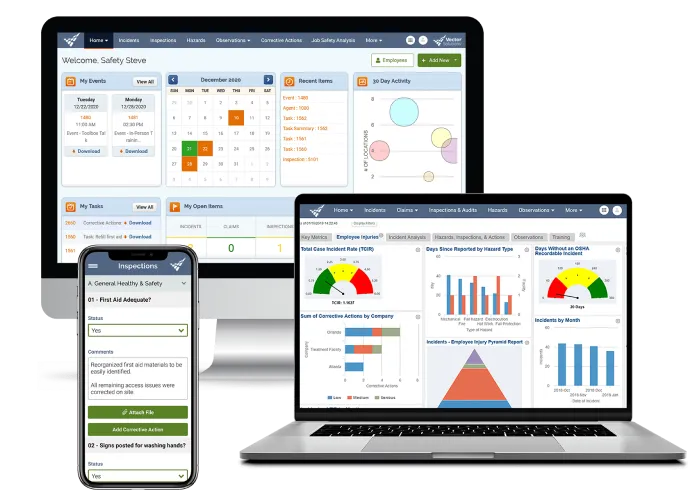
What to expect during an OSHA inspection
OSHA inspections follow a three-phase structure. Employers who prepare records and assign roles in advance turn a stressful event into a manageable process. The key is knowing what triggers an inspection and what the compliance officer will ask for.
Four situations typically bring an inspector to your site:
- An imminent danger report
- A fatality or severe injury
- A worker complaint or referral
- A programmed inspection targeting high-hazard industries or emphasis programs
With 34,625 inspections in FY 2024, complaint-driven and planned visits were equally likely.
The three inspection phases
Opening conference: The compliance safety and health officer (CSHO) presents credentials and explains the inspection scope. You have the right to ask for the reason and scope of the visit. As of May 2024, employees can authorize a third-party representative under the walkaround final rule. Plan for broader participation than past inspections may have included.
Walkaround: The CSHO observes conditions, interviews employees, reviews records, and photographs hazards. Your assigned employer representative should accompany the CSHO throughout. Take parallel notes and document the same conditions being observed.
Closing conference: The CSHO discusses findings and potential citations. This is your chance to provide added context, show corrective actions already underway, or share records the CSHO may not have reviewed.
Preparation shapes how smoothly each phase goes. Use this readiness checklist:
- Assign an employer representative and a backup before any inspection occurs.
- Keep OSHA 300 logs, training records, and written safety programs in a single accessible location. (Vector EHS Management’s inspection and audit tools give organizations one way to maintain this trail.)
- Verify the OSHA poster is displayed where all employees can see it.
- Confirm that hazard-specific programs are current and signed. These include hazard communication, lockout/tagout, and respiratory protection.
- Brief supervisors on their role: cooperate fully, answer only what’s asked, and document everything.
- Prepare a post-inspection response plan. You have 15 business days to contest citations through an informal conference or formal appeal.
Put your OSHA compliance system into action with Vector Solutions
You now have a framework for the five requirements that keep you compliant. Each step produces a documented artifact. Together, those artifacts form the evidence trail that separates a citation from a clean visit.
We built Vector Solutions to connect every piece of that framework in one platform. Our tools handle training assignment and tracking, automated OSHA 300/300A/301 log generation, and inspection management. ITA submission is built in, too. Your team spends less time on manual recordkeeping and more time on safety work that prevents injuries.
Turn Your Safety Program Into Inspection-Ready Evidence
High-hazard industry employers facing expanded ITA submission requirements need records that hold up on day one of a walkaround, not just at audit time.
Request a demo today
FAQs about OSHA compliance
Is OSHA compliance mandatory for all employers?
OSHA compliance is mandatory for most private-sector employers. The Occupational Safety and Health Act of 1970 sets the baseline. All covered employers must meet relevant OSHA standards and the General Duty Clause. That clause requires a workplace free from recognized hazards. Failure to comply can result in penalties up to $165,514 per willful or repeat violation, per OSHA’s penalty amounts. Exemptions apply to self-employed individuals and immediate family members of farm employers. Workplaces covered by other federal agencies, such as the Mine Safety and Health Administration, are also exempt. Twenty-two states and territories run their own OSHA programs. These may impose additional or more strict requirements.
What are the 4 categories of OSHA standards?
OSHA standards are organized into four categories by industry type:
- General Industry (29 CFR 1910): Covers manufacturing, warehousing, and most non-construction workplaces.
- Construction (29 CFR 1926): Applies to building, alteration, and demolition work.
- Maritime (29 CFR 1915–1919): Addresses shipyard employment, marine terminals, and longshoring.
- Agriculture (29 CFR 1928): Covers farming operations.
Most employers fall under General Industry. Verify your primary NAICS code to confirm which category and standards apply.
How long must I keep OSHA injury and illness records?
You must retain OSHA Form 300 and Form 301 for five years after the year they cover, per 29 CFR 1904.33. Form 300A must be posted from February 1 through April 30 each year. Retain it for the same five-year period. Electronic submission deadlines (March 2 each year for covered establishments) are separate from retention rules. Missing or incomplete logs are among the most frequently cited recordkeeping violations. OSHA can request records during any inspection or formal records request.
What should I have ready before an OSHA inspection?
Gather your OSHA 300 logs, training records, and written safety programs in one accessible location. Include equipment inspection logs. Assign an employer representative to accompany the compliance officer. Verify the OSHA poster is displayed. Brief supervisors to cooperate, answer only what’s asked, and document everything. Having records organized in advance shows readiness and cuts inspection time. If citations are issued, you have 15 business days to contest them.
Do small businesses need to comply with OSHA recordkeeping requirements?
Employers with 10 or fewer employees in most industries are exempt from routine OSHA recordkeeping on Forms 300, 300A, and 301. Still, all employers must report fatalities within 8 hours, per 29 CFR 1904.39. Hospitalizations, amputations, or loss of an eye must be reported within 24 hours. The exemption covers only routine recordkeeping. Small employers must still meet all other OSHA standards, including training, posting, and hazard controls. Documenting injuries and near misses internally is still wise. OSHA can request records after a complaint or programmed inspection.