October 22, 2026 6 min read

What Is Industrial Hygiene? Principles, Hazards, and Programs
Industry:
Solution:
EHS managers inherit hazard programs built on checklists and disconnected spreadsheets. Exposure data sits unused, controls drift, and verification never happens consistently.
What is industrial hygiene? Industrial hygiene is the science of protecting workers from workplace health hazards by anticipating, recognizing, evaluating, controlling, and confirming exposure risks. It turns hazard awareness into measured, documented, verifiable protection. It focuses on preventing illness before it occurs rather than reacting to incidents, and applies across manufacturing, healthcare, construction, and utilities.
This guide covers the five ARECC principles and what happens at each step, the five workplace hazard categories, the hierarchy of controls, how exposure limits work, and how to build an industrial hygiene program that holds up under audit. For broader context on how these practices fit into overall workplace safety, see what EHS is and why it matters.
Main Takeaways
- Industrial hygiene follows five principles: anticipation, recognition, evaluation, control, and confirmation (ARECC). Confirmation is the step most programs skip.
- Workplace hazards fall into five categories: chemical, physical, biological, ergonomic, and psychosocial. Psychosocial hazards are newly recognized as a core IH concern.
- The hierarchy of controls ranks protection by effectiveness, from elimination down to PPE. Controls higher on the hierarchy protect everyone by default, while PPE protects only those who wear it correctly.
- Exposure limits come from different bodies and do not always agree. OSHA PELs are legally enforceable, while ACGIH TLVs and NIOSH RELs are health-based recommendations that are often stricter.
- A program is only verifiable if monitoring data, corrective actions, and follow-up sampling are documented together. Without that record, you cannot show a control actually worked.
The State of Industrial Worker Safety and Wellbeing
What workers say about hazards, training, and the conditions they work in.
Read the Report
The ARECC Principles: How Industrial Hygiene Works in Practice
Industrial hygiene follows five principles, anticipation, recognition, evaluation, control, and confirmation (ARECC), that move teams from identifying potential hazards to verifying that controls actually reduced worker exposure.
- Anticipation. Industrial hygienists predict hazards before they appear by reviewing processes, materials, and job tasks, typically during design or process change.
- Recognition. Hazards that already exist are identified through walkthroughs, safety data sheets, and worker input, usually led by the industrial hygienist. Teams that need a structured approach can start with hazard identification training.
- Evaluation. Exposure levels are measured through air sampling, including for respirable crystalline silica, noise dosimetry, and other IH testing methods, which quantify risk against an applicable limit.
- Control. Measures are implemented to eliminate or reduce exposure using the hierarchy of controls.
Many sources still teach a four-principle version, AREC, which leaves out confirmation. Both versions are legitimate, but ARECC reflects current AIHA consensus.
Why Confirmation Completes the Framework
Many programs stop after implementing controls, but confirmation closes the loop by verifying that controls actually reduced exposure to acceptable levels. It includes follow-up monitoring, workplace inspections, corrective-action closure, and trend analysis over time.
In practice, confirmation means scheduling re-sampling after controls are installed, comparing post-control exposure data against the original baseline, documenting whether results meet the applicable exposure limit, and assigning corrective actions if the control fell short. Without these steps, there is no evidence the control works.
The gap shows up in industry data. Half of respondents (50%) in the AIHA Noise and Respiratory Survey report they have no specific planning process for advancing up the hierarchy of controls for noise exposures after initial short-term controls are in place. Their approach is ad hoc or case-by-case. Among US respondents, that figure rises to 53%.
The same survey found that 55% of respondents holding the CIH certification report an ad hoc approach, while 66% of those holding an equivalent non-CIH certification report a systematic process. Credentials alone do not guarantee systematic practice, which is why confirmation works best as a named, recurring step in the program.
Without confirmation, an industrial hygiene program is a plan on paper. With it, you have measurable proof that workers are protected and documentation that holds up under audit.
Workplace Hazards, Controls, and Exposure Limits
Industrial hygiene addresses five categories of workplace hazards and uses the hierarchy of controls and exposure-limit standards to determine how aggressively each must be managed
The Five Workplace Hazard Categories
Industrial hygiene programs must assess all five hazard categories, not just the ones that trigger obvious symptoms. Psychosocial hazards, including fatigue, chronic stress, shift-work demands, and workplace violence risk, are gaining recognition as core IH concerns.
| Hazard Category | Common Examples | Typical Controls |
| Chemical | Solvents, dust, benzene vapors, lead fumes | Ventilation, substitution, respiratory protection |
| Physical | Noise, vibration, radiation, extreme temperatures | Engineering enclosures, shielding, administrative scheduling |
| Biological | Bloodborne pathogens, mold, infectious agents | Sharps controls, ventilation, vaccination programs |
| Ergonomic | Repetitive motion, awkward postures, heavy lifting | Workstation redesign, mechanical assists, job rotation |
| Psychosocial | Fatigue, chronic stress, shift-work demands, violence risk | Scheduling controls, employee assistance programs, staffing adjustments |
Chemical hazards also carry labeling and training obligations under the OSHA Hazard Communication standard.
NIOSH reports that work-related psychosocial hazards are on the verge of surpassing many other occupational hazards in their contribution to poor health, injury, disability, and costs.
Biological hazards can present as either acute or chronic exposures. Acute effects have rapid onset and short duration, while chronic effects are long-lasting or recurring. The distinction determines whether a control needs to prevent a single event or manage ongoing exposure.
How the Hierarchy of Controls Works
Here’s a closer look at what some of those terms mean:
- Elimination. Physically remove the hazard from the workplace.
- Substitution. Replace the hazard with something less hazardous or not hazardous.
- Engineering controls. Use engineering means, such as machine guarding, to isolate the hazard.
- Administrative controls. Change the way people work to reduce risk, such as reducing worker exposure time.
- PPE. Provide personal protective equipment to protect the worker. Always use PPE as a last defense.
When applying the hierarchy of controls, you may find that a combination of controls from different levels provides the best protection. For example, an engineering control can reduce noise level, and then earplugs provide further protection from the remaining noise.
Consider excessive noise in a manufacturing plant. Elimination removes the noisy machine. If that is not possible, substitution replaces it with a quieter model. Engineering controls add sound-dampening enclosures, and administrative controls rotate workers to limit exposure time. PPE protects only the individual, and only when it is worn correctly every time.
Understanding Exposure Limits: PEL, TLV, REL, and STEL
PEL, TLV, REL, and STEL are exposure limits set by different bodies. OSHA’s PELs are legally enforceable in the US. ACGIH’s TLVs and NIOSH’s RELs are health-based recommendations, often stricter than PELs. STELs limit short-term peak exposure, typically over 15 minutes, and come from OSHA or ACGIH depending on the source.
After evaluating a hazard, industrial hygienists compare monitoring results against established exposure limits. Because these systems do not always agree, programs must document which standard they follow.
| Limit | Governing Body | Enforceable? | Time Basis | When To Use |
| PEL | OSHA | Yes | 8-hour TWA | Minimum compliance floor; many PELs date to the 1970s |
| TLV | ACGIH | No (recommended) | 8-hour TWA | Health-based benchmark; often stricter than PELs |
| REL | NIOSH | No (recommended) | Up to 10-hour TWA | Research-based; used in federal agency guidance |
| STEL | OSHA, ACGIH | Depends on source | 15-minute TWA | Protects against acute peak exposures |
Benzene shows the gap between recommended and enforceable limits. ACGIH lowered the benzene TLV-TWA from 0.5 ppm to 0.02 ppm, adopted in December 2023 and published in the 2024 TLV book. The change eliminated the short-term exposure limit entirely and added a skin notation indicating that dermal absorption is a meaningful exposure route alongside inhalation. According to Gradient, that is a 25-fold reduction, and it leaves the health-based limit 50 times lower than OSHA’s enforceable 1 ppm PEL for benzene (29 CFR 1910.1028).
ACGIH TLVs are recommendations, not regulations. They apply only where a jurisdiction adopts them, and some have deferred adoption of the new benzene value while OSHA’s 1 ppm PEL remains the enforceable US limit.
Many employers adopt the most protective applicable limit as their internal operating standard, document that decision, and use it as the benchmark during the confirmation step.
How To Build and Manage an Industrial Hygiene Program
An effective industrial hygiene program follows a repeatable cycle: assess hazards, monitor exposures, assign corrective actions, train the workforce, and verify results, then repeat. Each stage feeds the next, so findings from verification shape the next round of assessment.
Assess, Monitor, and Document
The worksite analysis may include interviews with workers; inventories of chemical and hazardous materials; job task observations; reviews of work schedules, production records, accident and incident reports, equipment and maintenance schedules, safety programs, written procedures, and safety data sheets; change analyses; job hazard analyses; routine worksite inspections; an effective system for employees to report hazards and near misses; incident investigations; and analysis of injury and illness trends over time.
Establish an exposure monitoring schedule based on risk. High-risk tasks get priority sampling, and routine tasks get periodic re-evaluation. Retain IH testing results, sampling methods, and lab reports as part of the program record. Without written records of assessments, monitoring data, and the limits applied, you cannot demonstrate compliance or track improvement.
Act, Train, and Verify
When monitoring reveals exposures above the applicable limit, assign corrective actions with clear owners, deadlines, and follow-up dates, and track them to closure rather than just assignment.
Industrial hygiene training should be role-specific. Supervisors need to recognize exposure symptoms and escalation triggers, while workers need to understand the controls protecting them and when to stop work.
Teams supporting IH programs at scale often centralize monitoring data, training records, corrective actions, and SDS management in one place. Vector EHS Management, for example, connects these workflows across sites and shifts.
Verification closes the ARECC loop at the program level. Schedule re-sampling after controls are implemented, compare results against baseline, and confirm exposures dropped below the target limit. Audit the program annually to review whether monitoring schedules are current, corrective actions are closed, training is up to date, and new hazards have been assessed.
With a limited global population of Certified Industrial Hygienists, many organizations rely on a blend of in-house EHS generalists, contracted CIHs, and technology to maintain program rigor across multiple sites.
Document Exposures, Controls, and Corrective Actions in One Place
Connect monitoring records, inspections, and corrective action tracking so confirmation is documented, not assumed.
Explore Vector EHS Management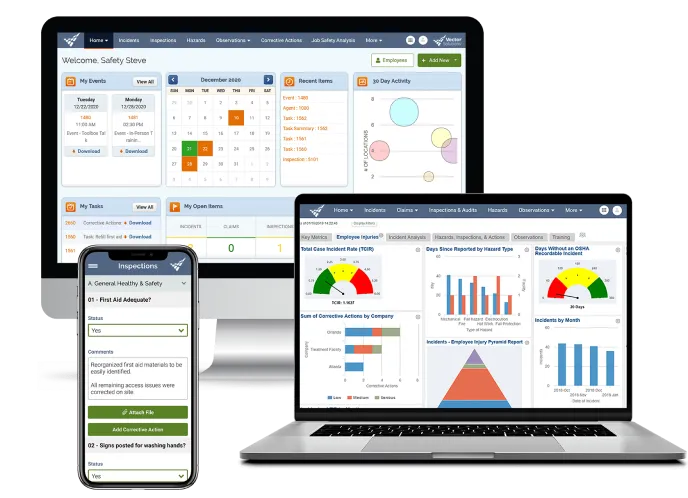
Put Your Industrial Hygiene Program into Action with Vector Solutions
Readers now have a framework for building, documenting, and verifying an industrial hygiene program. It measures exposures, tracks corrective actions to closure, and proves controls worked through follow-up monitoring.
Vector EHS Management connects exposure monitoring records, corrective action assignment and closure, SDS management, and inspection scheduling in one system across sites and shifts.
The outcome is that every hazard gets assessed, every control gets verified, and every audit finds the documentation it needs.
See Vector EHS Management in Action
Exposure monitoring records, corrective action tracking, SDS management, and inspection scheduling in one platform built for EHS teams.
Request a demo
FAQs About Industrial Hygiene
What Is Industrial Hygiene?
Industrial hygiene is the science of protecting workers from workplace health hazards by anticipating, recognizing, evaluating, controlling, and confirming exposure risks. It focuses on preventing illness before it occurs rather than reacting to incidents, and applies across manufacturing, healthcare, construction, and utilities.
What Does an Industrial Hygienist Do?
Industrial hygienists identify workplace health hazards, measure worker exposure through air sampling and noise monitoring, recommend controls, and verify those controls worked. They come from varied backgrounds including chemistry, engineering, biology, and nursing, and may hold Certified Industrial Hygienist credentials.
How Do I Know if My Workplace Needs an Industrial Hygiene Program?
You need one if your workplace uses hazardous chemicals, generates noise or dust, involves repetitive motion or heavy lifting, exposes workers to biological agents, or runs shifts that create fatigue. OSHA requires exposure monitoring for specific substances above action levels, but proactive programs also reduce claims and insurance costs.
My Monitoring Results Are Just Below the Exposure Limit. Do I Need To Act?
Results below the limit do not require immediate controls, but they do require continued monitoring to confirm exposure stays at a safe level. Results near a limit often drift upward as processes change, equipment wears, or production increases, so treat a near-limit result as a signal to re-sample rather than a clean bill of health.
What Happens if Follow-Up Monitoring Shows Controls Did Not Work?
Escalate to a higher level on the hierarchy of controls, document the gap, assign corrective actions with new deadlines, and schedule another round of verification monitoring. Common failure modes include incomplete ventilation, inconsistent PPE use, or process changes that reintroduced the hazard.
Can I Run an Industrial Hygiene Program Without a Certified Industrial Hygienist on Staff?
Yes. Many organizations combine in-house EHS generalists, contracted CIHs for specialized monitoring, and centralized software to maintain rigor across sites. OSHA does not require CIH certification for most IH work, though complex exposure assessments and sampling interpretation benefit from that expertise.